The domino effect Changes impact food sources, animal populations

Each species feels the weight of climate change in different ways, which then leads to cascading effects through food webs and entire ecosystems.

Read this article for free:

or

Already have an account? Log in here »

To continue reading, please subscribe:

Subscribe and receive a limited-edition Free Press branded hat or tote.

Digital Subscription

One year of digital access for only $205*

  • Enjoy unlimited reading on winnipegfreepress.com
  • Read the E-Edition, our digital replica newspaper
  • Access News Break, our award-winning app
  • Play interactive puzzles

*First annual payment billed as $205.00 + GST for one year. This annual subscription will automatically renew at $233.00 + GST every 52 weeks (10% off the regular annual price of $259.35). Offer available to new and qualified returning subscribers only. Cancel any time.

To continue reading, please subscribe:

Add Free Press access to your Brandon Sun subscription for only an additional

$1 for the first 4 weeks*

  • Enjoy unlimited reading on winnipegfreepress.com
  • Read the E-Edition, our digital replica newspaper
  • Access News Break, our award-winning app
  • Play interactive puzzles
Start now

*Your next Brandon Sun subscription payment will increase by $1.00 and you will be charged $17.95 plus GST for four weeks. After four weeks, your payment will increase to $24.95 plus GST every four weeks.

Hey there, time traveller!
This article was published 23/10/2020 (2084 days ago), so information in it may no longer be current.

Each species feels the weight of climate change in different ways, which then leads to cascading effects through food webs and entire ecosystems.

The stressed Arctic fox population offers a superb example in northern Manitoba.

This cute, fuzzy species of the canine family stands about 30 cm tall, about two thirds of the size of their red fox cousins. It is, despite its small stature, the primary terrestrial predator in the Arctic.
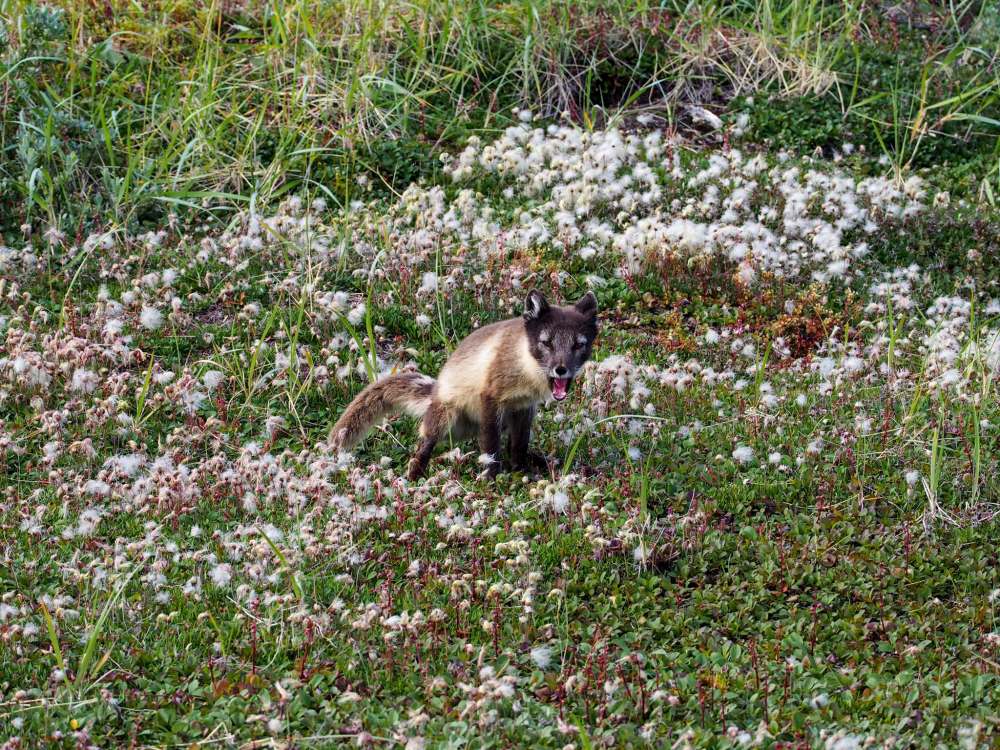
Chloe Warret Rodrigues photo
The Arctic fox stands almost 30 cm tall, about two thirds of the size of their red fox cousins.
Chloe Warret Rodrigues photo The Arctic fox stands almost 30 cm tall, about two thirds of the size of their red fox cousins.

Arctic foxes experience climate change through several mechanisms. First, they are (and always have been) heavily influenced by the fluctuations in the population size of lemmings, a rodent that acts as their primary food source, especially critical in the spring. But the lemming population is declining.

Arctic foxes are also impacted by changes in the sea-ice ecosystem, since they’re known to scavenge the remains of kills left behind by the likes of polar bears. So, when polar bears have a good year, historically, the foxes do, too. But polar bears are having fewer good years.

“We’ve found there’s a long-term decline in the Arctic fox numbers in this area,” says Jim Roth, a professor of biological science at the University of Manitoba.

SARAH LAWRYNUIK / WINNIPEG FREE PRESS
Jim Roth studies Arctic foxes and foodwebs in the Churchill region.
SARAH LAWRYNUIK / WINNIPEG FREE PRESS Jim Roth studies Arctic foxes and foodwebs in the Churchill region.

“There’s lots of annual variation. Some years, people still see lots of Arctic foxes around, other years not so many…. But, if you look at the long-term trend over the last 50, 60 years there has been a decrease.”

Roth and his team of researchers regularly monitor 120 fox dens in the area and they use data on the number of animals trappers have harvested as an index to follow and monitor the population’s health.

But there’s another ripple in the story: Arctic foxes now have competition for resources.

“We are finding more red foxes out on the tundra,” Roth says.

Climate change is expected to create a more hospitable environment for the red fox on the northern limits of its habitat, and with that, the population is expected to prosper. Roth is fascinated by the southern creature’s encroachment into a new biome. But that change might come at the cost of the health of the Arctic fox population here.

“Competitors can compete indirectly by eating all the food… or directly through interference,” he says. “Red foxes are known to kill Arctic foxes.”
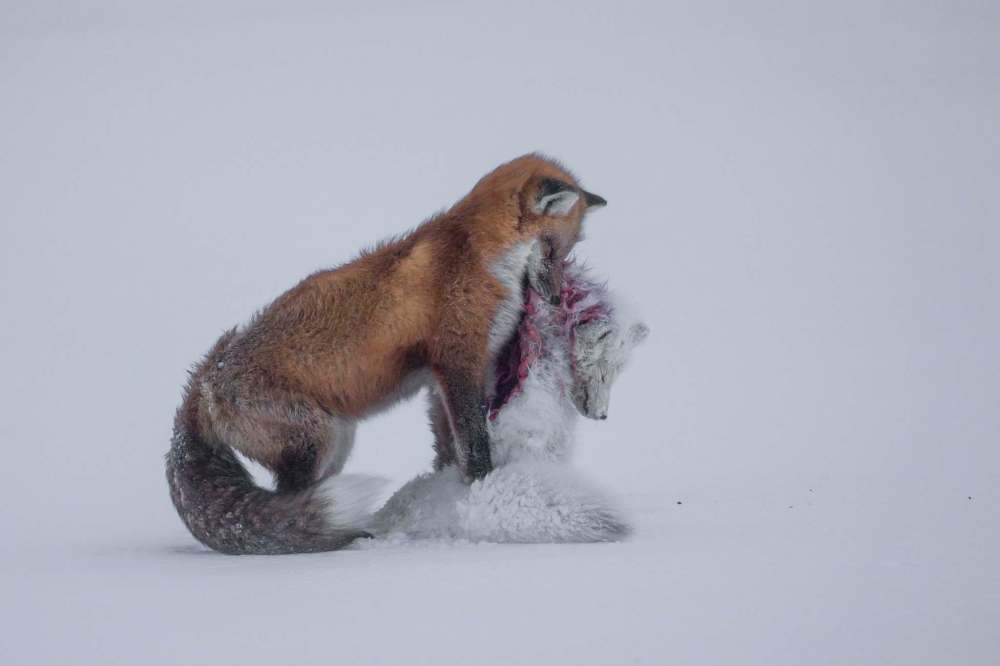
Don Gutoski photo
Don Gutoski photo

In 2015 the photo that garnered the award for wildlife photographer of the year, was captured by an amateur photographer who spotted a bloodied, deceased Arctic fox grasped in the mouth of a red fox near Cape Churchill.

“Churchill is such a cool place, because you’ve got the intersection of these three different biomes — you’ve got the forest, the tundra, you’ve got the marine environment — and so I’m really interested not only in interactions between species, but species that are crossing ecosystem boundaries.”

From their study of fox dens, which are used repeatedly over hundreds of years, the researchers are finding more inhabited by red foxes.

Both foxes are impacted by lemming numbers.

“Churchill is such a cool place, because you’ve got the intersection of these three different biomes– you’ve got the forest, the tundra, you’ve got the marine environment.”
– Jim Roth, professor of biological science at the University of Manitoba

“I’m really interested in food webs. Species interactions. How changes amongst one species affects others, both directly and indirectly,” Roth says.

“Lemmings are, arguably, the most important species for wildlife on the tundra. They have these dramatic fluctuations in abundance. When they’re really abundant all the predators have lots to eat. Then they reproduce and so predator populations go up. Then when the lemming populations crash, the predators have to feed on something else. Then they nail all the birds and everything else.”

Lemmings rely on snow to burrow into and protect them throughout the harsh winters. But climate change has brought about changes in snow quality, which Roth believes has led to a dampening of the lemming populations. The good years aren’t as good as they once were.
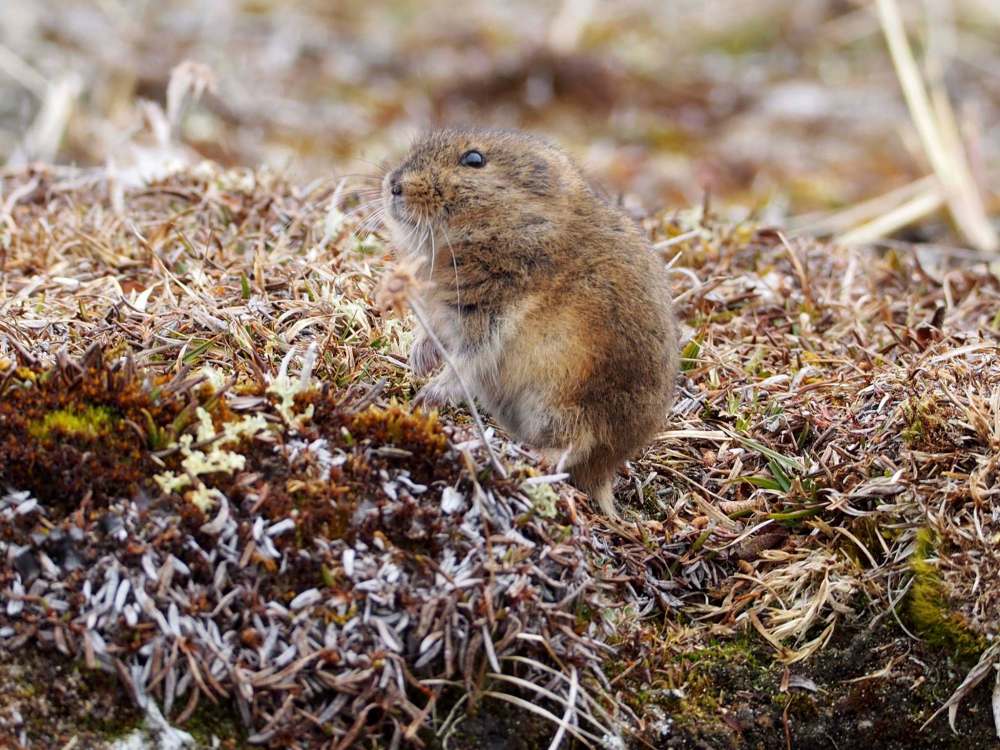
Chloe Warret Rodrigues photo
Lemmings are a critical food source for arctic foxes.
Chloe Warret Rodrigues photo Lemmings are a critical food source for arctic foxes.

When he was a graduate student in the mid-1990s, in a good year lemming populations would be about 12 animals per hectare — now it’s two, he says.

“That’s a peak year now,” he says. “Which is just bizarre, given how important lemmings are.”

The possible silver lining here might be that red foxes are not the only southern dwellers that are picking up and moving north. While lemmings have traditionally been the dominant rodent in these parts, Roth and his research team have also begun trapping more meadow voles, which could potentially act as a new food source for both foxes.

DNA analysis of fox fecal matter by one of Roth’s graduate students has shown that the animals are just as likely to have eaten voles now as lemmings.

The more research Roth and his team pursues, the more questions they have. But without a doubt the world for the Arctic fox in this subarctic region is changing.

“I think the biggest change is the change in the distribution of species,” he says.

“We’re getting more of these southern generalists moving up north into where you typically have these Arctic-adapted species, because southern species couldn’t persist. It’s getting (to the point that) lots of tourists come up in the fall to see polar bears, and they never see an Arctic fox, they see red foxes.”

sarah.lawrynuik@freepress.mb.ca

Report Error Submit a Tip

More Stories

Experts debunk Scheer's most-seats claim

Joan Bryden, The Canadian Press 7 minute read Preview

Experts debunk Scheer's most-seats claim

Joan Bryden, The Canadian Press 7 minute read Saturday, Oct. 19, 2019

OTTAWA - Experts on Canada's parliamentary system say Andrew Scheer should know better than to erroneously contend that whoever wins the most seats on Monday gets to form the government.

The Conservative leader was, after all, Speaker of the House of Commons for almost five years and, as such, should be well aware that the only rule that matters is who can command the confidence of the majority of MPs — whether they be all from one party, or from a multitude of partisan affiliations.

"It lowers him in my esteem and maybe the esteem of other people because I'm sure he knows he's wrong," said political science professor Peter Russell, who helped advise Gov. Gen. Michaelle Jean in 2008, when she had to navigate an attempt by three opposition parties to form a coalition to replace Stephen Harper's minority Conservative government.

"He's doing damage because there's so many Canadians who will believe what he says to be true."

Read
Saturday, Oct. 19, 2019

‘Right to disconnect’ requires cultural shift

Editorial 4 minute read Preview

‘Right to disconnect’ requires cultural shift

Editorial 4 minute read Thursday, Dec. 9, 2021

When the pandemic sent many workers home, the line between the personal and professional became increasingly blurred. It’s difficult, after all, to have a clear delineation between home and the office if home is the office and the office is home.

But that uncertainty around work/life balance — something everyone seems to want and value, but few seem able to actually achieve — predates the pandemic. The exhausted executive who sleeps with their iPhone on their pillow is a trope for a reason; technology has enabled us to do our work from anywhere — but that also means we can do our work everywhere, at any hour, because there’s always more work to do.

Many workers are always on, always connected. In a system that prioritizes productivity above all else, staying late is seen as evidence of commitment and dedication. So, too, is answering emails at 9:30 p.m.

And so, on its face, Ontario’s new Working for Workers Act, which passed on Nov. 30, is an intriguing Canadian initiative. The legislation requires workplaces with 25 or more employees implement written policy regarding “disconnecting from work,” which mostly means not engaging in workplace communications outside of work hours.

Read
Thursday, Dec. 9, 2021

Long wait for functional wheelchair ends

Katie May 6 minute read Preview

Long wait for functional wheelchair ends

Katie May 6 minute read Monday, Sep. 16, 2024

After waiting nearly five years, Tom Landy finally has a functional wheelchair.

He’s taken it for a spin in the garage, but the customized power wheelchair still needs work before it can be operated outdoors.

“I am happy that I am mobile, but it’s still far from over,” Landy said.

On Friday, the 47-year-old Winnipegger was able to properly operate the wheelchair for the first time since he received it in September 2023. It has needed so many adjustments, modifications and repairs. When he tried to steer it a couple of weeks ago, the wheelchair wouldn’t move forward or backward — only left and right — resulting in another call to repair personnel, who arrived Friday afternoon to make another fix. It’s the latest on a long road of delays for Landy, who first spoke publicly about his extraordinarily long wait for a new wheelchair last summer.

Read
Monday, Sep. 16, 2024

Groups mobilize to help homeless get through blizzard

Tyler Searle 4 minute read Preview

Groups mobilize to help homeless get through blizzard

Tyler Searle 4 minute read Tuesday, Apr. 12, 2022

AS they prepare for the blizzard that’s about to wallop southern Manitoba, community organizations that help Winnipeg’s homeless are banding together to ensure no one gets left out.

“There is obviously a sense of nervousness,” said Tessa Whitecloud, CEO of Siloam Mission. “At the same time, there’s a knowledge that the right people are being brought around the table to figure out how we can best resource folks.”

The Salvation Army Centre of Hope, Siloam Mission, Main Street Project (MSP) and dozens of other organizations will keep in constant contact during the blizzard. If services at one resource run out or are taxed, others will step up to accommodate people seeking shelter, Whitecloud said.

The Centre of Hope, Siloam and MSP, which currently operates out of the Salvation Army’s Weetemah Centre at 324 Logan Ave., have a collective shelter capacity of 449 beds.

Read
Tuesday, Apr. 12, 2022

Late-night beer shops slowly converting to craft-beer gospel

Ben MacPhee-Sigurdson 8 minute read Preview

Late-night beer shops slowly converting to craft-beer gospel

Ben MacPhee-Sigurdson 8 minute read Friday, Aug. 17, 2018

You feel like a beer, but it’s late and the Liquor Marts are all closed. Thankfully you’re in Manitoba, where beer vendors can fill the void into the wee hours.

There are hundreds of privately owned beer stores, typically located adjacent or attached to hotels, throughout the province. They’re open late and the beer is cold — what more could you possibly want?

With the surge in local (and otherwise) craft beer in the province over the past few years, the answer is selection. And in this department, not all beer stores are created equal.

In 2014, a similar state-of-the-vendors piece found disparity in the calibre of beer vendors when it comes to selection and overall shopping experience. Since then, the growth of growler bars and an increasing selection of breweries in Winnipeg (and beyond) made it seem like the right time to revisit the city’s beer vendor scene — the good, the bad and the ugly.

Read
Friday, Aug. 17, 2018

Readers reflect on what the Free Press means to them

28 minute read Preview

Readers reflect on what the Free Press means to them

28 minute read Friday, Nov. 25, 2022

On the eve of the Free Press’s sesquicentennial, we asked readers to share what the newspaper means to them.

Read
Friday, Nov. 25, 2022