Resilient wood frogs keep researcher hopping

One of the Churchill region’s most resilient animals is a lesser-known critter, one that has the ability to freeze like a hockey puck to weather the North’s frigid winters and has a habitat range that dips south all the way to North Carolina.

Read this article for free:


or

Already have an account? Log in here »

To continue reading, please subscribe:

Subscribe and receive a limited-edition Free Press branded hat or tote.

Digital Subscription

One year of digital access for only $205*

  • Enjoy unlimited reading on winnipegfreepress.com
  • Read the E-Edition, our digital replica newspaper
  • Access News Break, our award-winning app
  • Play interactive puzzles

*First annual payment billed as $205.00 + GST for one year. This annual subscription will automatically renew at $233.00 + GST every 52 weeks (10% off the regular annual price of $259.35). Offer available to new and qualified returning subscribers only. Cancel any time.

To continue reading, please subscribe:

Add Free Press access to your Brandon Sun subscription for only an additional

$1 for the first 4 weeks*

  • Enjoy unlimited reading on winnipegfreepress.com
  • Read the E-Edition, our digital replica newspaper
  • Access News Break, our award-winning app
  • Play interactive puzzles
Start now

*Your next Brandon Sun subscription payment will increase by $1.00 and you will be charged $17.95 plus GST for four weeks. After four weeks, your payment will increase to $24.95 plus GST every four weeks.

Hey there, time traveller!
This article was published 23/10/2020 (2115 days ago), so information in it may no longer be current.

One of the Churchill region’s most resilient animals is a lesser-known critter, one that has the ability to freeze like a hockey puck to weather the North’s frigid winters and has a habitat range that dips south all the way to North Carolina.

It’s Canada’s most widely distributed amphibian: the wood frog.

Jon Davenport, assistant professor of biology at Appalachian State University in North Carolina, makes annual trips to Churchill (at least when he isn’t blocked from field work by a global pandemic) to monitor the wood frog population and understand how it is being affected by climate change.
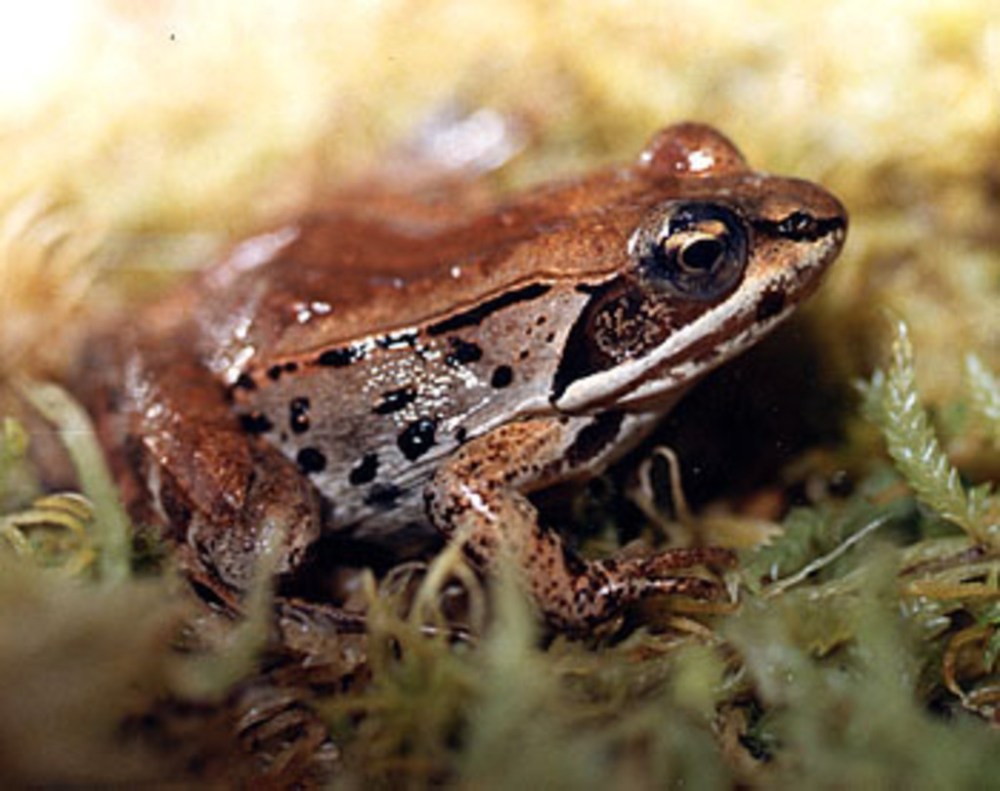
In Churchill frogs can live for four years but some evidence suggests there are frogs that can live up to eight years.

“It’s amazing to me that they’re even up there. Why go through all the trouble to be up there when it’s so extreme? And that’s what we’re trying to understand. And as the environment becomes even more extreme, how resilient are they?” Davenport says.

Overall, the northern Manitoba population remains stable, but there are stressors, such as drying ponds where frogs lay eggs.

In tracking adult and juvenile frog movements over the past four years, unsurprisingly, the animals avoid hot, dry areas, Davenport says. What is surprising is the amount of time the frogs spend on the tundra landscape when they are more adapted to living in the woods.

“We’re trying to understand how are they so stable, given that the environment is changing? There’s a couple things we think are going on. Because maybe the ponds are drying earlier, and the frogs aren’t necessarily getting there any earlier, but they can speed up their growth to respond to that,” he says.

“It’s amazing to me that they’re even up there. Why go through all the trouble to be up there when it’s so extreme?”
– Jon Davenport, assistant professor of biology at Appalachian State University in North Carolina

“And even as those ponds are drying, and they come out, the adults and some of the smaller ones do spend a lot of time out in the open tundra…. We think it’s because the shrubs — which (previously) weren’t on the tundra as much — they’ve encroached onto the tundra. So the frogs can hop out of the pond, even if they have to a little earlier… and there’s a shrub that provides them with some relief from the UV radiation.

“So, that shrub encroachment, that changing of the environment, could actually benefit the adults in some ways, but the ponds drying could negatively affect the juveniles and the larvae.”
SUPPLIED
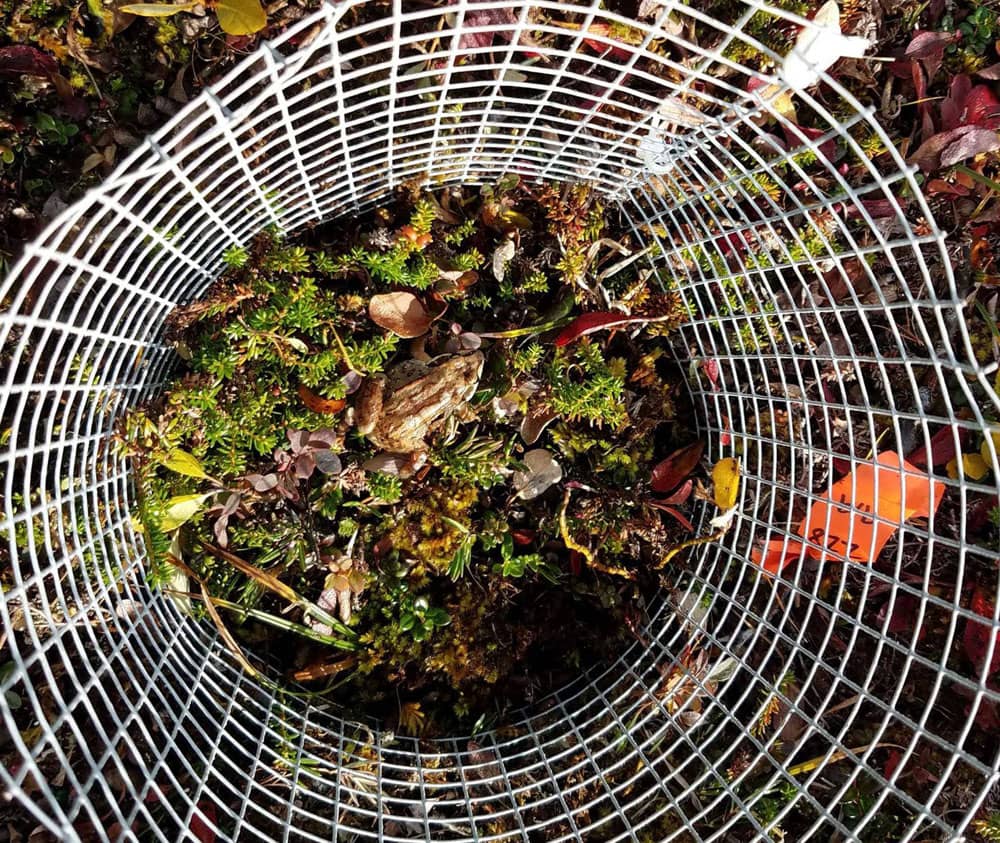
A frog settles into its new caged enclosure for the duration of the winter months.
SUPPLIED A frog settles into its new caged enclosure for the duration of the winter months.

This led Davenport to venture into the frog real-estate market. He started building what he calls “frog condos” — cages the research team erects around a frog as it selects its winter hibernation spot.

“They basically turn into a little frozen hockey puck. We call it super-cooling. They prevent ice crystals from forming in organs and they change over their sugars in a manner that prevents them from getting any damage to organs and basically allows them to shut down most functions and just be a little frozen Popsicle for, roughly up there in Churchill, it’s about 8 1/2 months of the year,” he says.

“At that spot, they dig a little bit into the soil and they just freeze.”

He’s itching to know: why that spot?

Based on limited data so far, Davenport believes the longer time spent in hibernation expands the frog’s lifespan. Where he lives, in North Carolina, the lifespan of frogs is two to three years; in Churchill, they know the frogs can live until they’re at least four, with some evidence suggesting there are eight-year-old frogs hopping around.

“We call it super-cooling. They prevent ice crystals from forming in organs and they change over their sugars in a manner that prevents them from getting any damage to organs and basically allows them to shut down most functions and just be a little frozen Popsicle for, roughly up there in Churchill, it’s about 8 1/2 months of the year.”
– Jon Davenport

“It kind of makes sense, if you think about it. If they’re frozen for eight months of the year, they’re really only actively hopping around doing stuff for four months, so their equivalent of eight years is really only 2 1/2 years for a normal frog,” he says.

Monitoring of the frog population, despite its continued stability, is important, Davenport says, because of its position at the bottom of the food web.

After 10 years of research, going in with an expectation he would see declines in this frog population, Davenport is now reasonably confident in the animal’s incredible ability to adapt to whatever Mother Nature throws at it.

“They are being pushed, but these are the populations that are on the edge of their range and have already been pushed for however many thousands of years. So maybe for them, they are actually more resilient and we shouldn’t expect as crazy of a change for them, as we should expect if those changes occur at lower (latitudes).”

sarah.lawrynuik@freepress.mb.ca

Report Error Submit a Tip

More Stories

More than half of Manitoba parents struggle to access child care: survey

Dylan Robertson 11 minute read Preview

More than half of Manitoba parents struggle to access child care: survey

Dylan Robertson 11 minute read Monday, Sep. 9, 2019

Marie-Serge Bibeau says she’s one of the lucky ones. As soon as she got pregnant, people advised her to get on the list for a child-care spot. Ultimately, she only had to wait five months: one-third of the average wait time.

“It’s really stressful; it doesn’t give people the initiative and the motivation to go back to work,” said Bibeau, who lives in Lockport.

Although Winnipeg has some of the country’s most affordable daycare, a Statistics Canada survey has found 52 per cent of Manitobans struggle to access spots, the highest rate in Canada.

The spots that do appear seem to exist in higher-income areas.

Read
Monday, Sep. 9, 2019

It pays to put off collecting your Canada pension

Martin Cash 5 minute read Preview

It pays to put off collecting your Canada pension

Martin Cash 5 minute read Thursday, Aug. 20, 2020

Like most 77-year-olds, after winding down a long-time family business that included a year-long demolition project, Elliot Rodin decided to start a new on-line business.

It required the creation of sophisticated equations and could help Canadians earn as much as $100,000 in additional funds from their government pensions, so, nothing too complicated.

The website, HelpYouRetire.ca recently went live. Rodin has figured out the obscure mathematical formulas that lets people key in a modest amount of information and find out what their Canada Pension Plan, Quebec Pension Plan and Old Age Security benefits would be if they delayed the start of receiving their pension benefits by six months or a year or longer.

It’s not a problem Rodin has been distracted by all his life. After finishing up the demolition of Central Grain Co. Ltd. — the large grain elevator complex that was at the corner of Archibald Street and Provencher Boulevard — he happened across an article that said that 90 per cent of Americans didn’t start their retirement benefits at the right time.

Read
Thursday, Aug. 20, 2020

The view from here: Phyllis Green. Boob Tree, 1975

2 minute read Preview

The view from here: Phyllis Green. Boob Tree, 1975

2 minute read 2:02 AM CDT

Staycation: The Art of Being Here feautres more than 100 Manitoba-related artworks from the Winnipeg Art Gallery-Qaumajuq collection, spanning the past 50 years. These pieces reveal how the places around us are layered with memory, story and lived experience. Over the coming weeks, the Free Press will spotlight works from this eclectic exhibition, each one offering a new way of seeing home. Experience it in person and enjoy some staycation time at the gallery, on view until December.

Phyllis Green. Boob Tree, 1975

(Yarn, wood. Collection of the Winnipeg Art Gallery; Acquired with funds from the Estate of Mr. and Mrs. Bernard Naylor, funds administered by The Winnipeg Foundation, 2014-128. Photo: Ernest Mayer.)

The year 1975 was designated International Women’s Year by the United Nations, and in celebration, the WAG staged the show Images of Women, which explored how women had historically been depicted, an impressive selection but by mostly male artists. Amid pushback from the community, Sharron Zenith Corne and Marian Yeo organized a second exhibition, Woman as Viewer, which challenged those portrayals by only featuring works by women. It was called the first Canadian exhibition of feminist art. American artist Phyllis Green’s Boob Tree, a four-foot-tall crochet sculpture of a cluster of breasts, adorned the exhibit posters, which were so popular they were snatched by passersby! The sculpture is playful and unsettling, re-appropriating the objectification of women’s bodies.

Read
2:02 AM CDT

Survival guide offers a frightening perspective on life in U.S. prisons

Reviewed by Bill Rambo 4 minute read Preview

Survival guide offers a frightening perspective on life in U.S. prisons

Reviewed by Bill Rambo 4 minute read 2:02 AM CDT

Canadian criminal sentencing guidelines identify “three traditional utilitarian goals — deterrence … incapacitation and rehabilitation.”

In spite of lofty intentions, fiction and film have identified North American incarceration in general as largely negative, incapacitating most inmates only while they are actually behind bars. Prison often leads to more crime, teaching criminal behaviour.

Tom Nelson spent more than 17 years in medium and maximum security facilities in the U.S. for such pasttimes as auto theft, armed robbery and drug dealing. Then he turned that life of crime around and became a successful physical trainer and gym owner in Los Angeles.

Nelson met and formed a friendship with Taylor Sheridan, creator and writer of such series as Yellowstone, Landman and the prequels 1883 and 1923. When COVID devastated the gym business and Nelson’s health was failing, Sheridan suggested turning Nelson’s attempt at a screenplay about prison life into a book.

Read
2:02 AM CDT

New lab a win for Winnipeg’s long game

Editorial 4 minute read Preview

New lab a win for Winnipeg’s long game

Editorial 4 minute read 2:02 AM CDT

It would be easy to overlook the announcement this week that the federal government was green-lighting a quarter-billion-dollar expansion of the National Microbiology Laboratory’s Canadian Science Centre for Human and Animal Health on Arlington Street.

Easy to overlook, in part, because it will take a decade to build the new 140,000-square-foot laboratory specializing in medical countermeasures.

But make no mistake, this latest investment from Ottawa galvanizes Winnipeg’s reputation as a global leader in the research of the world’s most infectious diseases. It also confirms that a wager made by Manitoba political leaders nearly 40 years ago is paying off in spades.

The existing NML was, to be frank, hastily conceived compensation for one of the most egregious examples of political pork-barrelling ever seen in Canada.

Read
2:02 AM CDT

Blues Brother bringing sci-fi debut this fall

Ben Sigurdson 4 minute read 2:02 AM CDT

He’s busted ghosts, wailed on a harmonica in sunglasses, created a vodka brand sold in a skull-shaped bottle and dabbled in the Niagara Peninsula wine industry. And now Ottawa-born actor and comedian Dan Aykroyd is trying his hand in a new field — writing fiction.

Aykroyd’s literary debut Soulhider lands in bookstores Oct. 27 via HarperCollins, falling squarely into the paranormal/science fiction genre, while bringing the Ghostbusters and Saturday Night Live star’s inevitable touch of humour.

The novel follows an insurance adjustor in New York State recruited by aliens to hide human souls they’ve harvested — and invariably getting caught up between warring alien factions.

● ● ●