

First Nations’ concerns overshadowed by talk of major projects

Advertisement
Read this article for free:
or
Already have an account? Log in here »
To continue reading, please subscribe:

Digital Subscription
One year of digital access for only $205*
- Enjoy unlimited reading on winnipegfreepress.com
- Read the E-Edition, our digital replica newspaper
- Access News Break, our award-winning app
- Play interactive puzzles
*First annual payment billed as $205.00 + GST for one year. This annual subscription will automatically renew at $233.00 + GST every 52 weeks (10% off the regular annual price of $259.35). Offer available to new and qualified returning subscribers only. Cancel any time.
To continue reading, please subscribe:
Add Free Press access to your Brandon Sun subscription for only an additional
$1 for the first 4 weeks*
- Enjoy unlimited reading on winnipegfreepress.com
- Read the E-Edition, our digital replica newspaper
- Access News Break, our award-winning app
- Play interactive puzzles
*Your next Brandon Sun subscription payment will increase by $1.00 and you will be charged $17.95 plus GST for four weeks. After four weeks, your payment will increase to $24.95 plus GST every four weeks.
Read unlimited articles for free today:
or
Already have an account? Log in here »
The contrast could not have been more stark in Ottawa — unceded Algonquin territory — this week.
On one side, hundreds of chiefs and their proxies met at the annual summer meeting of the Assembly of First Nations to debate resolutions focused on issues — primarily crises — in their communities.
Of the 53 policy resolutions and two emergency resolutions proposed by the chiefs, pressing topics such as child welfare, housing, drinking water, poverty, Alberta separatism, citizenship, and online attacks from deniers of the atrocities of residential schools were all on the agenda.
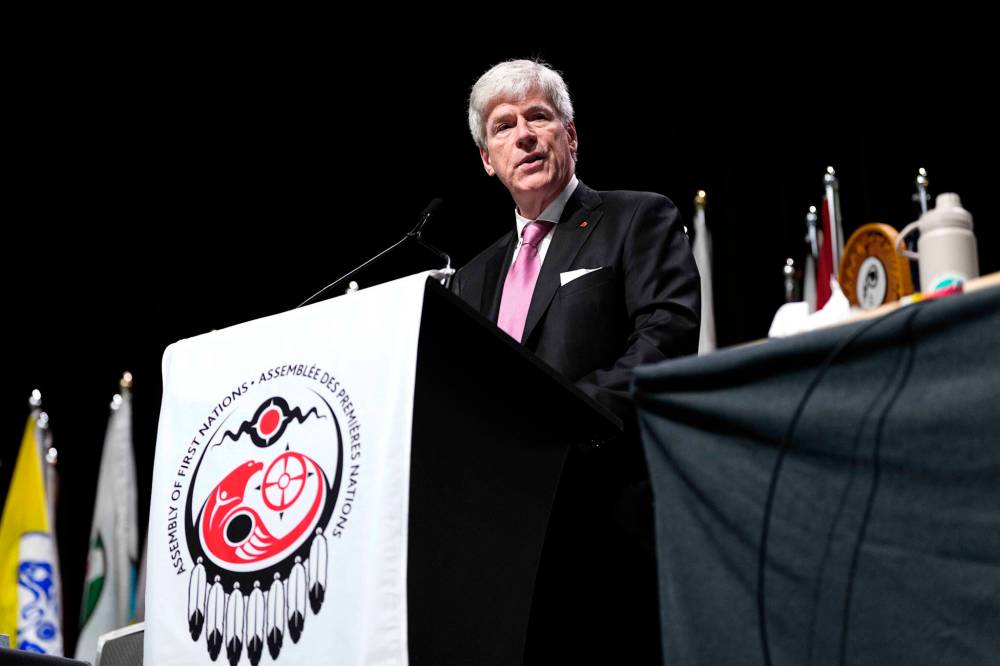
JUSTIN TANG / THE CANADIAN PRESS
“There is no good way to build major projects without First Nations partnership and leadership. Full stop,” Energy and Natural Resources Minister Tim Hodgson said at the general assembly Thursday.
On the other side, over seven cabinet ministers from the federal government showed up basically to argue the case for the fast-tracking of “major projects.”
“I come here with a simple message,” Energy and Natural Resources Minister Tim Hodgson announced. “There is no good way to build major projects without First Nations partnership and leadership. Full stop.”
Similar speaking notes came from Crown-Indigenous Relations Minister Rebecca Alty, Intergovernmental Affairs and Canada-U.S. Trade Minister Dominic LeBlanc, and Northern and Arctic Affairs Minister Rebecca Chartrand.
These were important words that needed to be said, of course — representing promises that were not always made in the past in Canada — but the fact is the federal representatives came to discuss one issue and little else.
Even presentations on important issues like justice by Public Safety Minister Gary Anandasangaree and child welfare by Indigenous Services Minister Mandy Gull-Masty were drowned out by arguments that investing in resource development projects and expanding Canada’s economy is the answer.
By the end of the assembly, only one thing was clear: First Nations and federal cabinet ministers are having very different conversations.
It was also obvious that the Carney government’s plan to get First Nations onside in fast-tracking consultation and moving ahead with mines, pipelines and other major projects is failing — and failing fast.
In May, the federal government announced its plan to create a “Crown Consultation Hub” to co-ordinate efforts to consult with First Nations on major national projects and have the process completed within a year.
The fact that, in the modern era, no “major” national economic resource development project has ever completed constitutionally mandated consultations with First Nations stakeholders within a year did not deter the federal Liberals.
Its new policy purports to “streamline” consultation and address Indigenous rights via a singular, one-time process.
The problem is, no one consulted First Nations on changing the consultation process.
This past Wednesday, every single chief in attendance voted unanimously on a resolution to reject the Carney government’s reforms on major project approvals if environmental protections or Indigenous rights are not fully assessed and considered.
In other words: one year ain’t gonna cut it.
One wonders, however, if the Carney government heard the message.
We won’t have to wait too long to find out.
On Oct. 26 there will be a first ministers meeting between First Nations leaders, territorial and provincial premiers and Prime Minister Mark Carney.
Inspired by the fact the federal cabinet will have announced a few weeks beforehand which of Canada’s proposed resource development projects will be deemed in “the national interest,” for the first time ever this first ministers meeting will focus exclusively on First Nations interests.
According to a description of the First Nations-First Ministers’ Meeting (FNFMM) on the the AFN website: “The 2026 FNFMM will bring together First Nations leadership alongside the Prime Minister and provincial and territorial premiers to establish shared priorities, set direction, and strengthen nation-to-nation relationships grounded in First Nations leadership.”
The question is: whose priorities are we talking about?
First Nations understand that Canada’s economy is facing an “emergency.”
The actions of the global economy — and in particular U.S. president Donald Trump — have forced the Canadian economy to radically switch from its reliance on the United States to become a more autonomous, independent entity.
First Nations, however, are facing other emergencies, with many equally as pressing — even matters of life and death.
Take, for example, the issue of drinking water.
The other major topic going into the AFN meetings was the federal Liberal’s proposed Bill C-37, the First Nations Clean Water Act.
The bill is a fairly radical revisioning of Justin Trudeau’s previously-proposed Bill C-61, which recognized First Nations’ legal right to safe and reliable drinking water but died on the debate floor.

If C-61 had been implemented, the federal government would have had to treat members of First Nations like every other Canadian citizen and a supply of clean water would have been a legal obligation — not an issue at the whim of bureaucrats and politicians.
Carney’s Bill C-37 removed language surrounding First Nations’ rights to water and focuses mostly on addressing emergency situations — like the more than five dozen First Nations that are currently grappling with water issues.
In the end, though, the issue of clean drinking water was barely addressed at this week’s AFN assembly.
Talk of major projects drowned out everything else.
niigaan.sinclair@freepress.mb.ca
Niigaan Sinclair is Anishinaabe and is a columnist at the Winnipeg Free Press.
Our newsroom depends on a growing audience of readers to power our journalism. If you are not a paid reader, please consider becoming a subscriber.
Our newsroom depends on its audience of readers to power our journalism. Thank you for your support.
Niigaan Sinclair is Anishinaabe and is a columnist at the Winnipeg Free Press.
Our newsroom depends on a growing audience of readers to power our journalism. If you are not a paid reader, please consider becoming a subscriber.
Our newsroom depends on its audience of readers to power our journalism. Thank you for your support.
Advertisement Advertise With Us
Advertisement Advertise With Us