

A decision to fight from outside, rather than surrender to party politics

Advertisement
Read this article for free:
or
Already have an account? Log in here »
To continue reading, please subscribe:
Digital Subscription
One year of digital access for only $1.44 a week*
- Enjoy unlimited reading on winnipegfreepress.com
- Read the E-Edition, our digital replica newspaper
- Access News Break, our award-winning app
- Play interactive puzzles
*Billed as $5.77 plus GST every four weeks. After 52 weeks, price increases to the regular rate of $19.95 plus GST every four weeks. Offer available to new and qualified returning subscribers only. Cancel any time.
To continue reading, please subscribe:
Add Free Press access to your Brandon Sun subscription for only an additional
$1 for the first 4 weeks*
- Enjoy unlimited reading on winnipegfreepress.com
- Read the E-Edition, our digital replica newspaper
- Access News Break, our award-winning app
- Play interactive puzzles
*Your next Brandon Sun subscription payment will increase by $1.00 and you will be charged $17.95 plus GST for four weeks. After four weeks, your payment will increase to $24.95 plus GST every four weeks.
Read unlimited articles for free today:
or
Already have an account? Log in here »
Is there any room in our current political culture for principle?
These are the lingering questions left in the wake of Laurier-Sainte-Marie MP Steven Guilbeault’s decision to quit federal politics.
You should know, first off, this was not an impetuous decision on Guilbeault’s part.
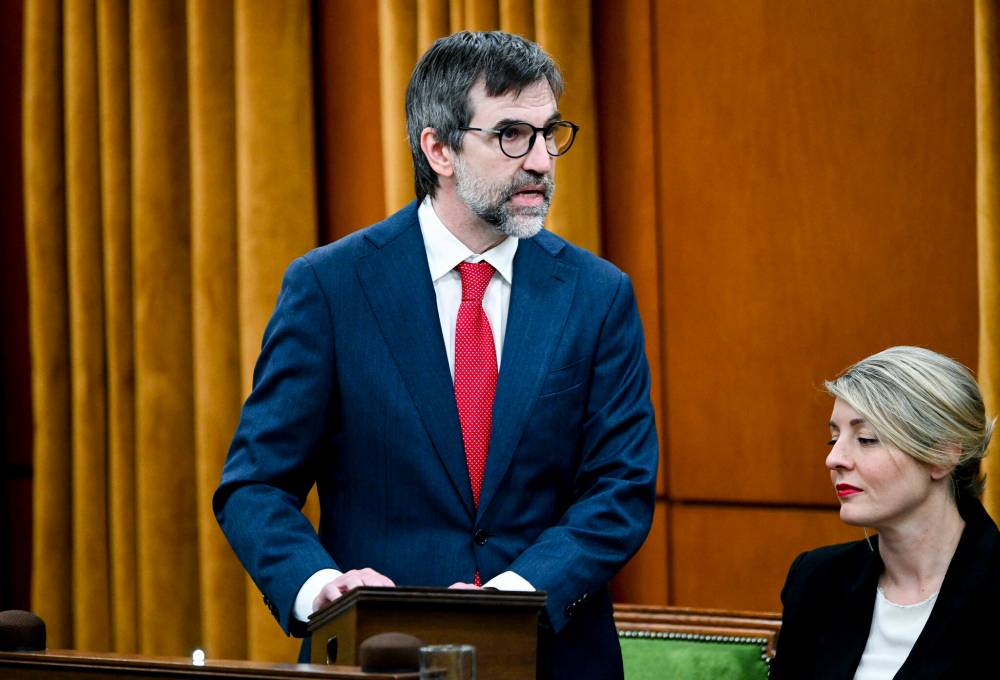
SPENCER COLBY / THE CANADIAN PRESS FILES
Liberal MP Steven Guilbeault’s decision to quit federal politics was not impetuous.
The former environmental activist and star cabinet minister in both prime minister Justin Trudeau and Mark Carney’s governments waged a long and fruitless campaign within the governing party for a more aggressive strategy to combat climate change.
Starting under Trudeau’s watch, Guilbeault began to suffer a significant string of losses on policy, including the inability to sell the consumer carbon tax, which Trudeau mishandled and Carney ended.
Against Guilbeault’s advice, Carney weakened climate-change policies, delayed Canada’s timetable for reducing CO2 emissions and supported the building of a new pipeline for Alberta Premier Danielle Smith, who has rewarded the prime minister by enabling separatists in her province.
Last November, following Carney’s signing of a memorandum of understanding with Smith to build that pipeline, Guilbeault stepped down from cabinet. Then, after another round of concessions to Alberta on pushing back the timetable for industrial carbon tax increases, he bid adieu to caucus.
It appears Guilbeault’s decision to step down has been done with as much deference and respect for the Liberals as possible. He didn’t resign from caucus while the Liberals were amassing new MPs from floor crossings, or before three key byelection wins solidified a Liberal majority.
In other words, Guilbeault could have turned this into a murder-suicide, where he pushed the Liberals to the brink of another election while navigating his own departure into the political unknown.
I noticed Guilbeault for arguably the first time in February 2024, when he made headlines for suggesting the federal government did not want to fund gratuitous infrastructure projects — such as highway expansions — because there were better and more environmentally progressive projects to fund.
Guilbeault told the Montreal Gazette that Canada’s existing road infrastructure was “perfectly adequate to respond to the needs we have…. We can very well achieve our goals of economic, social and human development without more enlargement of the roads network.”
Guilbeault was only saying what made the most economic and environmental sense: that spending billions of dollars widening and lengthening roads was ultimately a waste when we have bigger needs for housing, mass transit and zero-emission energy generation that make Canada sustainable.
Unfortunately, Trudeau was waging a losing battle on carbon taxes with the Conservative party and progressive, outside-the-box thinking was deemed politically impractical. Guilbeault was forced to retract his comments as his party took the coward’s way out.
It’s impossible to say whether this was the beginning of the end of Guilbeault’s political career. It certainly had to be a moment when he began to question some of his career decisions.
Was Guilbeault’s decision principled, or was this yet another case of a former star Liberal candidate who had no experience in the cutthroat world of party politics refusing to accept the give and take that is inherent in the party system?
Perhaps a bit of both.
Guilbeault was a well-known environmental activist who likely enjoyed a culture of consensus while he was lobbying government to be more sustainable. He was no doubt aware of the “there’s-no-I-in-Team” culture of party politics. And yet, it had to be disheartening to watch Trudeau abandon the environment in pursuit of personal salvation, and then to serve in a government led by a serial pragmatist such as Carney, who put climate change well down on his list of priorities.
There is virtually no consensus in party politics. Leaders of parties and governments consolidate power at the top with the explicit expectation that others, even star members of cabinet, will support any and all decisions they make. Members of the party who do not agree with the direction set by the leader are still expected to outwardly show their support.
In many ways, our political system could not operate any other way. In a party, someone, ultimately, has to make a decision to move forward, and that person is the leader.
Acknowledging that reality, however, does not mean individuals are ineligible from expressing their concerns by leaving.

It’s also important to note that Guilbeault wasn’t involved in a feckless tantrum, or championing a vanity project. He was fighting for immediate steps to address a pressing, existential crisis. Those who criticize Guilbeault for taking a stand by resigning do not understand climate change or democracy.
The suggestion that personal principles must always be subsumed by the larger cause of keeping your party in power is ludicrous. Compromise may be a political reality, but it doesn’t make democracy stronger; it makes the imperfect culture of party politics more ignoble.
No one elected official should ever expect they will win every argument within a political party. But standing by idly while the country runs directly towards a climate apocalypse is hardly a honourable posture.
Guilbeault has not abandoned his party or his government. He has, however, demonstrated that there are some things worth fighting for, even if fighting means leaving.
dan.lett@freepress.mb.ca
Born and raised in and around Toronto, Dan Lett came to Winnipeg in 1986, less than a year out of journalism school with a lifelong dream to be a newspaper reporter.
Our newsroom depends on a growing audience of readers to power our journalism. If you are not a paid reader, please consider becoming a subscriber.
Our newsroom depends on its audience of readers to power our journalism. Thank you for your support.
Born and raised in and around Toronto, Dan Lett came to Winnipeg in 1986, less than a year out of journalism school with a lifelong dream to be a newspaper reporter.
Our newsroom depends on a growing audience of readers to power our journalism. If you are not a paid reader, please consider becoming a subscriber.
Our newsroom depends on its audience of readers to power our journalism. Thank you for your support.
Advertisement Advertise With Us
Advertisement Advertise With Us