

Legislature language ban doesn’t make sense, doesn’t solve problem

Advertisement
Read this article for free:
or
Already have an account? Log in here »
To continue reading, please subscribe:

Digital Subscription
One year of digital access for only $205*
- Enjoy unlimited reading on winnipegfreepress.com
- Read the E-Edition, our digital replica newspaper
- Access News Break, our award-winning app
- Play interactive puzzles
*First annual payment billed as $205.00 + GST for one year. This annual subscription will automatically renew at $233.00 + GST every 52 weeks (10% off the regular annual price of $259.00). Offer available to new and qualified returning subscribers only. Cancel any time.
To continue reading, please subscribe:
Add Free Press access to your Brandon Sun subscription for only an additional
$1 for the first 4 weeks*
- Enjoy unlimited reading on winnipegfreepress.com
- Read the E-Edition, our digital replica newspaper
- Access News Break, our award-winning app
- Play interactive puzzles
*Your next Brandon Sun subscription payment will increase by $1.00 and you will be charged $17.95 plus GST for four weeks. After four weeks, your payment will increase to $24.95 plus GST every four weeks.
Read unlimited articles for free today:
or
Already have an account? Log in here »
For generations, legislative assemblies across Canada have maintained long lists of “unparliamentary” language — words and phrases deemed too inflammatory for civilized debate.
The idea was simple enough: if politicians were prohibited from insulting each other directly, decorum in the chamber would improve.
That logic may have worked in another era. It clearly isn’t working anymore.
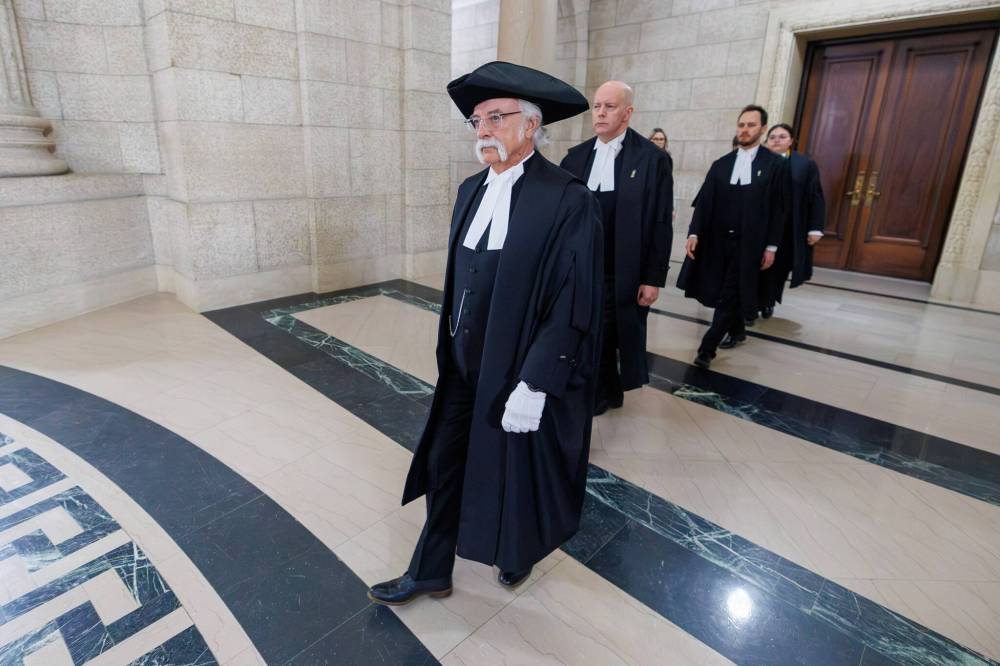
MIKE DEAL / FREE PRESS FILES
Speaker Tom Lindsey should seriously reconsider the blanket banning of words such as “racist,” “bigot,” “homophobe,” “misogynist” and “transphobe” in Manitoba’s legislature.
Which is why Manitoba’s legislature should seriously reconsider the blanket banning of words such as “racist,” “bigot,” “homophobe,” “misogynist” and “transphobe” in the assembly chamber.
Think of it as a paradigm shift.
Speaker Tom Lindsey’s recent ruling prohibiting MLAs from using those words was undoubtedly well-intentioned. Speakers are tasked with maintaining order in a chamber that can quickly descend into chaos. They traditionally avoid allowing members to impugn each other’s motives or character.
But there’s a growing problem with applying decades-old parliamentary rules to modern political realities.
Sometimes behaviour actually is racist. Sometimes comments genuinely are misogynistic or homophobic. And preventing elected officials from identifying or condemning that behaviour creates a bizarre contradiction: offensive conduct can occur in the chamber, but members are forbidden from accurately describing it.
That makes little sense in 2026.
Premier Wab Kinew is right to challenge Lindsey’s ruling. So is deputy premier Uzoma Asagwara.
The issue here is larger than partisan politics or the latest dust-up between the NDP government and Progressive Conservative opposition. It speaks to how legislatures evolve — or fail to evolve — alongside society itself.
The Manitoba legislature of 50 years ago looked vastly different than it does today. It was overwhelmingly white, overwhelmingly male and far less reflective of the province’s diversity. Today’s assembly includes Indigenous MLAs, racialized MLAs, more women and Manitoba’s first non-binary MLA.
That matters.
The language and rules governing debate should recognize that discrimination and identity-based attacks are not theoretical concepts. They are real experiences for many elected officials.
When Tory MLA Wayne Ewasko heckled Kinew with, “Hey, quit drinking,” it touched on a deeply harmful stereotype about Indigenous people and alcohol. Kinew, who does not drink alcohol, called the comment discriminatory and racist.
Lindsey ultimately removed Ewasko from the chamber after he refused to unequivocally apologize.
Yet under the speaker’s new ruling, calling a remark racist is now prohibited.
There’s something fundamentally backwards about that.
The focus should be on preventing racist behaviour, not on policing whether someone uses the word “racist” in response to it.
And let’s be honest about something else: decorum in Manitoba’s legislature has deteriorated badly in recent years despite all the old parliamentary rules remaining firmly in place.
Question period often resembles a schoolyard shouting match more than a serious democratic institution. Heckling has become constant. Personal attacks are routine. MLAs interrupt each other incessantly. Speakers repeatedly struggle to maintain control.
Nobody watching proceedings at the legislature today could credibly argue that banning certain words has preserved civility.
If anything, politicians have simply become more creative in finding ways to insult one another without technically violating parliamentary language rules.
The result is often absurd.
An MLA may be prohibited from calling another member racist directly, but can strongly imply racism through carefully chosen euphemisms or insinuations. Another member can make comments widely interpreted as discriminatory while insisting they intended no offence. Everyone ends up arguing over semantics instead of substance.
That’s exactly what has unfolded repeatedly in the current legislature.
The conflict surrounding comments directed at Kinew and Asagwara demonstrates how outdated these rules have become. Tory Leader Obby Khan’s recent remark toward Asagwara — “You are a terrible person, whatever you are” — was deemed “dehumanizing” and “hateful” by the Speaker himself. Yet the language available to condemn such behaviour inside the chamber is now restricted.
There’s something fundamentally wrong with that.
None of this means legislatures should become free-for-alls where MLAs casually hurl accusations at each other all day long. There still needs to be a standard of evidence and accountability. False or reckless allegations should carry consequences.
But context matters.
If an MLA engages in conduct widely understood to invoke racist stereotypes or demean someone based on identity, other members should not be muzzled from identifying it plainly.
Parliamentary privilege exists partly to allow legislators to speak candidly about matters of public importance without fear. Surely confronting discrimination falls within that principle.
Lindsey deserves credit for trying to restore order in an increasingly unruly chamber. Being speaker is one of the hardest jobs in politics. No ruling will satisfy everyone, particularly in today’s hyper-partisan climate.

But maintaining decorum cannot come at the expense of confronting harmful behaviour honestly.
In fact, legislatures may ultimately regain more public respect by allowing frank discussions about discrimination instead of pretending such issues can be managed through procedural word bans.
Manitoba’s assembly doesn’t have a language problem nearly as much as it has a behaviour problem.
And no list of forbidden words is going to fix that.
tom.brodbeck@freepress.mb.ca
Tom has been covering Manitoba politics since the early 1990s and joined the Winnipeg Free Press news team in 2019.
Our newsroom depends on a growing audience of readers to power our journalism. If you are not a paid reader, please consider becoming a subscriber.
Our newsroom depends on its audience of readers to power our journalism. Thank you for your support.
Tom has been covering Manitoba politics since the early 1990s and joined the Winnipeg Free Press news team in 2019.
Our newsroom depends on a growing audience of readers to power our journalism. If you are not a paid reader, please consider becoming a subscriber.
Our newsroom depends on its audience of readers to power our journalism. Thank you for your support.
Advertisement Advertise With Us
Advertisement Advertise With Us