

Reducing residential speed limit meaningless without enforcement

Advertisement
Read this article for free:
or
Already have an account? Log in here »
To continue reading, please subscribe:
Monthly Digital Subscription
$1 per week for 24 weeks*
- Enjoy unlimited reading on winnipegfreepress.com
- Read the E-Edition, our digital replica newspaper
- Access News Break, our award-winning app
- Play interactive puzzles
*Billed as $4.00 plus GST every four weeks. After 24 weeks, price increases to the regular rate of $19.95 plus GST every four weeks. Offer available to new and qualified returning subscribers only. Cancel any time.
Monthly Digital Subscription
$4.99/week*
- Enjoy unlimited reading on winnipegfreepress.com
- Read the E-Edition, our digital replica newspaper
- Access News Break, our award-winning app
- Play interactive puzzles
*Billed as $19.95 plus GST every four weeks. Cancel any time.
To continue reading, please subscribe:
Add Free Press access to your Brandon Sun subscription for only an additional
$1 for the first 4 weeks*
*Your next subscription payment will increase by $1.00 and you will be charged $16.99 plus GST for four weeks. After four weeks, your payment will increase to $23.99 plus GST every four weeks.
Read unlimited articles for free today:
or
Already have an account? Log in here »
Residential streets are meant to be places where people live, not environments where motor vehicle speed is the dominant consideration.
Yet in Winnipeg, a default speed limit of 50 km/h has turned many neighbourhood roads into corridors where vehicles routinely travel at 55 or 60 km/h, despite the presence of children, pedestrians, cyclists and dog walkers.
That disconnect between how streets are used and how fast we allow cars to move through them is why the city’s proposal to lower the default residential speed limit to 40 km/h is such an obvious and overdue step.
MIKAELA MACKENZIE / FREE PRESS FILES
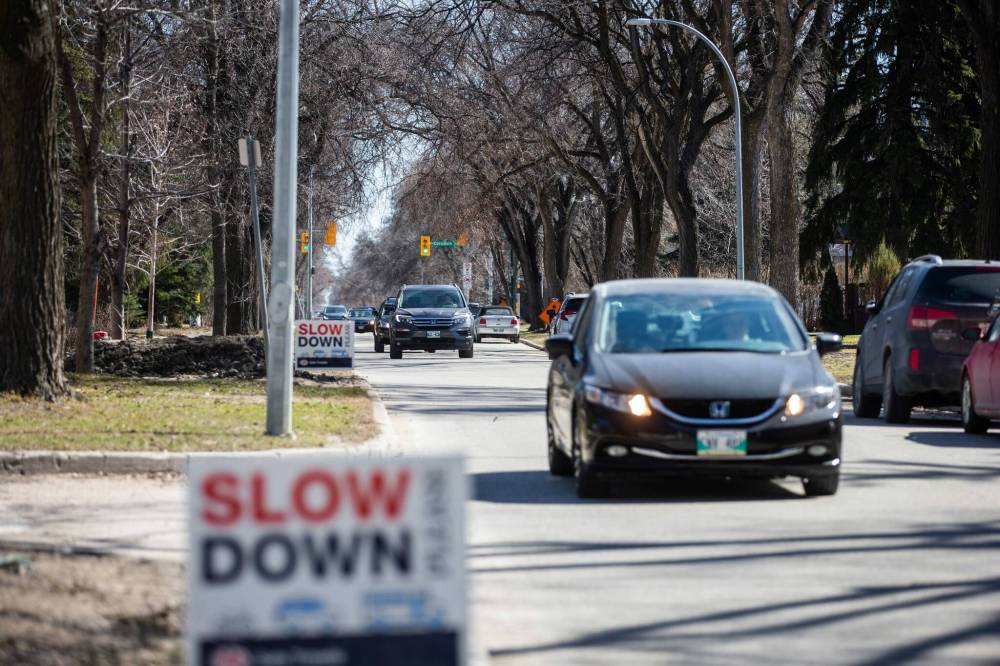
Winnipeg’s public service is recommending council reduce the default speed limit from 50 to 40 km/h on residential streets and minor collector roads.
Winnipeg’s public service is recommending council reduce the default speed limit from 50 to 40 km/h on residential streets and minor collector roads. A report going to the public works committee next week says the change would improve safety for pedestrians, cyclists and other vulnerable road users.
It would not apply to major routes, but to the neighbourhood streets where people cross the road daily, where kids play and where mistakes at high speeds have the most serious consequences.
This should not be controversial.
The problem with a 50 km/h limit is not just that it’s too fast. It’s that it’s rarely treated as a true limit at all. With little enforcement, drivers assume — often correctly — they can exceed it without consequence. As a result, 50 km/h quickly becomes 55 or 60 in real-world driving.
At those speeds, the margin for error shrinks dramatically. A moment’s distraction, a pedestrian stepping off the curb or a cyclist navigating around a parked car can turn into a life-altering event. Slower speeds reduce stopping distances, give drivers more time to react and significantly lower the risk of severe injury when collisions occur. This isn’t about opinion; it’s about basic physics.
Lowering the default limit to 40 km/h helps reset expectations. Even if some drivers continue to push the limit, the overall operating speed on residential streets comes down. That change alone can make neighbourhoods feel calmer, safer and more livable.
Waverley West city councillor Janice Lukes, chair of the public works committee, supports the recommendation, though she notes amendments to the provincial Highway Traffic Act are required before it could take effect.
“The difference in time is seconds to get somewhere when you’re going 40 or 50 km/h, but it makes a big difference,” said Lukes. “It creates a better quality of life for neighbourhoods.”
She’s right. The idea that reducing residential speeds by 10 km/h would meaningfully inconvenience drivers doesn’t hold up. What it would do is improve safety and make neighbourhood streets feel less intimidating for people on foot or on bikes.
The recommendation also reflects how Winnipeg is changing. Population density is increasing, and more people are choosing to walk or cycle for short trips. Residential streets are increasingly shared spaces, but our speed limits remain rooted in an era when moving vehicles quickly was the primary goal.
However, there’s a crucial caveat city council must not ignore: changing the number on a sign will not, by itself, change driver behaviour.
Winnipeg already has proof of that.
In March 2023, the city launched pilot projects in four neighbourhoods to study the effects of reduced speed limits of 30 km/h and 40 km/h. The impact on actual driving speeds was minimal. The reason was simple — enforcement was almost non-existent.
Drivers quickly realized the new limits came with little risk of tickets or penalties. With no sustained enforcement and few visible consequences, most people continued driving as they always had. The pilots didn’t fail because lower speeds don’t work; they failed because the city didn’t make them matter.
That lesson is critical.
If council lowers the default residential speed to 40 km/h — and it should — it must also commit to enforcing it. That means a visible enforcement strategy and street designs that discourage speeding in the first place. Without those measures, the change risks being largely symbolic.

The report recommends the public service return in a year with updates on provincial approval and an implementation plan. It estimates the cost of signage changes and a public information campaign at about $525,000. That may be enough to inform drivers of the new limit, but it won’t be enough to ensure compliance.
Mayor Scott Gillingham has said he won’t prejudge the issue, noting it would prompt a “robust discussion” if the province grants permission. That discussion is warranted, but it should begin with a clear acknowledgment: the current default needs to be changed.
A 50 km/h limit on residential streets is a policy choice, not an inevitability. And in neighbourhoods increasingly used by pedestrians and cyclists, it is a choice that no longer makes sense.
Lowering the default speed to 40 km/h won’t solve every safety issue on its own. Without enforcement, it would have little impact. But it is a sensible, evidence-based step toward streets that better reflect how people actually live.
tom.brodbeck@freepress.mb.ca
Tom has been covering Manitoba politics since the early 1990s and joined the Winnipeg Free Press news team in 2019.
Our newsroom depends on a growing audience of readers to power our journalism. If you are not a paid reader, please consider becoming a subscriber.
Our newsroom depends on its audience of readers to power our journalism. Thank you for your support.
Tom has been covering Manitoba politics since the early 1990s and joined the Winnipeg Free Press news team in 2019.
Our newsroom depends on a growing audience of readers to power our journalism. If you are not a paid reader, please consider becoming a subscriber.
Our newsroom depends on its audience of readers to power our journalism. Thank you for your support.
Advertisement Advertise With Us
Advertisement Advertise With Us