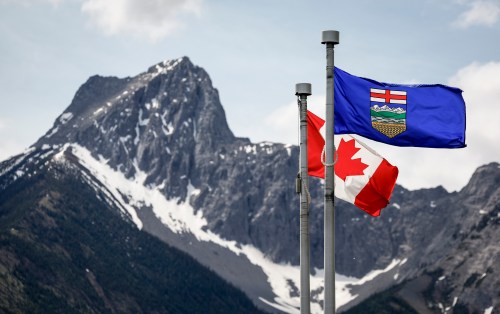
A Maple Leaf moment Canadians from coast to coast are finding and displaying patriotic pride — some for the first time — in response to the bullying coming from our suddenly bellicose neighbour to the south

Read this article for free:
or
Already have an account? Log in here »
To continue reading, please subscribe:

Digital Subscription
One year of digital access for only $205*
- Enjoy unlimited reading on winnipegfreepress.com
- Read the E-Edition, our digital replica newspaper
- Access News Break, our award-winning app
- Play interactive puzzles
*First annual payment billed as $205.00 + GST for one year. This annual subscription will automatically renew at $233.00 + GST every 52 weeks (10% off the regular annual price of $259.35). Offer available to new and qualified returning subscribers only. Cancel any time.
To continue reading, please subscribe:
Add Free Press access to your Brandon Sun subscription for only an additional
$1 for the first 4 weeks*
- Enjoy unlimited reading on winnipegfreepress.com
- Read the E-Edition, our digital replica newspaper
- Access News Break, our award-winning app
- Play interactive puzzles
*Your next Brandon Sun subscription payment will increase by $1.00 and you will be charged $17.95 plus GST for four weeks. After four weeks, your payment will increase to $24.95 plus GST every four weeks.
Read unlimited articles for free today:
or
Already have an account? Log in here »
Hey there, time traveller!
This article was published 24/03/2025 (567 days ago), so information in it may no longer be current.
It’s hard to pinpoint the exact moment the flag-waving, chest-thumping Canadian patriotism movement began.
But it’s not a stretch to say it had something to do with hockey, that old proxy for geopolitical beefs.
Surely a tipping point was with the booing of the American anthem in Canadian NHL arenas immediately after the country was struck by the political equivalent of slashing — the introduction of tariffs, as an impending threat, that left the country wanting to throw off its gloves.
And throw off its gloves Canada did, in the round-robin matchup against the U.S. at the 4 Nations Face-Off tournament last month, when three fights broke out within the first nine seconds of the game.
Canada captain Sidney Crosby (right) hoists the trophy after defeating the United States in overtime at the 4 Nations Face-Off championship hockey game last month in Boston. 
Canada’s OT victory over the U.S. days later in the tournament’s final was the knockout punch, perhaps weightier symbolically even than then-Prime Minister Justin Trudeau’s promises of counter-tariffs.
Regardless, Canadians from all corners of the country — and Manitobans with significant consensus across the political spectrum — have made it pretty clear about their feelings living in the shadows of the oversized Trumpian world.
Canada is not for sale. Nor is it available for annexation. A 51st state? Please.
But no matter how kooky the threat, and whatever the last word on tariffs, the damage has been done. Canada’s “special relationship” with its neighbours to the south likely won’t be taken for granted by political leaders on either side of the border for some time.
A Probe Research poll commissioned by the Free Press reflects the current mood in the country and the province.
A full 77 per cent of Manitoba respondents say they feel prouder to be a Canadian today than they did at this time last year, a sentiment clearly caught up with defiance in the face of President Donald Trump’s aggression.
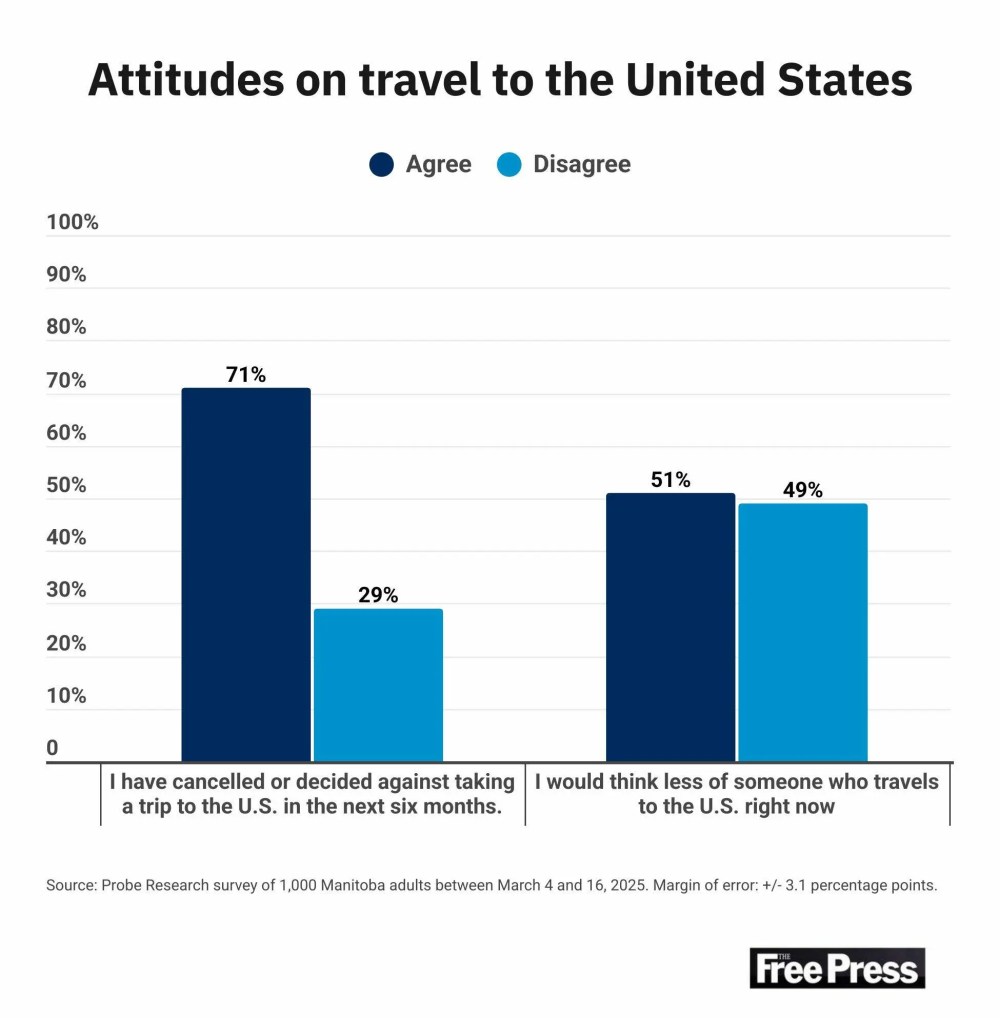
Manitobans are acting on these attitudes in different ways — from buying Canadian-made rather than American-made products (65 per cent) and wearing or flying the Maple Leaf (19 and 17 per cent, respectively) to cancelling planned trips to the States (17 per cent). Some (seven per cent) say they’re still booing the U.S. anthem at sports venues.
More than half also say that they’d think less of someone who travels to the U.S. right now.
This shift seems dramatic for a country that supposedly has long survived, to quote Marshal McLuhan, “as the only country… without an identity.”
A country that, at any rate, not long ago viewed eager flag-waving as a bold partisan gesture, caught up in trucker-convoy protests and other headline-grabbing causes.
“It’s a pretty interesting change,” says Curtis Brown, a principal at Probe Research. “A few years ago, after that statue was pulled down at the Manitoba legislature, it was more taboo to be rah-rah Canada and wave the flag.”
Brown is referring to the toppling of the Queen Victoria statue by protesters on Canada Day in 2021, in response to the discovery of unmarked graves at former residential school sites.
And yet, as Brown says and the research shows — based on a random and representative sample of 1,000 Manitoba adults between March 4 and 16 — rising patriotic and anti-American feelings now cut broadly across the political aisle as well as all demographic groups considered, with small but notable outliers.
The situation feels oddly reminiscent of the 1960s, when Canadians left and right embraced nationalism in response to perceived threats to sovereignty from the U.S., particularly owing to its pressure on our government to fall in line with its Cold War agenda.
Many progressives found unlikely inspiration in the writings of George Grant, an anti-war cultural conservative who defended the British Empire, though he was active in left-wing circles associated with the early NDP.
Now, as then, the patriotic surge isn’t entirely free of internal tensions, dilemmas and ironies but remains broadly bipartisan and centred on an American threat.
Lively talk about flags, hockey and nationalism plays out at the Osborne ANAF legion Wednesday night under the gaze of British monarchs and Canadian Second World War soldiers in the surrounding photo gallery.
“I am very much a proud Canadian, but I’m prouder to be an Aboriginal from a sovereign nation,” says one of the men gathered around a table. He adds that while he refuses to buy American products, if he can avoid them, he’s still “actively fighting for our native rights.”
“But you’re really Canadian,” he says, calling out to one of his friends.
“This is about the existence of Canada. This is tapping into something much deeper and more emotional.”–Curtis Brown
The friend nods. “I’m a little bit biased, though,” he says, “because Canada gives a lot of opportunities to my family, right? My mom, my dad, we escaped civil war in Somalia.”
Another says he’s never had every any shame about showing patriotic pride.
“I feel like with a lot of provinces,” he adds, “there was a lot of interprovincial tension, and now there isn’t, because what brings a group of people together? A common enemy.”
Differences of opinion are aired about the nature of Canadian sovereignty and confederacy, but all seem to feel that the country’s current hockey adversary is showing signs of becoming a geopolitical one, too.
At least one raises his glass to Canada’s victory over the U.S. in the 4 Nations Face-Off. The buy-Canadian rule is observed by all, by the looks, in their choices of beer.
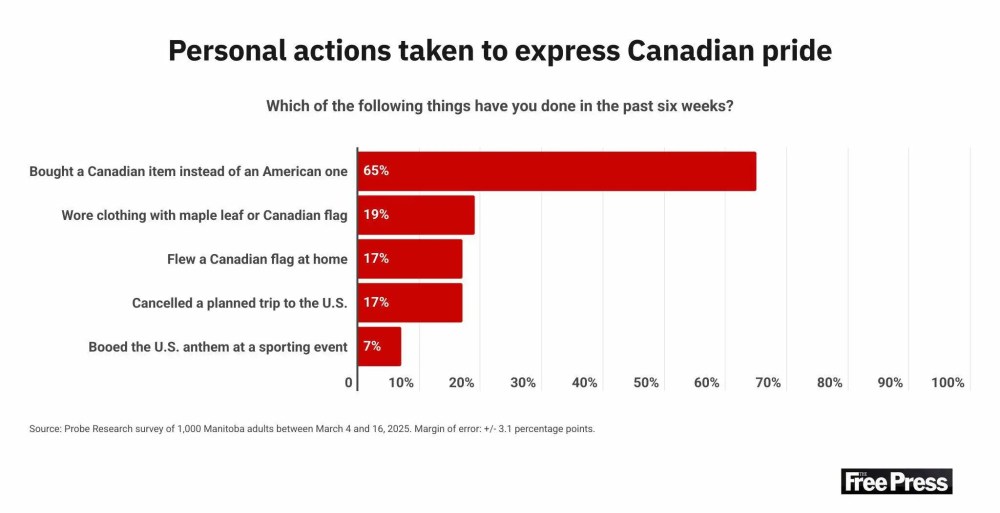
While buy-Canadian habits, reinforced by our country’s counter-tariffs on the U.S., are the most common ways Manitobans are retaliating against Trump’s trade-war threats, Brown says there’s more than economics at play.
“This is about the existence of Canada. This is tapping into something much deeper and more emotional,” he says. “I don’t think in most people’s lifetimes, Canada has faced this kind of existential threat where the leader of the country next door is talking about annexing us.”
Talk, of course, is the key word here, with international relations experts stating annexation of Canada remains highly unrealistic. This recognition isn’t lost on Manitobans, most of whom, as Probe’s research shows, neither want Canada to join the U.S. nor think the scenario likely.
Manitobans wouldn’t be wrong to see in Trump’s bluster about making Canada the 51st state something more ominous than simply poor diplomatic manners.
His imposition of tariffs on Canada are connected to a broader tendency in his foreign policy, an “American First” nationalism that scorns multilateralism and “liberal international” norms, and therefore makes him an isolated and highly unpredictable actor on the global stage.
And even if some of Trump’s defenders, when pressed, seem to treat Trump’s 51st-state rhetoric as an amusing negotiation tactic and not to be taken at face value, a surprising number of Canadians on the political right support the spirit of that idea.
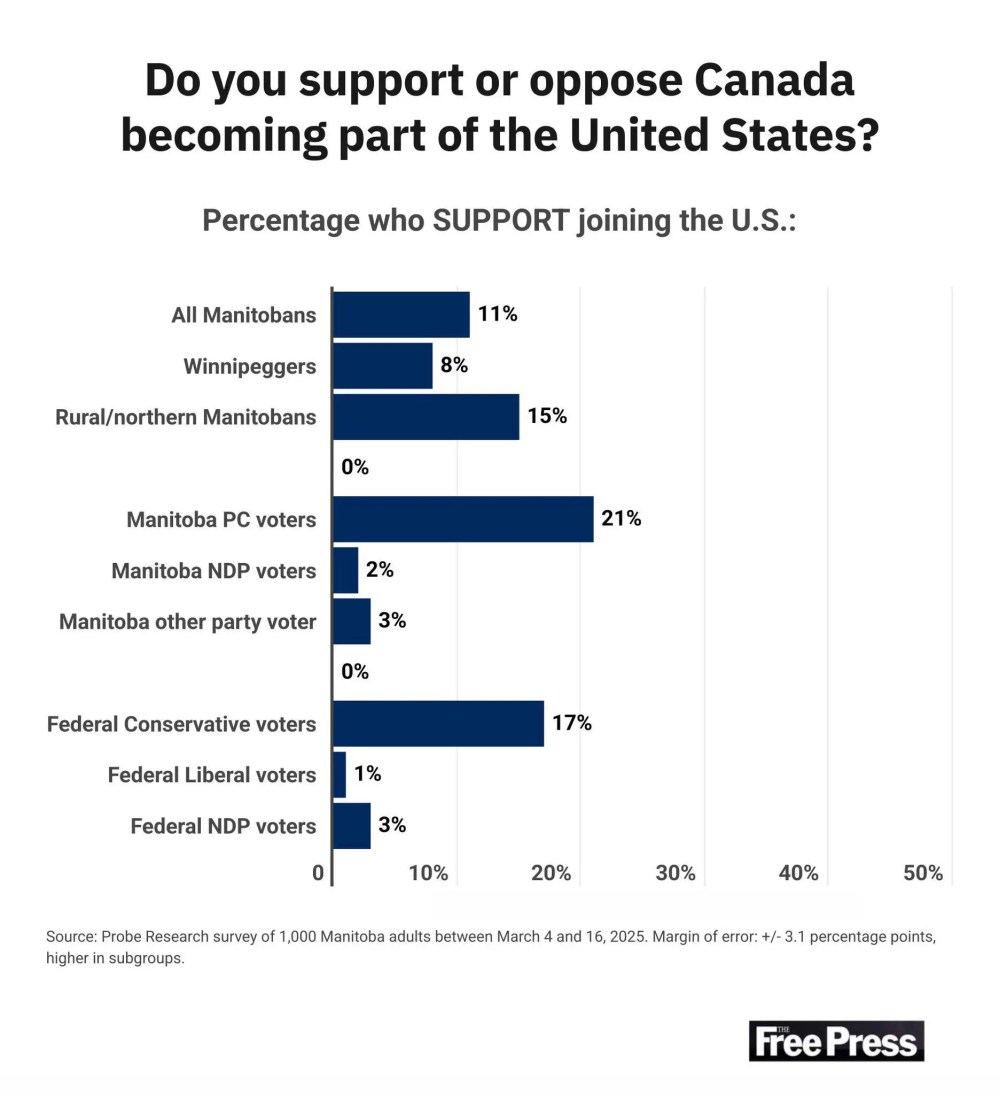
Perhaps one of the most striking nuances to Probe’s research is the revelation that about one in five Manitobans who vote Conservative, either provincially or federally, support joining the U.S.
That figure dovetails with Leger360’s findings that 21 per cent of Conservative voters in Canada are “more likely to be in favour of Canada joining the United States.”
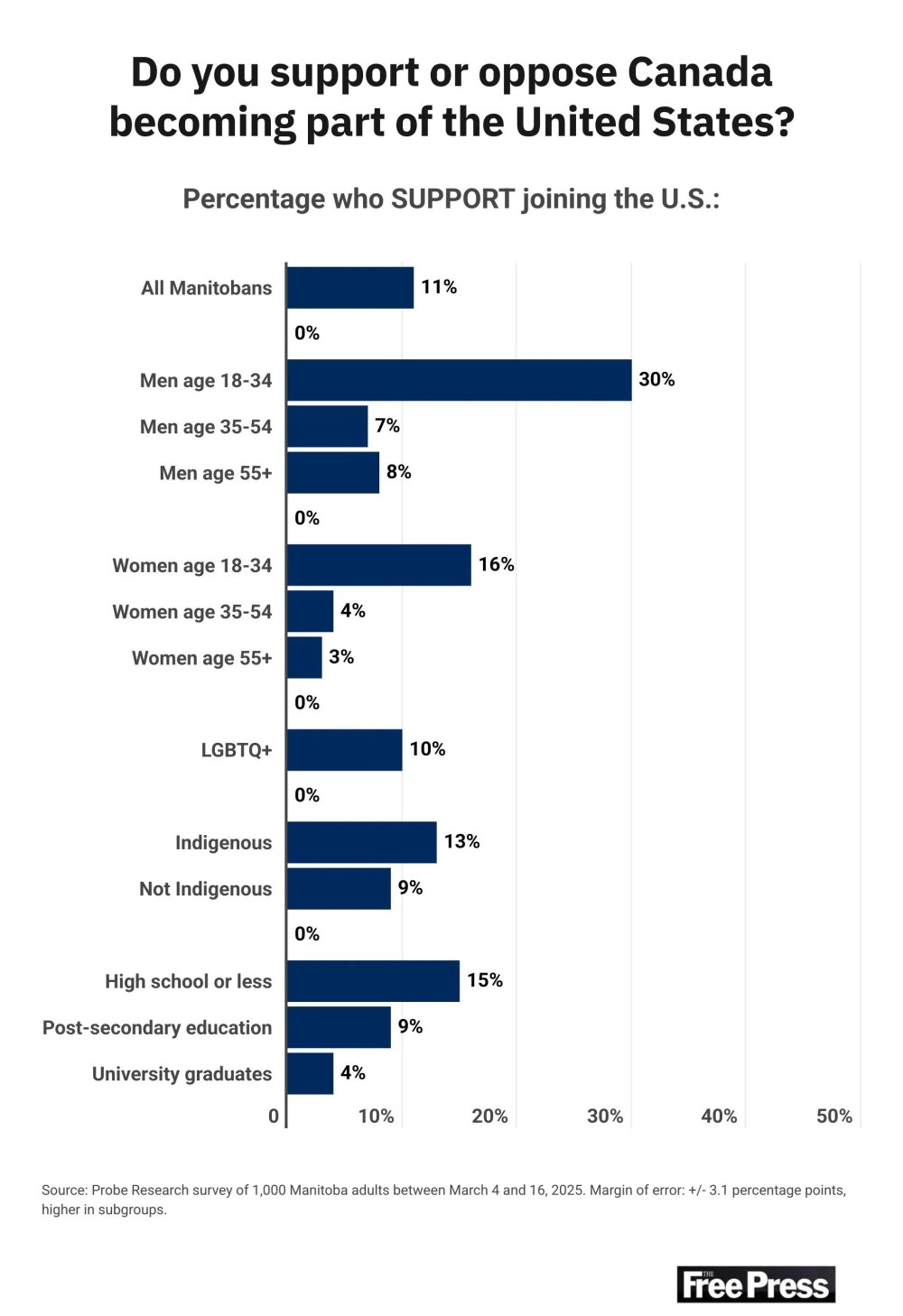
“The vast majority (of conservatives) don’t want to be part of the U.S.,” says Brown. “But there’s definitely a group within that conservative base, and it tends to be younger men and rural, that are warmer and more open to the idea.”
Does this trend seem counter-intuitive, given that conservatives aren’t historically known for being shy about promoting “Canadian values” and national sovereignty?
Or are some conservatives, not unlike those liberals now proudly declaring “I am Canadian,” guilty of fair-weather patriotism — flying the flag only when it suits their pet causes?
Brown, for his part, connects this trend to economic anxiety among Millennials and Gen Z. He observes they’ve had a harder time buying homes and advancing their careers than their parents and may see the potential advantages of joining the U.S., such as being paid in American dollars.
Business is booming in one quaint sector of the Canadian economy.
According to Flags Unlimited, a major manufacturer in Ontario, Canadian flag sales have doubled compared to a year ago and, unsurprisingly, this shift is felt in Winnipeg, too.
RUTH BONNEVILLE / FREE PRESS FILES Samantha Hobson is seeing an increase in online sales from buyers with American addresses.
“Sales have been excellent,” says Samantha Hobson, whose family owns the Flag Shop on Osborne Street. “We sold a significant amount of flags during the (trucker convoy), but I would say that the fury with which people are coming in to buy flags currently is much higher.”
She adds that a lot of customers say they’re flying the flag at their home for the first time and that the Flag Shop is seeing an increase in online sales from buyers with American addresses.
“Some are Canadians,” she says. “Some of them are (Americans) just quite upset with the current political climate, and basically are using the Canadian flag as sort of a protest.”
Maple Leaf-mania is rearing its head in so many other ways. On the Winnipeg subreddit, a parent proudly posts a map of River Heights that, using GPS, shows a path run by their son — from Oxford Street to Kenaston Boulevard for the borders, with a lot of dekes and twists between, roughly, Ash and Borebank streets for the leaf, to create a perfect Canadian flag.
Another in the subreddit asks how they might get their hands on one of the flags flown on Parliament Hill. Each day the flag is taken down at sunset and a new one is hoisted at sunrise, with the old flags available to the public through an order form on their website. The currently wait time, according to federal government’s website “exceeds 100 years.”
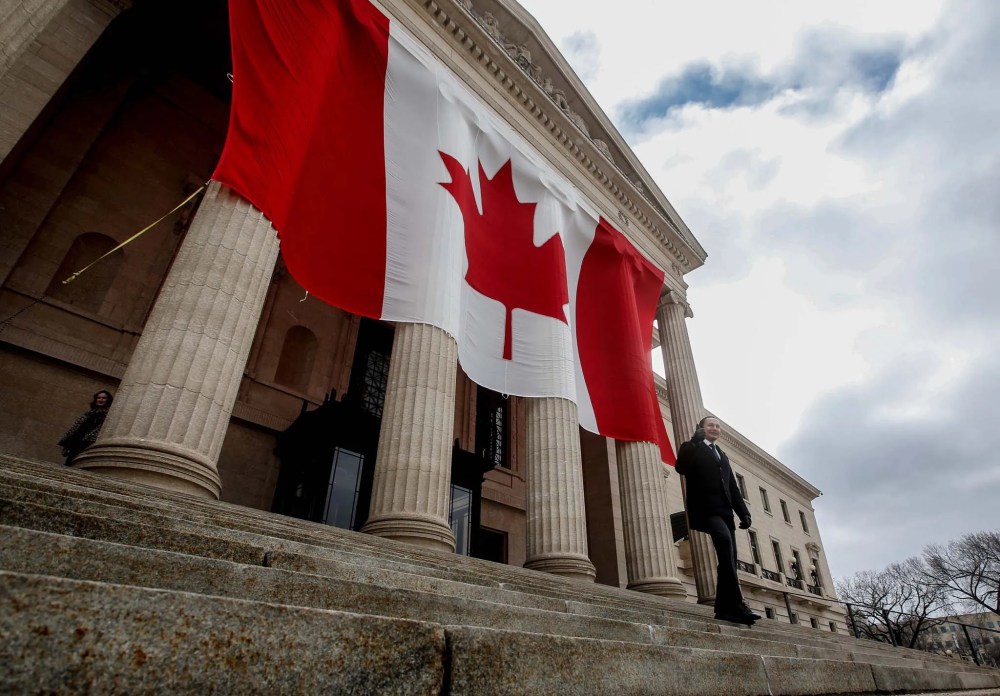
One flag on legislative grounds that can’t so readily be swapped is the colossal Maple Leaf draped over the Manitoba Legislature Beaux-Arts entrance, which Premier Wab Kinew officially unveiled at a snowy outdoor news conference on March 4.
Premier Wab Kinew officially unveiled a huge Canadian flat outside the Manitoba Legislature on March 4.
“Oh Canada. This is our home and native land,” begins the excerpt of his speech on an post on his Instagram page.
“And I think, today, all of us are patriots. And our team is here to reassure everyone in Manitoba and across the country that we will always be the true north, strong and free.”
The post’s reception, and to some extent its tone, contrasts with Kinew’s Canada Day Instagram post last July, when he stood inside the legislature, with Indigenous painter Dee Barsy’s works displayed behind him, and addressed the viewer pensively.
“When I was in France recently, I saw our flag flying everywhere, and it really, really moved me,” he said in a message that honoured the sacrifices of Indigenous soldiers in the Second World War and that implicitly connected Canadian civic duty and inclusivity to anti-fascism.
Below the post, many commenters replied with “no pride in genocide,” earning them dozens or hundreds of likes, with some calling for the cancellation of Canada Day.
There’s little of such rumblings on Kinew’s March 4 post in front of the legislature’s giant new flag. It’s met broadly with support, praise and Maple Leaf emojis in the comments.
For all the apparent consensus in Manitoba and Canada across political and cultural groups in favour of Canadian solidarity in the face of Trump’s threats, there are clearly different forces of momentum within it.
And dissent of the sort just described — with anger over the colonialist legacy leading some to neither identify with nor admire Canada — certainly still exists.
How the solidarity movement unfolds has to do with how coalitions evolve and the choices they make.
One of the choices may, for those who say they love Canada, be between a temperate patriotism and a hot nationalism.
The first is supposed to allow for pride when the country is seen as living up to or moving towards its highest ideals — and shame when it fails at this. The second would dismiss such shame as anti-Canadian.
“A narrow nationalism,” says University of Manitoba historian Sean Carleton, “risks a backsliding on much of what could actually make Canada different from the United States.”
“Loving your country means that you are courageous enough to look at the things that are not going well and fixing them.”–Sean Carlton
Carleton was a panelist last week at a roundtable discussion at the U of M on the knotty and often unresolved questions surrounding Canadian sovereignty in “Trumpian times,” organized in response to student questions and interest on this topic.
He goes on to say that instead of fixating on what’s made Canada great, “we need to continue to focus on building a more honourable future, and that includes strengthening relations with Indigenous people.”
Whether patriotism versus nationalism risks being a distinction without a real difference, Carleton urges us to resist the temptation towards black-and-white thinking.
“Loving your country means that you are courageous enough to look at the things that are not going well and fixing them,” he says.
conrad.sweatman@freepress.mb.ca

Conrad Sweatman is an arts reporter and feature writer. Before joining the Free Press full-time in 2024, he worked in the U.K. and Canadian cultural sectors, freelanced for outlets including The Walrus, VICE and Prairie Fire. Read more about Conrad.
Our newsroom depends on a growing audience of readers to power our journalism. If you are not a paid reader, please consider becoming a subscriber.
Our newsroom depends on its audience of readers to power our journalism. Thank you for your support.