

First Nations awaiting Hydro consults

Advertisement
Read this article for free:
or
Already have an account? Log in here »
To continue reading, please subscribe:
Monthly Digital Subscription
$1 per week for 24 weeks*
- Enjoy unlimited reading on winnipegfreepress.com
- Read the E-Edition, our digital replica newspaper
- Access News Break, our award-winning app
- Play interactive puzzles
*Billed as $4.00 plus GST every four weeks. After 24 weeks, price increases to the regular rate of $19.95 plus GST every four weeks. Offer available to new and qualified returning subscribers only. Cancel any time.
Monthly Digital Subscription
$4.99/week*
- Enjoy unlimited reading on winnipegfreepress.com
- Read the E-Edition, our digital replica newspaper
- Access News Break, our award-winning app
- Play interactive puzzles
*Billed as $19.95 plus GST every four weeks. Cancel any time.
To continue reading, please subscribe:
Add Free Press access to your Brandon Sun subscription for only an additional
$1 for the first 4 weeks*
*Your next subscription payment will increase by $1.00 and you will be charged $16.99 plus GST for four weeks. After four weeks, your payment will increase to $23.99 plus GST every four weeks.
Read unlimited articles for free today:
or
Already have an account? Log in here »
With licences for two major Manitoba Hydro projects set to expire later this year, affected First Nations await consultation — and want to see change.
Licences for the Churchill River Diversion and Lake Winnipeg Regulation projects, first issued in the 1970s, expire Sept. 1 and Aug. 1, respectively.
The diversion directs water to five stations accounting for roughly 75 per cent of Manitoba’s power generation. The latter project allows Hydro to generate power by manipulating Lake Winnipeg’s water levels.
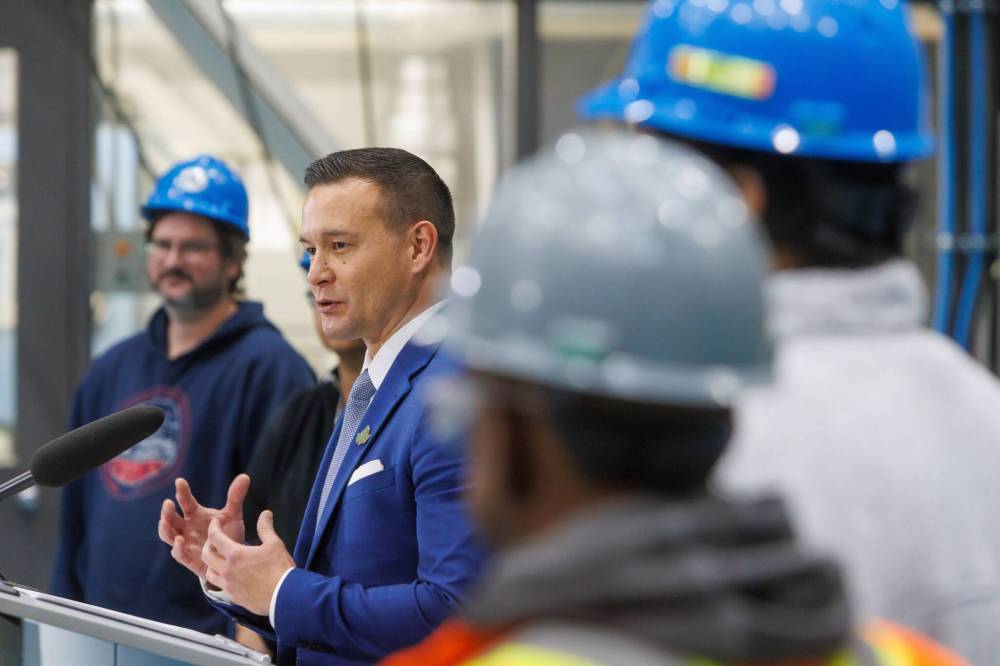
MIKE DEAL / FREE PRESS FILES
Environment and Climate Change Minister Mike Moyes says short-term licence extensions are an option if a deal isn’t struck in time.
There is no timeline for the licence renewals, said Environment Minister Mike Moyes. He said that would be dependent on consultations with impacted First Nations.
“Sometimes discussions take longer, sometimes they’re shorter,” he said. “It really depends on how… this process unrolls.”
Letters were sent to some First Nations two weeks ago and more will reach communities in the coming weeks, a government spokesperson said. The letters ask First Nations how they’d like to be consulted, Moyes said.
He wouldn’t say if the government is considering short-term licence extensions for the two projects but noted it’s an option. Last November, Manitoba Hydro requested five-year extensions.
Some Indigenous communities are against the extensions, saying they perpetuate a harmful status quo and hurt the environment and their traditional way of life.
“We always are going to make sure that Manitobans can rely on Manitoba Hydro, that the lights are going to be on,” Moyes said. “At the same time, we want to make sure that we’re having really good consultations with First Nation communities.”
Leslie Dysart, the appointed lead of Manitoba Hydro issues for O-Pipon-Na-Piwin Cree Nation, said Tuesday he wasn’t aware of incoming consultations.
The community of roughly 1,100 people has felt a “tremendous, devastating effect” because of the Churchill River Diversion, Dysart said.
Fishing on South Indian Lake, a key part of the diversion, was once the First Nation’s economic boon. Now, the white fish populations are marginal compared to decades past, and just a dozen locals fish for trade, Chief Shirley Ducharme said.
“Even with the trappers — there’s not very many trappers now,” she said. “It was a trading post, but now, it’s so hard to go to the trap lines.”
Most band members rely on income assistance, which is “insufficient” with inflation. The number of residents exceeds the jobs available in the community, Ducharme said.
Other First Nations — including Tataskweyak and Pimicikamak — and the Manitoba Métis Federation have expressed concerns about environmental and social impacts of the Hydro projects.
Some grievances are appearing in lawsuits: Hydro has faced a slew from First Nations over the past year. In the most recent, Norway House Cree Nation is suing Hydro and the provincial and federal governments over Lake Winnipeg water level manipulation.
“They have to do away with this 50-year licensing,” said Doreen Spence, chief of Tataskweyak Cree Nation.
The Churchill River Diversion and Lake Winnipeg Regulation projects became operational in 1976. Environmental damage has accumulated over the decades, Spence said, adding the lake sturgeon population Tataskweyak members once fished from is nearly gone.
Tataskweyak hired scientists to study the impact of Hydro’s Missi Falls control structure on the Churchill River roughly six years ago.
Spence, in a Free Press op-ed earlier this month, called for Missi Falls to mimic the natural rhythm of the river and for Hydro to stop creating “dramatically low flows and sudden historically high rushes of water.”
Dysart echoed her, saying Manitoba Hydro should follow lake operation parameters set in 1973, so water levels wouldn’t fluctuate so dramatically.
“That would still allow Manitoba Hydro to generate power but would bring stability to our environment, and hopefully some well-being,” Dysart said.
Issuing short-term licences continues environmental destruction, Dysart said, adding O-Pipon-Na-Piwin hasn’t been adequately compensated for damages.
Manitoba Hydro will continue to operate under current licence terms until instructed otherwise, spokesman Peter Chura wrote in an email. Hydro hasn’t requested changes to either project’s operating parameters.
The Crown utility engages with communities affected by its projects on an ongoing basis; discussions can address the effects of hydroelectric development, Chura wrote.
The province must consult Indigenous groups under Section 35 of Canada’s Constitution Act before renewing the licences.

“Previous governments did not do proper engagement, they did not do proper consultation,” Moyes said. “We were looking for a way to bring in a new approach.
“I’m really looking forward to having (discussions) on a government-to-government basis, really trying to work through and mitigate the impacts to the environment.”
The province is having “constructive conversations” with Indigenous communities about economic participation, including in the energy sector. Discussions about sharing Manitoba Hydro revenues with First Nations are “being had,” Moyes said.
Manitoba Hydro’s 10-year plan includes procuring wind power from Indigenous-owned businesses.
gabrielle.piche@winnipegfreepress.com
Gabby is a big fan of people, writing and learning. She graduated from Red River College’s Creative Communications program in the spring of 2020.
Our newsroom depends on a growing audience of readers to power our journalism. If you are not a paid reader, please consider becoming a subscriber.
Our newsroom depends on its audience of readers to power our journalism. Thank you for your support.
Gabby is a big fan of people, writing and learning. She graduated from Red River College’s Creative Communications program in the spring of 2020.
Our newsroom depends on a growing audience of readers to power our journalism. If you are not a paid reader, please consider becoming a subscriber.
Our newsroom depends on its audience of readers to power our journalism. Thank you for your support.
Advertisement Advertise With Us
Advertisement Advertise With Us