

Getting a handle on homelessness
Councillor believes managed-encampment pilot, similar to successful strategy in Halifax, would prove beneficial for Winnipeg crisis
Advertisement
Read this article for free:
or
Already have an account? Log in here »
To continue reading, please subscribe:
Monthly Digital Subscription
$1 per week for 24 weeks*
- Enjoy unlimited reading on winnipegfreepress.com
- Read the E-Edition, our digital replica newspaper
- Access News Break, our award-winning app
- Play interactive puzzles
*Billed as $4.00 plus GST every four weeks. After 24 weeks, price increases to the regular rate of $19.95 plus GST every four weeks. Offer available to new and qualified returning subscribers only. Cancel any time.
Monthly Digital Subscription
$4.99/week*
- Enjoy unlimited reading on winnipegfreepress.com
- Read the E-Edition, our digital replica newspaper
- Access News Break, our award-winning app
- Play interactive puzzles
*Billed as $19.95 plus GST every four weeks. Cancel any time.
To continue reading, please subscribe:
Add Free Press access to your Brandon Sun subscription for only an additional
$1 for the first 4 weeks*
- Enjoy unlimited reading on winnipegfreepress.com
- Read the E-Edition, our digital replica newspaper
- Access News Break, our award-winning app
- Play interactive puzzles
*Your next subscription payment will increase by $1.00 and you will be charged $16.99 plus GST for four weeks. After four weeks, your payment will increase to $23.99 plus GST every four weeks.
Read unlimited articles for free today:
or
Already have an account? Log in here »
Designated encampment zones in Halifax gave civic officials and outreach workers a clearer understanding of the scale and day-to-day realities of the city’s homelessness crisis.
Now, after reducing the number of people living in those encampments from more than 200 by approximately three-quarters over the past two years, the city is preparing to gradually close its two remaining sites — a strategy that may offer lessons for Winnipeg as it prepares to study the viability of a managed-encampment pilot of its own.
“They were created at time where we needed an emergency response,” said Rachel Boehm, executive director of community safety with Halifax Regional Municipality, noting the designated spaces were set up in 2023 as a response to an emerging crisis coming out of the pandemic.
MIKE DEAL / FREE PRESS FILES
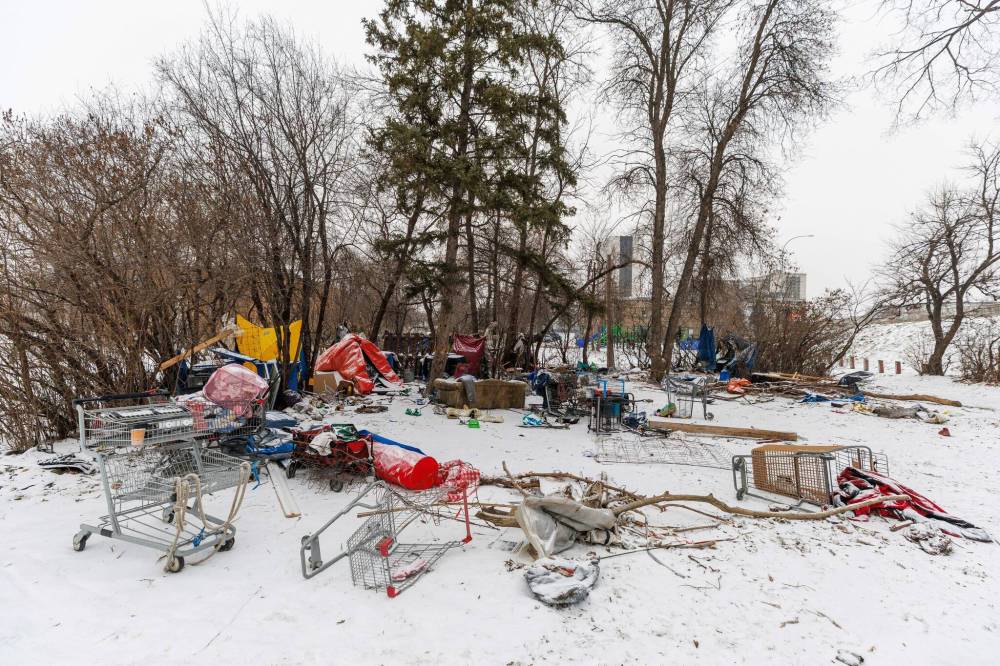
An encampment along Mayfair Avenue sits empty after its inhabitants were removed by the city in early December.
“More people were living outside, far more people living outside, than we had indoor capacity.”
The move reflected an acknowledgment of where Halifax stood in responding to homelessness, which has grown by 400 per cent since 2018.
Daniel McIntyre councillor Cindy Gilroy, who visited Halifax earlier this year and saw first-hand how that city and the Nova Scotia government addressed the issue, hopes a similar strategy could help tackle Winnipeg’s growing homelessness crisis.
Last week, Winnipeg city council voted 14-2 to direct staff to prepare a report on the feasibility of running a temporary “managed encampment to housing” pilot next spring and summer.
The proposal would explore whether a dedicated site could provide people experiencing homelessness with basic services and supports in one location.
Gilroy, who raised the successful motion to study the idea, said the model would include a 24-7 on-site organization responsible for monitoring the encampment, keeping it clean, de-escalating conflicts and working directly with residents to connect them with housing suited to their needs.
“Housing would be the ultimate goal… this would be temporary, and we would know where they are, taking them from housing directly from the encampment,” she said.
“A lot of the time, you don’t know where people are. Here, someone would be able to manage appointments for them, whether it be Employment Income Assistance, the justice system, or just medical appointments.”
Boehm credited Halifax’s designated encampments with accelerating efforts to move people into housing and supports.
“The designated encampments brought the majority of people into places that we could easily meet them, get to know them, understand what their challenges were and connect them with services,” she said. “That has brought us to where we are today.”
Over the past two years, Halifax and the province have rapidly expanded housing supply, bringing capacity to a point where it often meets demand. That effort has included the construction of dozens of pallet shelters and tiny homes.
Once home to hundreds of people, Halifax’s designated encampments now house roughly 50. While the progress is notable, challenges remain. Despite increased availability, the city continues to face a shortage of low-barrier housing options needed to support people experiencing addiction as well as homelessness.
“We feel it’s a number now that is small enough for us to take that very individualized case-management approach, which means working with people,” Boehm said. “They may be resistant to being housed, and it’s understanding why and what would be needed for that person to consider an indoor option.
“Sometimes it takes several different tries with different outreach workers or different approaches to find the right successful pathway for a person, and we’re prepared to take that time.”
Winnipeg’s proposed managed-encampment pilot could go further than Halifax’s model, though what that would look like remains to be seen.
Among the elements city staff have been asked to examine are potential locations, operational details, capacity and how safety issues would be addressed. The report will also include cost estimates for amenities such as two large metal garbage bins with regular city pickup, three portable washrooms and “modest” maintenance and cleaning services.
The city will also ask the province how it could participate, such as by funding and delivering supports for encampment residents, such as income assistance, addictions treatment mental-health services and housing.
Boehm acknowledged the encampments have impacted the Halifax communities they are within, including the loss of green space, increased garbage and issues with rodents. Crime has also been a factor, although not a major one.
MIKE DEAL / FREE PRESS FILES
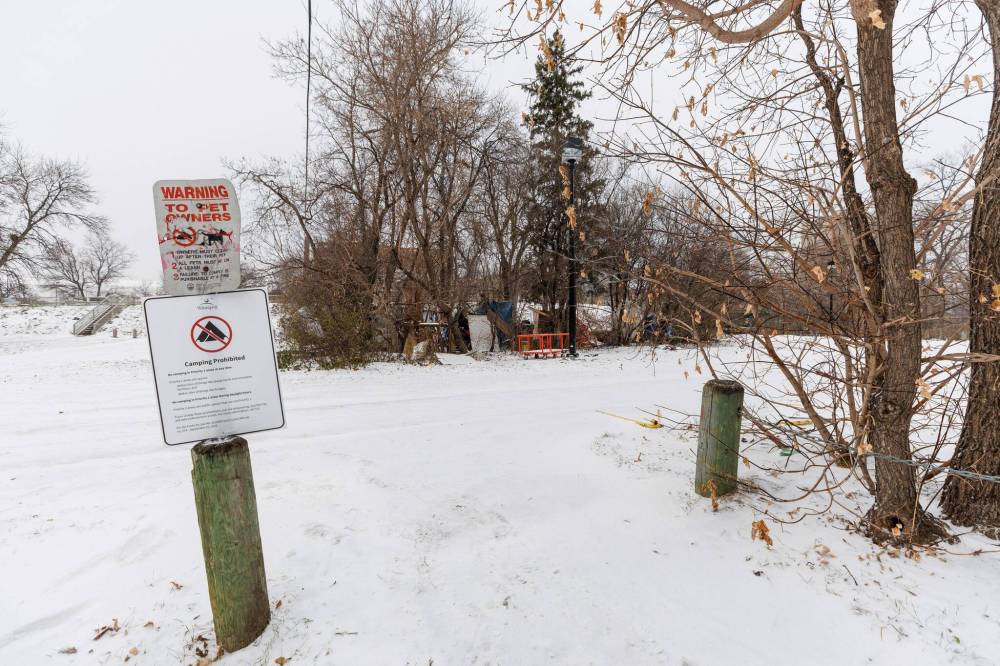
Winnipeg’s proposed managed-encampment pilot could go further than Halifax’s model, though what that would look like remains to be seen.
Not everyone supports the idea in Winnipeg.
Winnipeg Coun. Evan Duncan, chair of the property and development committee, said earlier this month he opposes the idea because it just moves people from one location to another and doesn’t resolve the issue.
He voted against it during the executive policy committee and city council votes.
“I don’t think it’s beneficial to say, ‘Come to this city-owned piece of land, set up however you like, do any type of drugs that you like, have whatever weapon you like,’” said Duncan (Charleswood-Tuxedo-Westwood).
“Essentially, a lawless community that is probably going to victimize more people, probably increase drug trafficking and probably introduce criminal and gang elements. I think this needs to be more thought out.”
Waverley West councillor Janice Lukes also voted against in both votes, citing concerns about provincial buy-in.
“The city cannot do it without provincial support – absolutely cannot do it without the province on board,” Lukes said in an email.
She also said she wants to see the “very limited” city staff who work on the homeless file to be focused on actions resulting from the city’s new bylaw, which bans encampments from many public spaces.
In Halifax, Boehm said the time has come to return parks and public spaces to the communities where encampments have been located. Last month, the city began the process of dismantling its remaining designated encampments over the next 18 to 24 months.

Still, officials are prepared to adjust if conditions change.
“We can slow the plan down,” she said. “We’re going to take a project-management approach, really use data to track our numbers and, aware of the risk that could emerge, keep an eye, a really close eye on things.”
Boehm said Halifax’s human-centred, compassionate approach has proven effective, adding that strong provincial support and partnership has been critical to making meaningful progress on the issue.
Winnipeg’s report is due back to council in about four months.
scott.billeck@freepress.mb.ca