The best 4-4 tie in hockey history A memorable night in Winnipeg saw Canada and the Soviets do battle in iconic series
Read this article for free:
or
Already have an account? Log in here »
To continue reading, please subscribe:
Digital Subscription
One year of digital access for only $1.44 a week*
- Enjoy unlimited reading on winnipegfreepress.com
- Read the E-Edition, our digital replica newspaper
- Access News Break, our award-winning app
- Play interactive puzzles
*Billed as $5.77 plus GST every four weeks. After 52 weeks, price increases to the regular rate of $19.95 plus GST every four weeks. Offer available to new and qualified returning subscribers only. Cancel any time.
To continue reading, please subscribe:
Add Free Press access to your Brandon Sun subscription for only an additional
$1 for the first 4 weeks*
- Enjoy unlimited reading on winnipegfreepress.com
- Read the E-Edition, our digital replica newspaper
- Access News Break, our award-winning app
- Play interactive puzzles
*Your next Brandon Sun subscription payment will increase by $1.00 and you will be charged $17.95 plus GST for four weeks. After four weeks, your payment will increase to $24.95 plus GST every four weeks.
Read unlimited articles for free today:
or
Already have an account? Log in here »
Hey there, time traveller!
This article was published 05/09/2022 (1507 days ago), so information in it may no longer be current.
There was no on-ice winner of Game 3 in the 1972 Summit Series but Team Canada head coach Harry Sinden was the hands-down, off-ice MVP with his candid assessment of the 4-4 draw at the Winnipeg Arena.
“If a tie is like kissing your sister, that looked like (movie star) Raquel Welch to me,” he told reporters afterward. “Aren’t we all glad to be alive and watching hockey like that?”
Today marks the 50th anniversary of the day the Manitoba capital played host to Game 3 of the Summit Series, a (supposedly) friendly competition pitting Canadian professionals from the NHL against Soviet “amateurs.”
It was the first best-on-best series between the two countries.
DAVE JOHNSON / WINNIPEG FREE PRESS FILES Canada vs Russia Summit Series - 1972 Game 3 - Winnipeg September 6, 1972.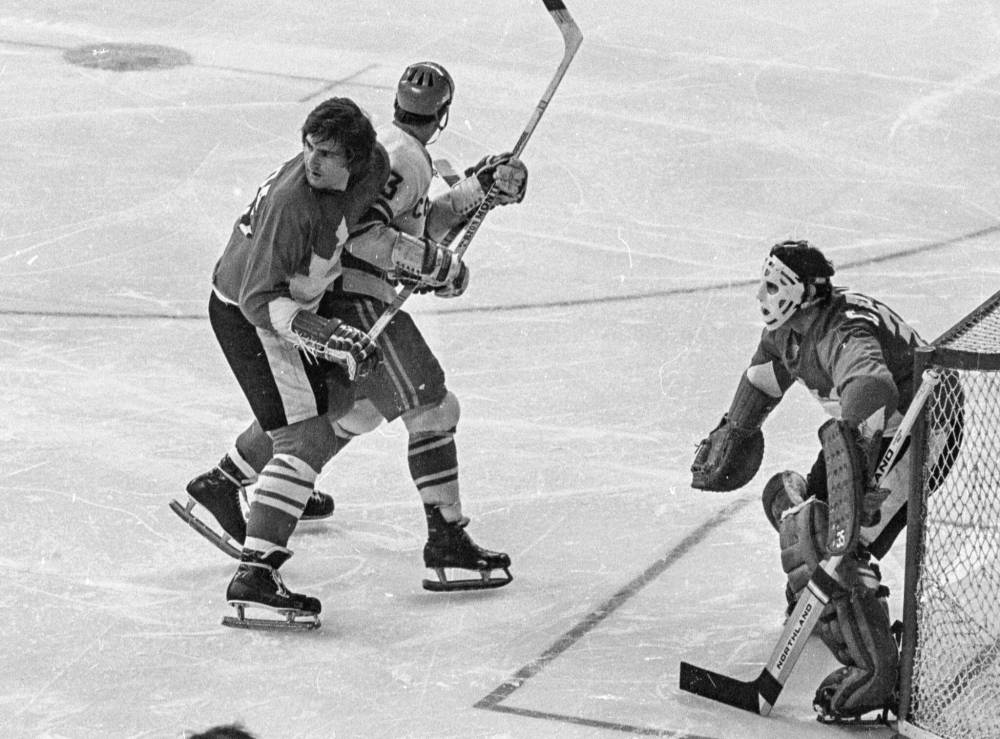
Things were finally starting to unfold on Sept. 6, 1972 as most hockey observers had expected as the Canadians built a pair of two-goal leads, 3-1 and 4-2, in the second period in front of a sold-out crowd of 9,800. The game could have been well in hand had Team Canada not surrendered a pair of short-handed goals, one by Vladimir Petrov and the second by Valeri Kharlamov.
Golden Jet talked himself out of a spot on team
IF Bobby Hull had mustered a few “no comments” at a charity golf tournament in July 1972, he might have been skating for Team Canada at the Winnipeg Arena two months later rather than sitting in the stands signing autographs.
The highest-profile — by far — poaching by the newly minted World Hockey Association, Hull had played in the annual golf tournament hosted by legendary broadcaster Danny Gallivan in Nova Scotia on July 7. After the final putt had been sunk, Hull answered questions from a few reporters.
IF Bobby Hull had mustered a few “no comments” at a charity golf tournament in July 1972, he might have been skating for Team Canada at the Winnipeg Arena two months later rather than sitting in the stands signing autographs.
The highest-profile — by far — poaching by the newly minted World Hockey Association, Hull had played in the annual golf tournament hosted by legendary broadcaster Danny Gallivan in Nova Scotia on July 7. After the final putt had been sunk, Hull answered questions from a few reporters.
He had been warned earlier by Team Canada officials to keep things quiet until the roster was formally announced a few days later but he let it slip that he had been asked to play in what was being billed as the “Super Series” against the Soviet Union.
Hockey Canada had already approved four WHA players on the roster — Hull, defencemen J.C. Tremblay (Quebec Nordiques), forward Derek Sanderson (Philadelphia Blazers) and goalie Gerry Cheevers (Cleveland Crusaders).
“My feeling was if we got him on the team, they’d have a hell of a time getting him off. He would have been on the team. We could have defended him and convinced the NHL,” says Alan Eagleson, the off-ice face of the eight-game event between hockey’s super powers.
“I knew what the NHL reaction was going to be. (NHL president) Clarence Campbell blew his top.”
Indeed, the NHL announced immediately that none of its players would be allowed to play if anybody from the WHA was on the roster. Hull and the other rebel leaguers had their Team Canada invitations revoked.
Eagleson says there’s no doubt that Team Canada would have been enhanced significantly by Hull and his WHA brethren. In fact, he says, the possible domino effect if they had been allowed to play could have seen Paul Henderson — the most famous member of the squad — on the outside looking in.
“Maybe Henderson doesn’t make the team if Sanderson is there. Bobby Clarke was the last player chosen, too,” he says.
Henderson, of course, became the hero, carving out his spot in hockey history by scoring the winning goals in Games 6, 7 and 8 while Clarke played the villain, two-handing Soviet star Valeri Kharlamov in Game 6, breaking his ankle.
geoffkirbyson@mymts.net
But as the game wore on, the Soviets started giving more ice time to their fourth line of Yuri Lebedev, Alex Bodunov and Viacheslav Anisin. Equipped with a pair of monikers — the “Kid Line” and the “Headache Line” — the trio erased the Canadian lead. Lebedev scored just 72 seconds after Paul Henderson had put the Canadians up 4-2 and then Bodunov pulled the Soviets even with just a minute and a half left in the second frame.
“They were all over us,” Sinden said years later. “I said to Fergie (assistant coach John Ferguson), ‘Who the hell are these guys? Where did they come from?’ They were really good young players who went on to be great players. They ended up tying the game. Fergie was stunned, just like I was.”
Serge Savard, one of the stalwarts on the Canadian blue line, says there’s no question Team Canada should have left Winnipeg with its second win of the series.
“A tie is not good when you’re leading 3-1,” he said, in a recent interview with the Free Press.
The Soviets had surprised virtually everybody by overcoming an early 2-0 lead in Game 1 in Montreal en route to a 7-3 victory. The Canadians recovered two nights later to record a 4-1 win at Maple Leaf Gardens in Toronto.
DAVE JOHNSON / WINNIPEG FREE PRESS FILES Canada vs Russia Summit Series - 1972 Game 3 - Winnipeg September 6, 1972. Today marks the 50th anniversary of the day the Manitoba capital played host to Game 3 of the Summit Series, a (supposedly) friendly competition pitting Canadian professionals from the NHL against Soviet “amateurs.”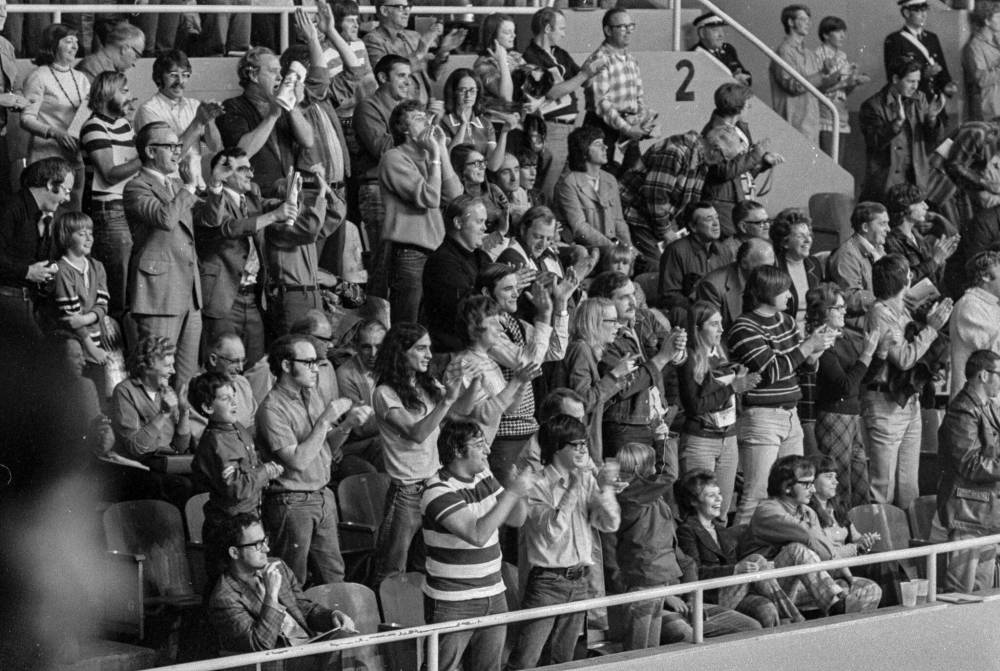
The Canadian players had been very confident — some would supremely overconfident — heading into the series, which saw the first four games held across Canada and the final four in Moscow.
“Everybody told us that we weren’t going to lose a game,” Savard says.
The overconfidence was due to their own ignorance about the quality of players that the Soviet system produced and an extraordinary acting job by those same players during an open practice the day before Game 1, in which they stumbled and bumbled their way through drills.
“They didn’t look that good,” defencemen Pat Stapleton said during an interview in Winnipeg six years ago. “Did they give us the biggest con job ever? They were falling down and they weren’t making their passes. We were set up.”
Stapleton, who dedicated much of his time and efforts in retirement to cementing Team Canada’s legacy, died in 2020 after suffering a stroke.
Neither Savard nor forward Pete Mahovlich was surprised the Kid Line stepped up in Winnipeg. Savard said he really didn’t know who any of the Soviets were but even though they were young, Lebedev, Bodunov and Anisin were hardly strangers to each other. Like the rest of the team, they had been seconded to a year-round hockey camp during which they rarely saw their families.
“All of those players were ready to go,” Savard said.
Mahovlich was used sparingly in Game 3 as his primary role was killing penalties.
“I hit the post twice in Winnipeg,” he said, in a recent chat.
DAVE JOHNSON / WINNIPEG FREE PRESS FILES Canada vs Russia Summit Series - 1972 Game 3 - Winnipeg September 6, 1972. The aftermath of Game 3 proved problematic for Team Canada.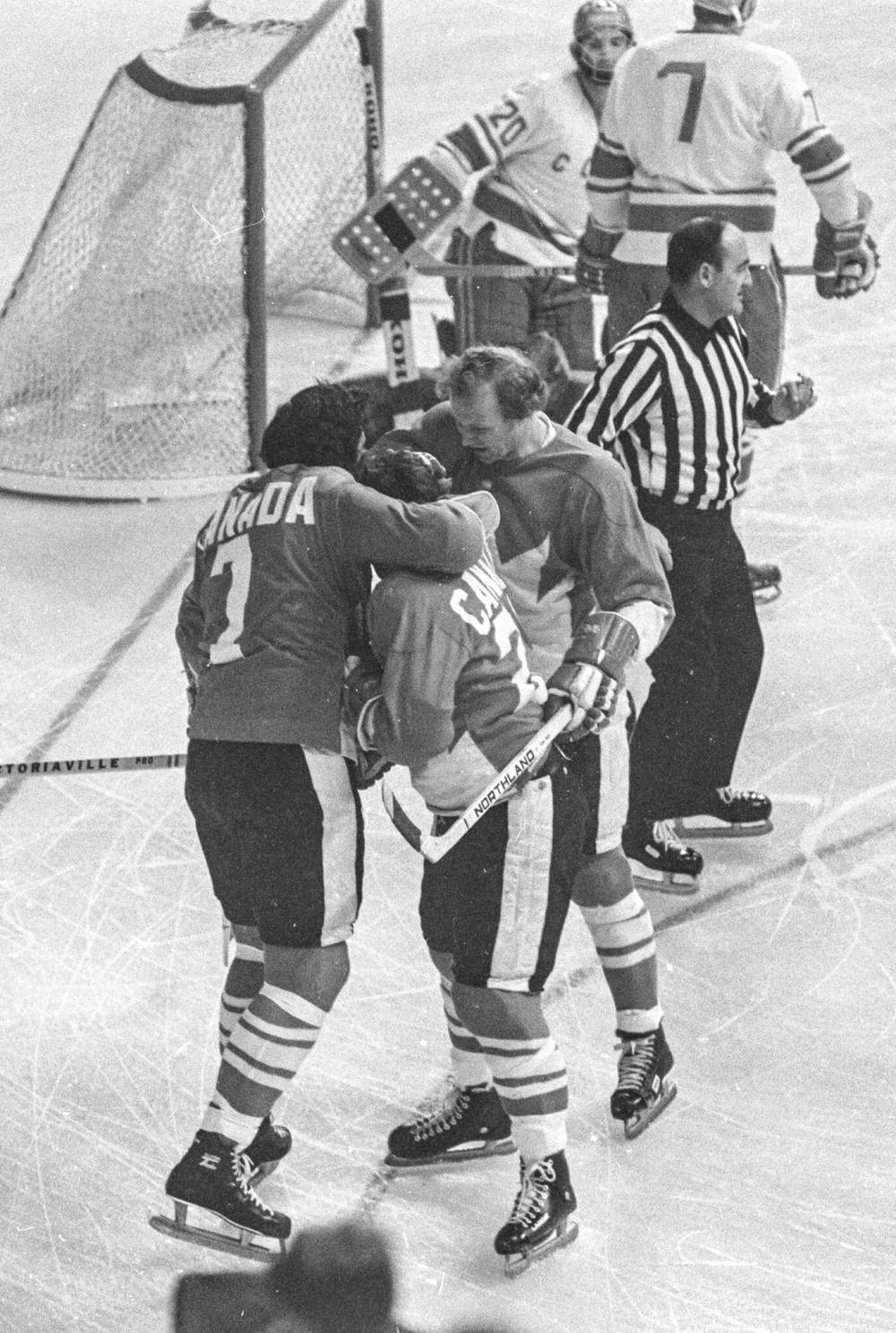
“It was a tight game. We realized these guys were very good. They had the ability to pass and move the puck extremely well. Their system was such that when they got into trouble, they knew they could throw the puck into an open area and they’d have a player there to pick it up. We may have had more shots on goal, but they won the time of possession.”
The aftermath of Game 3 proved problematic for Team Canada in other ways, too. Back when his team was expected to roll to eight consecutive victories, Sinden had promised every player on the 35-man roster they’d get to play in at least one game. In the dressing room following the Winnipeg game, he said he would make good on that pledge two nights later in Vancouver.
The Canadians lost that game 5-3 and were booed lustily by fans at the Pacific Coliseum, prompting Phil Esposito to give his famous post-game interview in which he expressed his disappointment in the fans.
Team Canada lost Game 5 in Moscow before winning the final three contests, including 6-5 on Henderson’s iconic goal in Game 8, to win the series.
Henderson scored the game-winner in the final three victories.
Said Mahovlich: “You can’t be down three games to one with one tie and then win the next three games unless somebody wrote the Hollywood script.”
geoffkirbyson@mymts.net

History
Updated on Tuesday, September 6, 2022 8:45 AM CDT: Adds sidebar, changes to jumbo story format
Updated on Tuesday, September 6, 2022 9:03 AM CDT: Removes Hull photo