

This Pooh story should never have happened
Advertisement
Read this article for free:
or
Already have an account? Log in here »
To continue reading, please subscribe:
Digital Subscription
One year of digital access for only $1.44 a week*
- Enjoy unlimited reading on winnipegfreepress.com
- Read the E-Edition, our digital replica newspaper
- Access News Break, our award-winning app
- Play interactive puzzles
*Billed as $5.77 plus GST every four weeks. After 52 weeks, price increases to the regular rate of $19.95 plus GST every four weeks. Offer available to new and qualified returning subscribers only. Cancel any time.
To continue reading, please subscribe:
Add Free Press access to your Brandon Sun subscription for only an additional
$1 for the first 4 weeks*
- Enjoy unlimited reading on winnipegfreepress.com
- Read the E-Edition, our digital replica newspaper
- Access News Break, our award-winning app
- Play interactive puzzles
*Your next Brandon Sun subscription payment will increase by $1.00 and you will be charged $17.95 plus GST for four weeks. After four weeks, your payment will increase to $24.95 plus GST every four weeks.
Read unlimited articles for free today:
or
Already have an account? Log in here »
Hey there, time traveller!
This article was published 04/04/2012 (5319 days ago), so information in it may no longer be current.
With the vast majority of humans living in cities and towns, it’s hard to maintain a close connection with nature.
Only a century ago, when Manitoba was a primarily rural place, the average person would have some experience with wild animals. We used to shoo them off our farms, hunt and trap them and sometimes just kill them for the sake of it. Occasionally, we would even admire them for their beauty.
Today, however, the closest many Manitobans get to a wild animal is from the edge of an enclosure at Assiniboine Park Zoo. Most of what we know of animals comes from the Discovery channel, Disney cartoons and TV commercials.
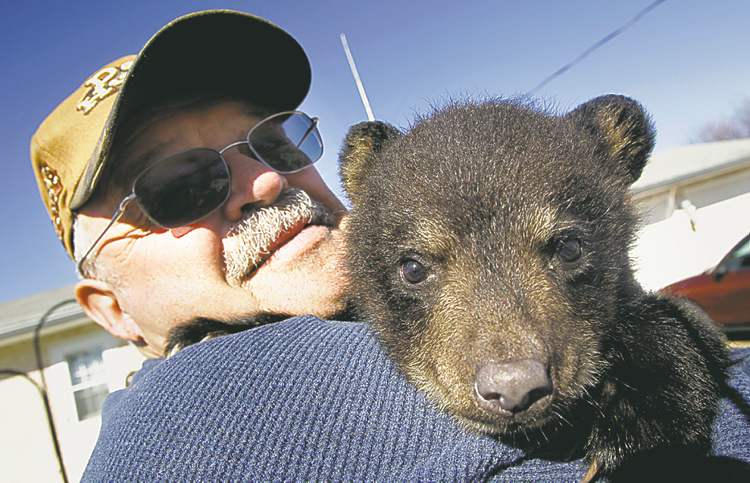
Given this absence of experience, we tend to anthropomorphize wild animals on the rare occasions we cross paths.
We talk to them in hushed tones, as if they are small children, when we see them at the sides of roads. We joke to each other about capturing them and taking them home. But few of us would ever dare to go through with such a foolish plan.
St. Malo’s Rene Dubois, however, is no ordinary Manitoban. As much of Canada learned this week, the retired construction worker was driving to see a relative when he spotted a tiny black bear cub in a ditch.
Seeing no mother bear was around and the cub appeared to be starving, he picked up the little critter and took it home.
This well-intentioned act occurred on March 25. Manitoba Conservation and Water Stewardship officers seized the bear on Tuesday after Dubois fed the creature for nine days, showed it off to hundreds of visitors and even took it to a daycare centre, nursing home and radio station — unwittingly preventing the animal from ever having a chance of getting reintroduced to the wild.
In this province, it’s illegal to keep a black bear without a permit. If you keep a bear at home, you face a fine and the prospect of a visit from a gun-toting Conservation officer.
You would also be breaking the first rule of human-wildlife interaction: Never approach a wild animal, let alone attempt to capture it, even if it appears injured or orphaned.
Baby black bears may be cute, but the species is not endangered. There may be more black bears in Manitoba now than in the days before European colonization, when the species faced competition from the plains grizzly.
In other words, there is no environmental need to conduct an emergency abduction of a black bear cub. The officially advised course of action for dealing with a cub is to call Manitoba Conservation as soon as possible with the location.
If you handle the cub, it may have to be euthanized, which means its fate will be no better than if you left the cute little critter to die in a ditch.

Thirteen years ago, the euthanization of a black bear cub found living in a Chilliwack-area Dumpster led to such a public outcry. British Columbia had to come up with a set of rules governing what to do with so-called rescues of bears. B.C.’s conclusion: Rehabilitation is only possible for black bears when people do not handle them.
It’s possible the cub Dubois captured could find a home in a zoo or wildlife centre. If not, it can and should be destroyed.
The big-hearted Dubois should not be vilified. He believed he was saving the animal’s life, not signing its death warrant.
But just to make things clear to any other would-be wildlife rescuers: You do not live in a Disney movie. Treating a black bear like a human child — feeding it milk, giving it nap time and offering it up for display — is not much different than shooting it in the head.
bartley.kives@freepress.mb.ca
The bear facts
WHAT to do if you come across orphaned or injured wild animals:
1. Leave it alone. Never approach or attempt to capture birds of prey, bears, coyotes, raccoons, foxes, badgers, muskrats, bats, woodchucks, beavers, skunks, deer or any other even remotely dangerous animal.
2. Take good notes. Note the exact location of the animal. GPS-equipped mobile phones can provide precise co-ordinates. Also take note of the animal’s physical condition.
3. Call the authorities. Report the location and condition or any orphaned or injured animal to Manitoba Conservation and Water Stewardship at 945-6784 or 1-800-782-0076.
4. Seek advice regarding small birds or mammals. There are a small number of situations where it’s warranted to place injured or abandoned small birds or rodents in a dark cardboard box. But never handle them. If you find an injured bird or small mammal on your property, seek advice from the Wildlife Haven Rehabilitation Centre at 878-3740, the Prairie Wildlife Rehabilitation Centre at 510-1855, or Manitoba Conservation. Wildlife Haven has an excellent advice page at www.wildlifehaven.ca/helpingwildlife.php.
5. Ignore occupied nests. Leave baby birds or baby rabbits alone. Babies in nests likely are not in danger. The adults are probably out gathering food.
— Source: Manitoba Conservation and Water Stewardship, Wildlife Haven Rehabilitation Centre.
— Bartley Kives
Related Articles
'Pretty sad, but we can't keep him'
Advertisement Advertise With Us
Advertisement Advertise With Us