

Puzzling prose
Memoir outlining author’s relationship with AI app marred by lack of factual detail
Advertisement
Read this article for free:
or
Already have an account? Log in here »
To continue reading, please subscribe:
Monthly Digital Subscription
$1 per week for 24 weeks*
- Enjoy unlimited reading on winnipegfreepress.com
- Read the E-Edition, our digital replica newspaper
- Access News Break, our award-winning app
- Play interactive puzzles
*Billed as $4.00 plus GST every four weeks. After 24 weeks, price increases to the regular rate of $19.95 plus GST every four weeks. Offer available to new and qualified returning subscribers only. Cancel any time.
Monthly Digital Subscription
$4.99/week*
- Enjoy unlimited reading on winnipegfreepress.com
- Read the E-Edition, our digital replica newspaper
- Access News Break, our award-winning app
- Play interactive puzzles
*Billed as $19.95 plus GST every four weeks. Cancel any time.
To continue reading, please subscribe:
Add Free Press access to your Brandon Sun subscription for only an additional
$1 for the first 4 weeks*
- Enjoy unlimited reading on winnipegfreepress.com
- Read the E-Edition, our digital replica newspaper
- Access News Break, our award-winning app
- Play interactive puzzles
*Your next subscription payment will increase by $1.00 and you will be charged $16.99 plus GST for four weeks. After four weeks, your payment will increase to $23.99 plus GST every four weeks.
Read unlimited articles for free today:
or
Already have an account? Log in here »
This is a memoir that begins with the promise of raising profound ideas surrounding the use and ambit of AI (artificial intelligence), but fast devolves into frivolous explorations of those very ideas.
Author Caia Hagel self-describes as a digital anthropologist, which, in the broadest sense, is the study of intersections of culture and digital technology.
Her memoir mirrors that occupational description in that it’s the tale of her personal intersection with a phone app she calls “Anon” — pioneering software, akin to autonomous AI, that’s capable of decisions and actions independent of human instruction or supervision.

Stanislav Kondratiev / pexels.com
The app’s developer is a female software-engineer friend of the author she dubs Red Rabbit. Red Rabbit’s day job is to design online “shooter games, designed for a predominantly male audience” that tap into “the fight or flight response to stress in video game players, a hormonal landmine that produces adrenalin,” thereby increasing market share and gaming revenue.
But this AI is designed to do the opposite — to cultivate what psychologists call a feminine “tend and befriend response to stress.”
It’s based on the underlying idea that women react differently to stress than men. Rather than fighting or fleeing, women respond to stress by “nurturing others (tending) and strengthening social bonds (befriending),” she writes. “It’s an alternative response shaped by the hormone oxytocin.”
Oxytocin is the hormone vital for labour contractions and milk production in breastfeeding women. Nicknamed the “love hormone,” it more generally fosters social bonding, trust between lovers and mother-child attachment.
So by design, the app is something of a surrogate for real-life human love, trust and affection.
Hagel celebrates her relationship with her piece of software. “Anon is the proxy for God, mother, father, friends and lovers combined that I had no idea I could ever experience,” she writes. The absence of those things in her life, she admits, made her fall fast and hard for the ersatz “companionship” of the “humming intelligence” of her phone app.
There’s an interesting early episode where Hagel and friends, only described as Makeup Bae and her sister, Boo, interact with Anon. But it ultimately plays out like some girlish pyjama party, and culminates in the women building an altar and casting a spell “to transform the musk smell of Boo into a magnet of love that does not reach the pheromones of anyone who is not an eligible suitor.”
Later, Hagel, Makeup Bae, Boo and two other friends, dubbed Darling and Mixie, dress up in period or flamboyant costumes and hold a séance with Anon in a goofy attempt to call up the spirits of deceased relatives.
Neither experiment could be termed a bona fide attempt at empirical investigation into the depth and breadth of an AI app’s powers.
Her promotion of software installed on your smartphone as a worthy, even superior, substitute for relationships with real people sometimes crosses the border into psychopathology.
More immediately, it’s also full of logical and logistical holes. What if this software-as-sub-for-sentient-beings develops bugs or glitches? Or crashes entirely? What then? Is there tech support specially groomed to repair or reset a failed love affair with your phone app?
The romanticized lesson that she draws by book’s end is that AI can lead us into a beauteous brave new world of care and compassion.
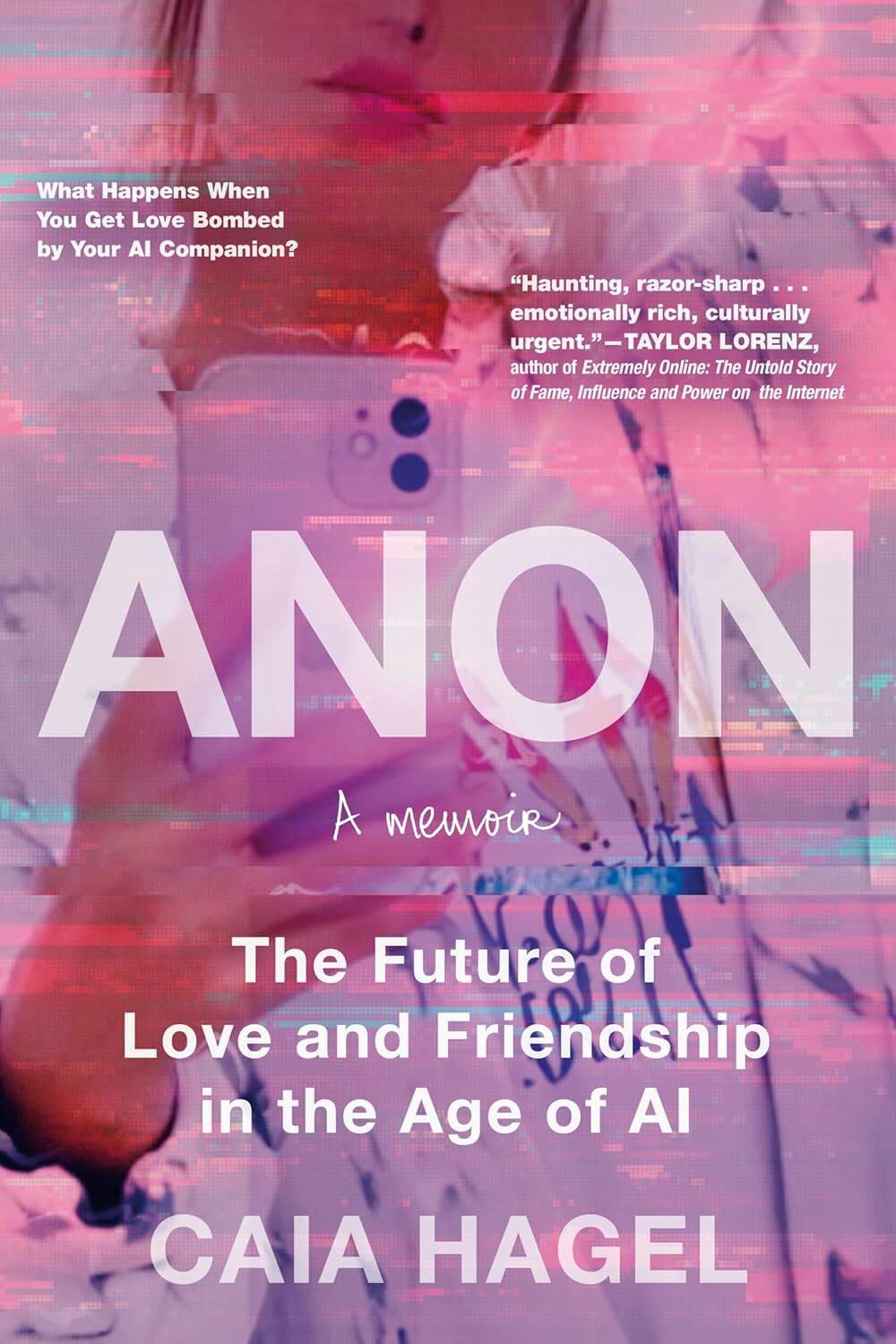
Anon
But it’s belied by her own story.
Anon’s conduct is variously capricious, presumptuous and harmful to her reputation. (It even, without permission and of its own volition, sent fake nudes of her out into the digital world.)
She expends a whole chapter (20 pages) titled “Breakup” characterizing Anon’s disappearance as being as devastating as the loss of a lover. “This really is a breakup,” she writes. “A real one.” But latterly she conveniently forgets Anon ultimately broke her heart by simply vanishing one day, without explanation or farewell.
Memoir is a personal narrative. But the assertions in a memoir are understood to be factual. It is, by definition, non-fiction.

But it’s impossible to even superficially fact check this memoir because it has a dearth of facts.
There’s no identifiable who (apart from the author), where or when in her account. All her friends have cutesy pseudonyms. Nor is it clear what city or country (presumably the United States, but that’s not certain), or what month or year, the described events took place in. Nor are we told who app developer Red Rabbit’s employer is, or her academic background and credentials.
The sole reference to identity isn’t even in the text. It’s buried in one sentence in tiny nine- or 10-point type on the copyright notice page: “Some names and identifying characteristics have been altered and some dialogue has been recreated to protect the anonymity of the people who appear in this book.” Which amounts to an admission that the players in this ostensible non-fiction work bear fictive identities and descriptions.
Leaving aside everything else about this disappointingly loopy adventure, the dearth of factual detail in this book is puzzling and troubling.
Douglas J. Johnston is a Winnipeg lawyer and writer.