PTE staff past and present reflect on 50 years of theatre
Downtown company evolved from humble beginnings to artistic powerhouse

Advertisement
Read this article for free:
or
Already have an account? Log in here »
To continue reading, please subscribe:

Digital Subscription
One year of digital access for only $205*
- Enjoy unlimited reading on winnipegfreepress.com
- Read the E-Edition, our digital replica newspaper
- Access News Break, our award-winning app
- Play interactive puzzles
*First annual payment billed as $205.00 + GST for one year. This annual subscription will automatically renew at $233.00 + GST every 52 weeks (10% off the regular annual price of $259.35). Offer available to new and qualified returning subscribers only. Cancel any time.
To continue reading, please subscribe:
Add Free Press access to your Brandon Sun subscription for only an additional
$1 for the first 4 weeks*
- Enjoy unlimited reading on winnipegfreepress.com
- Read the E-Edition, our digital replica newspaper
- Access News Break, our award-winning app
- Play interactive puzzles
*Your next Brandon Sun subscription payment will increase by $1.00 and you will be charged $17.95 plus GST for four weeks. After four weeks, your payment will increase to $24.95 plus GST every four weeks.
Read unlimited articles for free today:
or
Already have an account? Log in here »
Hey there, time traveller!
This article was published 26/11/2022 (1411 days ago), so information in it may no longer be current.
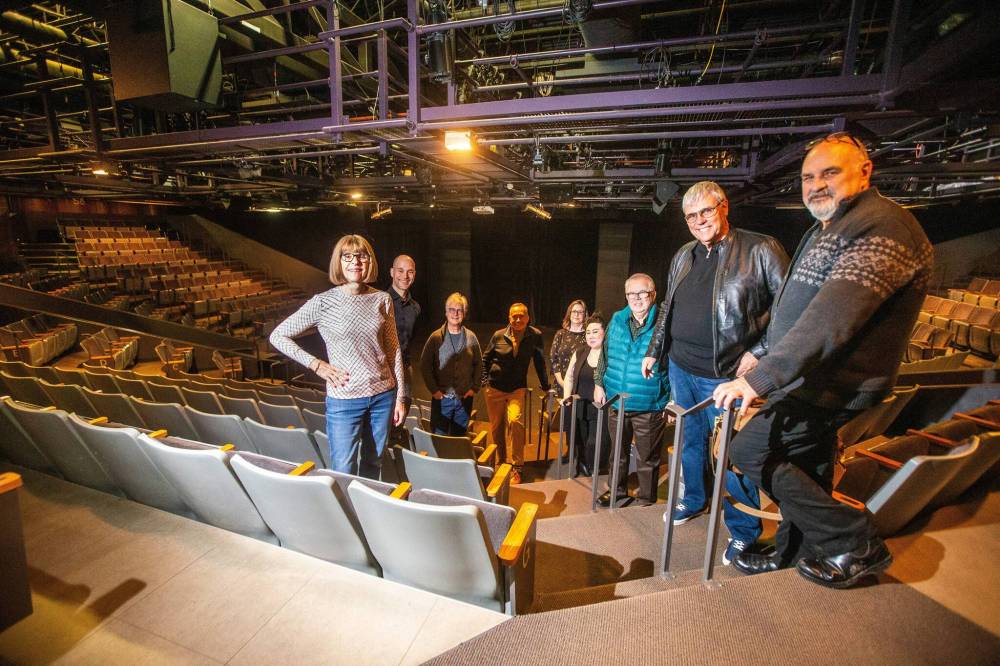
Nine people walked into the Cherry Karpyshin Theatre at Prairie Theatre Exchange Friday morning to pose for a picture, including the woman the room was named for.
The former general manager was surrounded by former artistic directors Colin Jackson — who was the first and also one of the organization’s co-founders — Gordon McCall, Michael Springate, Allen MacInnis and Robert Metcalfe, alongside another former general manager, Tracey Loewen. Current artistic director Thomas Morgan Jones and general manager Lisa Li smiled alongside their predecessors.
Has this group ever been in the same room? “Until this week, probably not,” MacInnis said.
MIKAELA MACKENZIE / WINNIPEG FREE PRESS
Past and present leadership of Prairie Theatre Exchange gather to celebrate 50 years: from left, Cherry Karpyshin, Thomas Morgan Jones, Robert Metcalfe, Allen MacInnis, Tracey Loewen, Lisa Li, Gordon McCall, Colin Jackson and Michael Springate.
They had a lot to talk about. The past, the present, the future. The productions that struck a chord and the ones that landed with a thud. The meaning of theatre. The meaning of life. Their kids and grandkids.
But most of all, they talked about the thread that connected them: a theatre company that started in an Exchange District building on the verge of condemnation.
“It was an enclosed space with a low ceiling and a post in the middle that I always imagined held up the whole building. We had to incorporate it in every show,” says McCall, who succeeded Jackson as AD. “It was wider than it was deep, and yet that was part of the charm of the place.”
“Colin, what did you say last night?” chimed in Metcalfe, who was AD from 2003 to 2018.
“City workers refused to go into it, because it was too dingy and scary,” Jackson said.
“So who would go in?” asked McCall. “Theatre artists.”
Loewen, who left PTE in 2021, said a word that has defined the organization has always been “yes”: there’s a certain buy-in that anyone engaging with PTE must make, she says.
It was in that space where PTE found its footing, working on productions of local and national playwrights such as Wendy Lill, Sandra Birdsell, Alan Williams, Morris Panych, Ted Galay and Kelly Rebar. Under the leadership of AD Kim McCaw, PTE introduced subscriptions. In 1983, 200 were sold. By 1985, that number topped 3,500.
In 1989, having outgrown the facilities on Princess, PTE moved to Portage Place, the then-new mall in downtown Winnipeg. Thirty-five years later, it remains one of the more vital components of the city’s downtown arts scene.
MIKAELA MACKENZIE / WINNIPEG FREE PRESS
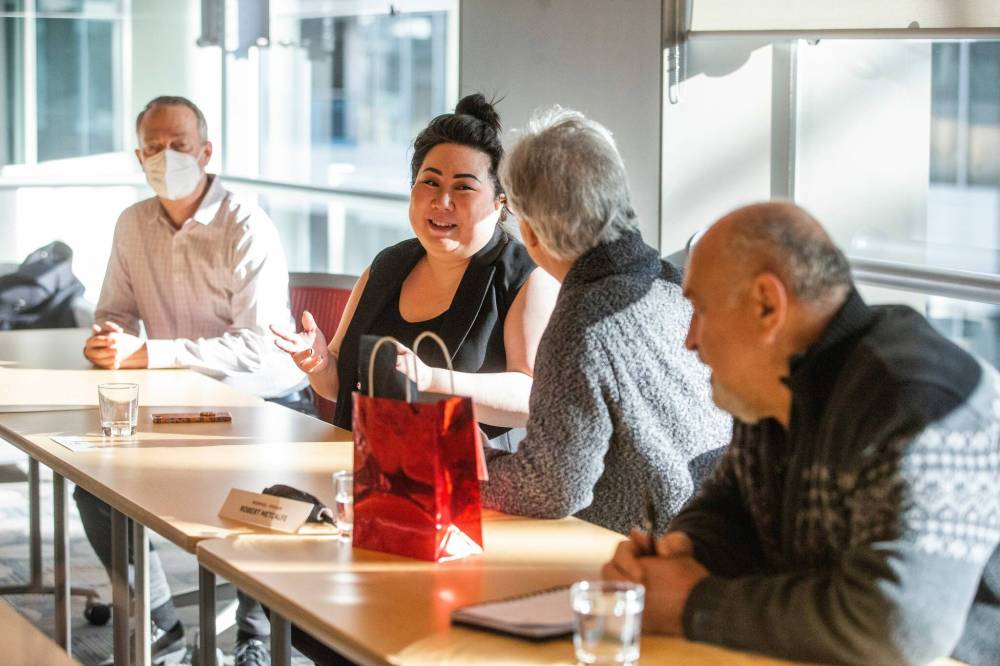
Current managing director Lisa Li chats with past leadership of PTE.
Jones, who became AD in 2018, says something that separates PTE from other places he’s worked is that the audience has a clear stake in the company’s success. MacInnis echoed that notion: after a production of Great Expectations didn’t live up to its title, a longtime subscriber let him know. MacInnis learned to appreciate that the audience members were more than seat-fillers; they helped shape the theatre’s output.
Springate (1992-1995) spoke with great reverence for his time with the company, highlighted by an adaptation of Margaret Laurence’s The Stone Angel, starring Shirley Douglas as Hagar Shipley. “We were told it couldn’t be done,” Springate says. But they did it. They said yes when it would have been simpler to say no.
When Springate says, “My period of time here changed my life,” everyone around the boardroom table nods.
In theatre, change can be good, Metcalfe says, as is some sense of uncertainty. “There’s nothing more anti-art than certainty,” he says.
If the last few years can attest to anything, it’s that performing arts always face uncertainty, which in PTE’s case spurred creative solutions as the pandemic raged. The company produced its first full-length filmed productions, plus digital presentations of shorter works, to stay connected with its audience as it was forced to stay home.
As the theatre industry continues to deal with the instability of the pandemic, companies like PTE must respond to the changing world, Metcalfe added.
Li and Jones say the company is ready to take that on as PTE enters its next 50 years.
“I imagine that we’ve always been responsive to the world in the moment,” Li says. “Theatre is meant to be responsive and urgent and talk about what’s happening. As long as we keep our integrity, keep our focus, I am of the belief that it will work out.
MIKAELA MACKENZIE / WINNIPEG FREE PRESS
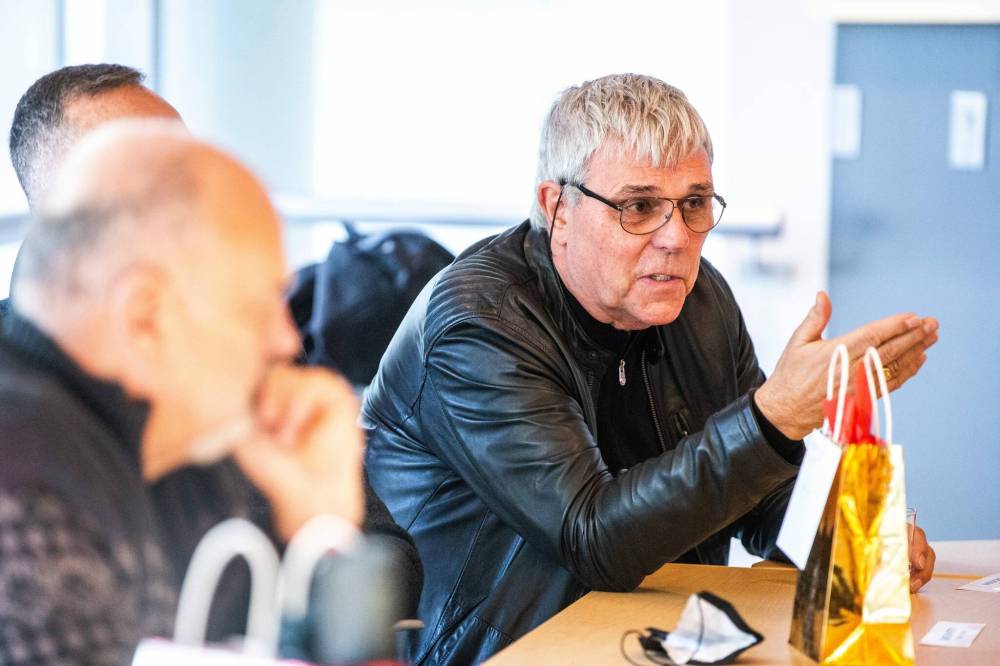
Colin Jackson, artistic director from 1972 to 1980, remembers the ‘dingy and scary’ Exchange District building PTE started in.

“Maybe that sounds a bit Pollyanna, but there is an unknown in theatre,” Li adds. “We sign up for that. If you want to have certainty, you can do something else. So we throw spaghetti, penne or linguini at the wall and see what sticks.
“But you’re doing it with all the knowledge of the last 50 years, and you make your best guess, and hope it works out.”
“We have to listen, we have to notice, and we have to act,” says Jones.
They have to keep saying yes.
ben.waldman@winnipegfreepress.com
Ben Waldman covers a little bit of everything for the Free Press.
Our newsroom depends on a growing audience of readers to power our journalism. If you are not a paid reader, please consider becoming a subscriber.
Our newsroom depends on its audience of readers to power our journalism. Thank you for your support.
How do you fit 50 years of theatre into one room? Ask Carman Johnston.
Johnston, the director of development for Prairie Theatre Exchange, was tasked with that job this year to mark the semi-centennial anniversary of his organization, which began in a crumbling, gritty building on Princess Street in 1972.
That year, Winnipeg’s theatre community was at a pivot point: the Manitoba Theatre School, run by the Manitoba Theatre Centre, was closed down, creating a vacuum in local artistic circles. With great concern, teachers, actors and community members banded together to found the Manitoba Theatre Workshop, which later became known as Prairie Theatre Exchange.
In the ensuing five decades, PTE — which is marking its 50th anniversary with a weekend of nostalgia and theatre — established itself as a central hub of performance and Prairie life. To mark the occasion, Johnston and the rest of PTE staff dove into the archive: 5,000 photographs, hundreds of costumes, handbills, posters, props, and memories telling the story of a once-fledgling company that has become an elder statesperson of Winnipeg’s artistic community.
Inside Portage Place, where PTE has been headquartered since 1989, Johnston and company transformed a small studio into a large shrine to the company’s past.
“Everything we could fit in here is in here,” says Johnston, who joined PTE’s staff in 2002.
He isn’t kidding: the room is bursting with pieces of the past that show off the organization’s range.
In one corner, dedicated to the company’s adaptations of Robert Munsch, Johnston gestures towards a dragon, a paperbag princess dress, and a Fart, each stars of various Munsch stories. In almost every corner is Doreen Brownstone, the legendary Manitoba actor who has starred in more PTE shows than would fit in a paragraph. There is the guitar used in River, based on the music of Joni Mitchell.
The names and works of playwrights, actors, lighting directors, costumers, stage designers all receive proper attention: a stunning example is a fireplace designed by Roger Schultz for a production of The Flyfisher’s Companion. Nearby is a maquette — a miniature stage design — for the Apartheid drama “Master Harold” … and the Boys, expertly crafted down to the finest detail.
As Johnston walks around the room, it becomes quite clear that theatre is an act of community: photographs of cast and crew hard at work mingle with newspaper clippings and reviews, which commingle with sketches of costumes and characters.
It also becomes clear that as time elapses, theatre elongates and stretches itself to fit the freshly established confines of new eras and expectations. In many cases, Johnston’s tour illuminates how theatre can be a proactive voice for social change.
One case in point is the 1981 production of The Ecstasy of Rita Joe, to which a table and small exhibit are dedicated. In Rita Joe, a simple yet powerful creative choice was made: Indigenous actors were cast to portray the play’s Indigenous characters.
“After grasping the perspective that theatre could be an instrument of change and after witnessing (former artistic director Gord McCall’s) courage to embrace change, my world was drastically altered and redirected,” wrote actor and singer Tom Jackson, who made his theatre debut in Rita Joe.
When it came to filling the room, Johnston says it would have been impossible to have included everything. For a theatre company that started out in a dingy building on Princess Street, that’s a beautiful problem to have half a century after its first day.
— Ben Waldman
Ben Waldman covers a little bit of everything for the Free Press.
Our newsroom depends on a growing audience of readers to power our journalism. If you are not a paid reader, please consider becoming a subscriber.
Our newsroom depends on its audience of readers to power our journalism. Thank you for your support.
Related Articles
Warm and fuzzy for Winnipeg winter


Advertisement Advertise With Us
Advertisement Advertise With Us
History
Updated on Monday, November 28, 2022 10:02 AM CST: Corrects first two paragraphs