

Spiritual ascent
Meaning of Mount Everest to Sherpas explored in documentary
Advertisement
Read this article for free:
or
Already have an account? Log in here »
To continue reading, please subscribe:
Monthly Digital Subscription
$1 per week for 24 weeks*
- Enjoy unlimited reading on winnipegfreepress.com
- Read the E-Edition, our digital replica newspaper
- Access News Break, our award-winning app
- Play interactive puzzles
*Billed as $4.00 plus GST every four weeks. After 24 weeks, price increases to the regular rate of $19.95 plus GST every four weeks. Offer available to new and qualified returning subscribers only. Cancel any time.
Monthly Digital Subscription
$4.99/week*
- Enjoy unlimited reading on winnipegfreepress.com
- Read the E-Edition, our digital replica newspaper
- Access News Break, our award-winning app
- Play interactive puzzles
*Billed as $19.95 plus GST every four weeks. Cancel any time.
To continue reading, please subscribe:
Add Free Press access to your Brandon Sun subscription for only an additional
$1 for the first 4 weeks*
*Your next subscription payment will increase by $1.00 and you will be charged $16.99 plus GST for four weeks. After four weeks, your payment will increase to $23.99 plus GST every four weeks.
Read unlimited articles for free today:
or
Already have an account? Log in here »
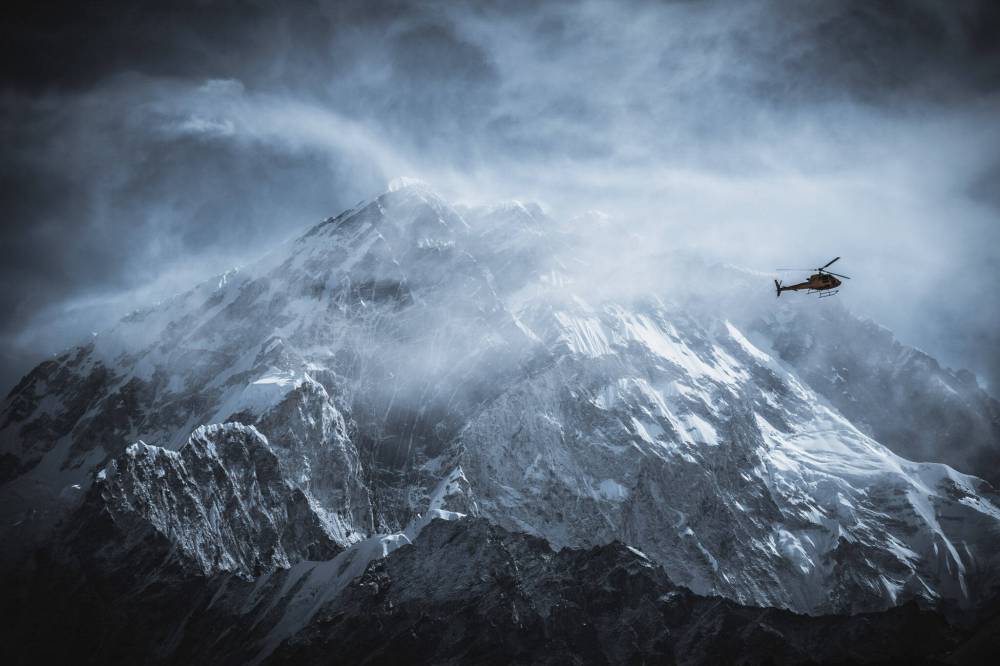
There are an estimated 200 unrecovered bodies on Mount Everest.
For many in the Tibetan Buddhist ethnic community known as Sherpas, this represents a disturbance to the spiritual and natural order.
Not only is the mountain itself a sacred living thing, a corpse left stranded on Everest represents a soul that can’t find peace and end its karmic cycle.
Merit Motion Pictures
A group of Sherpa climbers ascend Mount Everest to bring down a body in order to restore peace to the mountain.
Mingma Tsiri Sherpa, the subject of Canadian-made documentary Everest Dark (produced by Winnipeg’s Merit Motion Pictures and directed by Jereme Watt), is touched by these views.
He comes from a prestigious mountaineering family, who also carry Sherpa as their surname. He’s summited Everest 19 times and he and his brothers hold a Guinness World Record for the most aggregate Everest ascents between siblings.
According to the film’s producer, Merit Jensen Carr, his father was a mail carrier for the famous Sir Edmund Hillary who, with his Sherpa guide Tenzing Norgay, was the first to ascend Everest.
The filmmakers could hardly ask for a hero with more mountaineering aura. And yet for years, Sherpa did not set foot on Everest, haunted by a dream that he would die if he climbed again.
This retreat was a great relief to his wife, Chhiring. More than superstition moves her — she knows all too well the risks of Himalayan climbing, which have only increased in recent decades, owing to crowding, climate change and terrain instability.
Early in Everest Dark, however, we see Sherpa consulting with a Buddhist priest. Something has changed in Sherpa’s outlook, and the priest encourages this. Sherpa feels he must climb the mountain again — not out of vanity, but because of a spiritual debt owed.
“(Everest Dark is) the extraordinary story of a man who believes the mountain is sacred, and goes on a life-threatening mission with an elite group of Sherpa climbers to bring down a body from Everest in order to restore peace to the mountain,” says Carr.
A little later in the film, we see Chhiring ecstatic to reach Everest base camp after a 13-day trek. Sherpa has brought his wife along for this length of the journey, and she better understands what drives him.
But the forlorn look returns to her face the next morning when he becomes a distant speck ascending the world’s tallest mountain.
Everest Dark — which is beautifully photographed through aerial and body-mounted cameras, as well as more traditional techniques — is a film sharply aware of the Himalayan climbing industry’s human toll.
Merit Motion Pictures
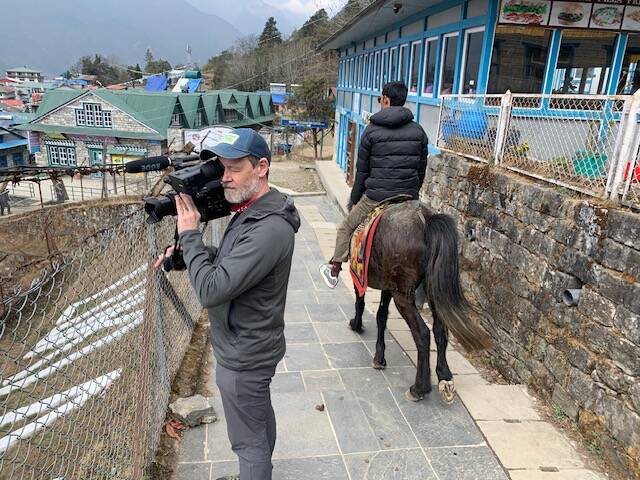
Ivan Hughes was a key cinematographer on the documentary.
“When a Sherpa dies, their family is destitute. Thirty per cent of the bodies are Sherpa bodies. Those climbers usually take no responsibility for those Sherpa deaths,” Carr says.
There’s a saying that the only thing worse for a developing country than being visited by Western capitalism is not being visited by capitalism. The same can be said about Nepal, a country proud of its mountaineering tradition, and both dependent on and exploited by the commercial industry surrounding that tradition.
It brings high risk — and generally lower benefits compared with Western guides — for the Sherpas, who do much of the groundwork and heavy lifting for tourist expeditions of mountains such as K2 and Everest.
“It’s an industry that’s extremely important to the people of Nepal,” says Winnipegger Ivan Hughes, a key cinematographer on the project.
“They do put their lives on the line. They put their livelihoods on the line. They put their family on the line every time they go up, that’s why this film is so important, because it’s told from that perspective.”
Sherpas have also been exploited reputationally — Hillary is remembered rather than Norgay, though the Sherpa was an indispensable partner, arguably far more knowledgeable about Himalayan high-altitude climbing.
Most people also tend to think the term “Sherpa” means guide or helper. In fact, it’s the name of a Nepalese ethnic group, whose members include many of the world’s best climbers.
Rising awareness of commercial climbing’s environmental costs and uneven benefits have helped undo the classic image of the mountaineer as an intrepid Westerner, conquering foreign peaks.
Yet in making the film’s protagonist a Sherpa, Carr says, the project still scared off American funders.
“They all said, ‘Oh yeah, no, we’re not going to tell this story unless you have an American character,’” she says.

Merit Motion Pictures
There are an estimated 200 bodies on Mount Everest; to the Sherpa people, these corpses represent a lost soul.
The film didn’t rely on an American crew either.
“One of the most important things that people can do is hire local crews,” Hughes says. “It was an all-Nepali crew, all local crew. It was Mingma’s trekking company that was involved in getting everyone and all the gear up to base camp.”

The length of time it took to make Everest Dark — about 10 years — proves it was not an easy project. The pandemic and the April 2015 Nepal earthquake, which killed nearly 9,000 people, including 22 on Everest due an avalanche, are backdrops to this film.
It also took time for filmmaker Watt to gain the Sherpa family’s trust — and at least as long for Carr to secure funding for the film, which came from Canadian sources, such as CBC, Telefilm, Manitoba Film and Music and the Canada Media Fund.
“This film is entirely financed in Canada. We had a huge budget. Everybody got behind it. Everybody loved the story,” Watt says.
Sunday’s screening of the film at the Gas Station Arts Centre includes a photo exhibit and is preceded by a Q&A, which Carr hopes will be a chance for audiences to explore some of the film’s more understated themes surrounding the environment, development economics and spirituality.
winnipegfreepress.com/conradsweatman
Conrad Sweatman is an arts reporter and feature writer. Before joining the Free Press full-time in 2024, he worked in the U.K. and Canadian cultural sectors, freelanced for outlets including The Walrus, VICE and Prairie Fire. Read more about Conrad.
Our newsroom depends on a growing audience of readers to power our journalism. If you are not a paid reader, please consider becoming a subscriber.
Our newsroom depends on its audience of readers to power our journalism. Thank you for your support.