

Chinese love letter to cinema a film to be experienced

Advertisement
Read this article for free:
or
Already have an account? Log in here »
To continue reading, please subscribe:
Monthly Digital Subscription
$0 for the first 4 weeks*
- Enjoy unlimited reading on winnipegfreepress.com
- Read the E-Edition, our digital replica newspaper
- Access News Break, our award-winning app
- Play interactive puzzles
*No charge for 4 weeks then price increases to the regular rate of $19.95 plus GST every four weeks. Offer available to new and qualified returning subscribers only. Cancel any time.
Monthly Digital Subscription
$4.99/week*
- Enjoy unlimited reading on winnipegfreepress.com
- Read the E-Edition, our digital replica newspaper
- Access News Break, our award-winning app
- Play interactive puzzles
*Billed as $19.95 plus GST every four weeks. Cancel any time.
To continue reading, please subscribe:
Add Free Press access to your Brandon Sun subscription for only an additional
$1 for the first 4 weeks*
*Your next subscription payment will increase by $1.00 and you will be charged $16.99 plus GST for four weeks. After four weeks, your payment will increase to $23.99 plus GST every four weeks.
Read unlimited articles for free today:
or
Already have an account? Log in here »
In this visionary experiment from Chinese filmmaker Bi Gan (Long Day’s Journey Into Night), dream and film, history and memory come together in a beautiful, shifting kaleidoscope of images.
Resurrection can be unwieldy and opaque — and its biggest thematic ambitions might remain unrealized — but as it explores the ways cinema can transcend space and time, Bi’s super-meta movie is a stylistic and technical tour de force.
Resurrection (in Chinese with English subtitles) starts with a printed statement that humanity now exists in a world where people can achieve eternal life by choosing not to dream. There are dissidents, though, who refuse this option, the text goes on.
Entering the realms of imagination, these so-called “Deliriants” ecstatically burn through their lives, even if this means chaos, pain and death. They are pursued through their dreams by a force of order named the “Big Other.”
The storyline, announced in this stark, emphatic way, might sound too literal, maybe even a bit dorky. But any sense that Resurrection is overdetermined or obvious falls away once Bi gets going, as his swoony love of cinema transforms this simple scenario into something deliriously surreal and strange.
The agent of the Big Other — played by Shu Qi (The Assassin) in an almost wordless performance — first discovers an aged Deliriant slumbering in a celluloid representation of an opium den in Imperial China, a setting that immediately connects cinema to addictive dreaming.
The 25-year-old Jackson Yee, who started as a boy-band singer and whose acting credits include Better Days and A Little Red Flower, plays the Deliriant, hidden at first under chalky rubber prosthetics. His appearance references early movie monsters — a bit of Nosferatu, a little Quasimodo, a touch of Frankenstein’s creature.
The Deliriant is dying, but in an act of mercy — and maybe to satisfy her own curiosity — the Big Other allows him to dream through a hundred years of cinema on the way to his death.
This becomes a series of stories that move through decades of Chinese history, through film genres and through sensory experiences, with sequences exploring sight, sound, taste, smell and touch.
These changing narratives also display Yee’s starling range as an actor, as the Deliriant shifts character and form, becoming a young man hunted by military police during the Second Sino-Japanese war, a melancholic member of a work crew dismantling a Buddhist monastery during the Cultural Revolution and a leather-jacketed, streetwise card sharp in the 1980s.
Bi burns through genres — from German Expressionism to film noir to social realism to a cyberpunk vampire movie set on the eve of Y2K.
He nods to the early film works of the Lumière brothers and Georges Méliès, the sinister shadows of F. W. Murnau, the multiplying mirrors of Orson Welles, the moody poetry of Wong Kar-Wai, the contemporary urban grit of China’s “sixth-generation” filmmakers. And maybe we’re being Winnipeg-centric here, but Guy Maddin’s work echoes through the early sequences.
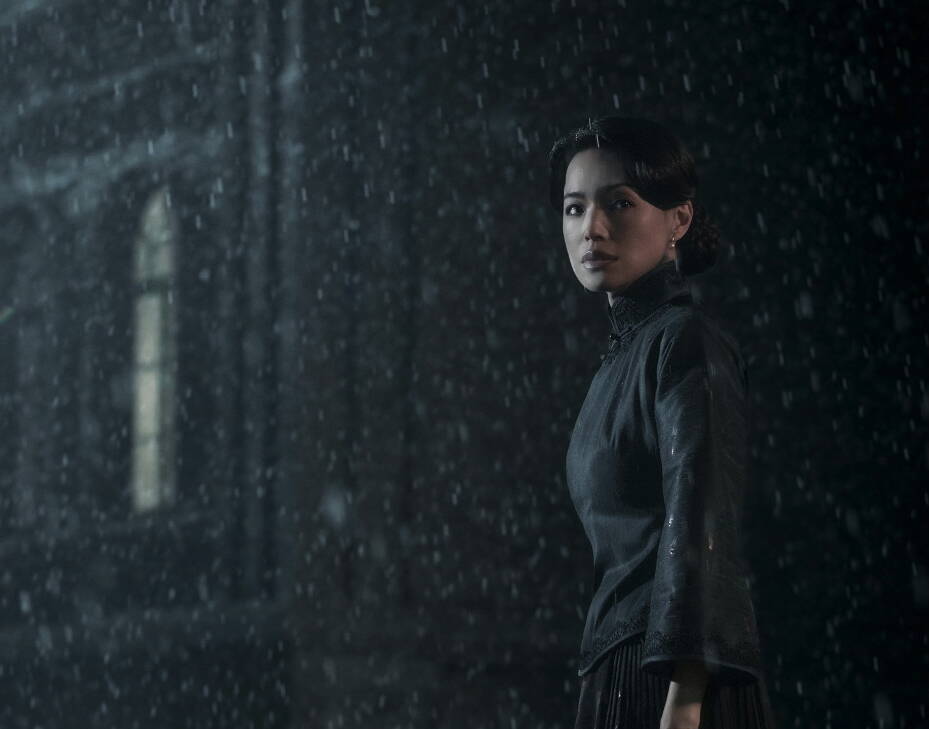
Huace Pictures
Shu Qi delivers an almost wordless performance as an agent of the Big Other.

There are all the things filmmakers love — spiralling staircases and crowded train stations and mysterious suitcases, gangsters and gamblers and plucky orphans, spooky theremin music and ’90s synth, rain and smoke and fog.
Because of Bi’s obsession with the alchemy of the film form, there are screens and light — so much light, showing up as matches, cigarette lighters, streetlamps, spotlights, bonfires and unquenchable nitrate flames.
There are labyrinthine spaces, spectacular and singular images, and tricky technical feats. (Bi is known for his extended tracking shots, and there’s a doozy here.) But there’s also some sense that this glorious too-muchness lacks a thematic throughline, that Bi’s gestures toward the profound and the poetic haven’t quite caught up to his dazzling sense of pure style.
Maybe Resurrection can’t be fully explained, but it can be experienced. Bi shares his aching obsession with film with his viewers, as Resurrection’s final moments explicitly address its audience, asking us to wonder at cinema’s past and ponder its uncertain future.
winnipegfreepress.com/alisongillmor
Studying at the University of Winnipeg and later Toronto’s York University, Alison Gillmor planned to become an art historian. She ended up catching the journalism bug when she started as visual arts reviewer at the Winnipeg Free Press in 1992.
Our newsroom depends on a growing audience of readers to power our journalism. If you are not a paid reader, please consider becoming a subscriber.
Our newsroom depends on its audience of readers to power our journalism. Thank you for your support.
Movie review
Resurrection
Starring: Jackson Yee and Shu Qi
● Dave Barber Cinematheque, to Wednesday
● 160 minutes, not rated
★★★★ out of five
Studying at the University of Winnipeg and later Toronto’s York University, Alison Gillmor planned to become an art historian. She ended up catching the journalism bug when she started as visual arts reviewer at the Winnipeg Free Press in 1992.
Our newsroom depends on a growing audience of readers to power our journalism. If you are not a paid reader, please consider becoming a subscriber.
Our newsroom depends on its audience of readers to power our journalism. Thank you for your support.
Advertisement Advertise With Us
Advertisement Advertise With Us