

Sad-astronaut narrative leaves viewers feeling lost in space

Advertisement
Read this article for free:
or
Already have an account? Log in here »
To continue reading, please subscribe:
Monthly Digital Subscription
$0 for the first 4 weeks*
- Enjoy unlimited reading on winnipegfreepress.com
- Read the E-Edition, our digital replica newspaper
- Access News Break, our award-winning app
- Play interactive puzzles
*No charge for 4 weeks then price increases to the regular rate of $19.95 plus GST every four weeks. Offer available to new and qualified returning subscribers only. Cancel any time.
Monthly Digital Subscription
$4.99/week*
- Enjoy unlimited reading on winnipegfreepress.com
- Read the E-Edition, our digital replica newspaper
- Access News Break, our award-winning app
- Play interactive puzzles
*Billed as $19.95 plus GST every four weeks. Cancel any time.
To continue reading, please subscribe:
Add Free Press access to your Brandon Sun subscription for only an additional
$1 for the first 4 weeks*
*Your next subscription payment will increase by $1.00 and you will be charged $16.99 plus GST for four weeks. After four weeks, your payment will increase to $23.99 plus GST every four weeks.
Read unlimited articles for free today:
or
Already have an account? Log in here »
Hey there, time traveller!
This article was published 24/02/2024 (681 days ago), so information in it may no longer be current.
There’s a new kind of space race going on in movies and TV. It’s the one that pits the “Sad Astronaut” stories against the “Just-Do-It Astronaut” stories.
The model of the former might be 2019’s Ad Astra, in which Brad Pitt is ostensibly searching for a distant space anomaly that threatens to destroy all life on Earth. You might think that would be plenty of motivation for any veteran astronaut. But, no, his underlying reason for accepting the mission is to find his emotionally absent father, who went missing decades ago at the edges of the solar system.
This astronaut doesn’t want to save the world. He just needs emotional closure. In this wacky, magnificently obsessive film, director James Gray explores daddy issues on a grand, intergalactic scale.
Apple+
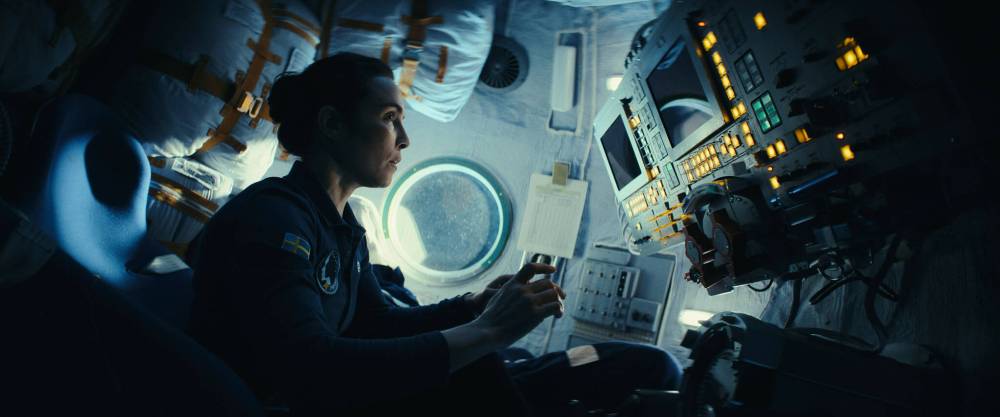
Noomi Rapace as Jo Ericsson aboard the International Space Station in Constellation.
On the more modest Just-Do-It side, we have Matt Damon in 2015’s The Martian. On a future mission to Mars, he gets stranded by a storm and must figure out how to survive alone on the planet with limited resources. “I’m gonna have to science the s—- out of this,” he declares, treating his solitary sojourn as a series of small, practical engineering problems to be solved. This is cheerful, can-do, lunch-bucket astronauting at its best.
Now we have Constellation, an often intriguing, occasionally frustrating new series on Apple TV+. The first episode starts off with a tense, terse extended action sequence, which seems to make it a likely candidate for the Just-Do-It school.
Jo Ericsson (Noomi Rapace) is aboard the International Space Station, where crew members are going about their ordinary daily chores when a catastrophic explosion causes massive destruction to the operating systems and a grisly medical emergency. After responding with tough, gritty, nuts-and-bolts competence, the crew that can fit into the one undamaged Soyuz vessel evacuates. Jo is left alone to make repairs on the second vessel before the oxygen supply runs out. So far, so pragmatic.
When a TV news commentator describes Jo as “literally the loneliest person in the universe,” however, Constellation tips its hand. This might be a Sad Astronaut series after all.
Sure enough, when Jo returns to Earth, she’s not herself. She seems to be slipping in and out of different realities, possibly because of some kind of rip in the space-time continuum that occurred during the accident. And it is motherhood — and her shifting relationship with her precocious daughter — that tests and retests her sense of herself, as the series becomes increasingly slow, moody and mysterious.
Constellation is another addition to the burgeoning sub-genre that emphasizes the emotional and psychological dimensions of space exploration, often in deeply gloomy ways.
In 2014, Interstellar told us that “love is the one thing we’re capable of perceiving that transcends dimensions of time and space.” This emphasis on what space travellers are feeling — their bonds to the loved ones left behind on Earth, the burdens they carry with them into zero gravity — led to what many critics call the Sad Dads in Space genre. Along with Ad Astra, Damien Chazell’s First Man (2018) featured Ryan Gosling as astronaut Neil Armstrong, whose work on the 1969 moon landing is seen as rooted in unresolved grief for a young daughter who died of cancer.
There are sad mothers, too, as in 2013’s Gravity, in which Sandra Bullock struggles to get back to Earth after the space shuttle she’s working on is bombarded by space debris. She’s also dealing with the loss of a child, which has left her emotionally frozen. It’s through fighting to survive, again and again and again, that she recommits to life.
Don’t get me wrong: Acknowledging that astronauts are human beings with families and feelings is a good thing. And there has been a lot of real-world research into the importance of astronauts maintaining their mental health, especially on long missions.
But applying constant emotional temperature-taking to fictional astronauts has had mixed results, even leading to some unintentional comedy in the now-cancelled Netflix series Another Life, which some critics dubbed “Instagrammers in Space.” In this show, Earth is menaced by a crystalline structure that is somehow connected to a distant star. As our planet’s fate hangs in the balance, the space crew sent to investigate is inexplicably made up of moody, mutinous 20-somethings.
Apple+
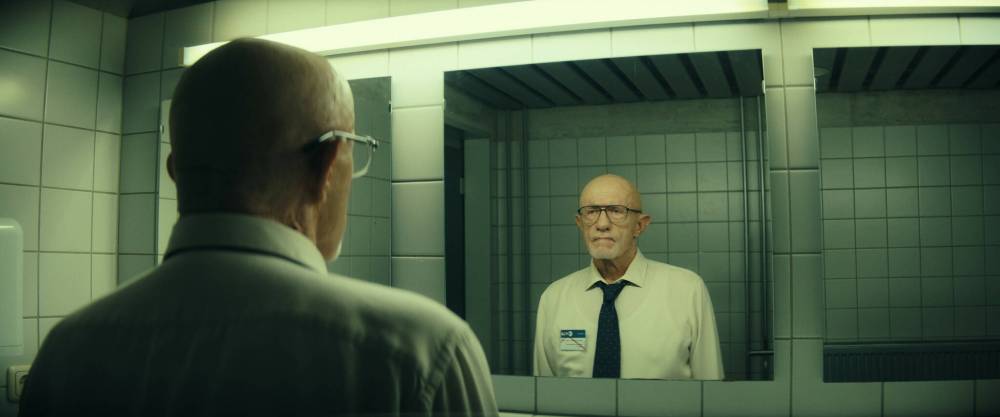
Jonathan Banks
They spend a lot of time whipping up emotional drama like contestants on some kind of intergalactic reality TV show — “Basically, The Real World on a spaceship,” suggests another commentator — and seem a bit aggrieved when they have to do actual astronaut stuff. Now it’s true that twentysomethings don’t want to define themselves by their jobs — a totally understandable attitude down here on Earth. They want work-life balance. But when your job involves literally saving the entire world, maybe just concentrate on the work part, at least for a while.
Space, of course, will always be a metaphor in movies and TV. It’s a vast, dark expanse that can be an emotionally evocative, visually stunning representation of self-discovery. Some of the most influential sci-fi films — the 1972 version of Solaris, 2001: A Space Odyssey, the more recent Arrival — treat the cosmos as an enigmatic, poetic, philosophical realm, as much inner space as outer space.

But when we see space only as metaphor, we can lose sight of the idea that space as space, just in and of itself, is already pretty cool.
Maybe along with this recent spate of dark, angsty, inward-looking astronaut movies and series, we could have just a few more that are expansive and outward-looking, peppy reminders of humankind’s boundless ingenuity and curiosity.
It doesn’t have to be nostalgic. We don’t need more The Right Stuff mythologizing. We don’t need more lantern-jawed, all-American heroes striding confidently in slow-mo.
But as someone who gets weak-kneed during the Apollo 13 scene in which NASA engineers start using their slide rules for emergency calculations, I do wish we could have just a few more astronauts who aren’t quite so mopey.
alison.gillmor@freepress.mb.ca
Studying at the University of Winnipeg and later Toronto’s York University, Alison Gillmor planned to become an art historian. She ended up catching the journalism bug when she started as visual arts reviewer at the Winnipeg Free Press in 1992.
Our newsroom depends on a growing audience of readers to power our journalism. If you are not a paid reader, please consider becoming a subscriber.
Our newsroom depends on its audience of readers to power our journalism. Thank you for your support.
Studying at the University of Winnipeg and later Toronto’s York University, Alison Gillmor planned to become an art historian. She ended up catching the journalism bug when she started as visual arts reviewer at the Winnipeg Free Press in 1992.
Our newsroom depends on a growing audience of readers to power our journalism. If you are not a paid reader, please consider becoming a subscriber.
Our newsroom depends on its audience of readers to power our journalism. Thank you for your support.
Advertisement Advertise With Us
Advertisement Advertise With Us