Props for 50 Small studio turned into a large shrine to the PTE's past

Carman Johnston, the director of development for Prairie Theatre Exchange, was tasked with the job this year to mark the semi-centennial anniversary of his organization, which began in a crumbling, gritty building on Princess Street in 1972.

Read this article for free:


By clicking the button above, an account will be created and you will begin to receive some of our recommended newsletters. You may opt out of any newsletter by visiting your Email and Communication Preferences page or by clicking "unsubscribe" at the bottom of any email.

or

Already have an account? Log in here »

To continue reading, please subscribe:

Subscribe and receive a limited-edition Free Press branded hat or tote.

Digital Subscription

One year of digital access for only $205*

  • Enjoy unlimited reading on winnipegfreepress.com
  • Read the E-Edition, our digital replica newspaper
  • Access News Break, our award-winning app
  • Play interactive puzzles

*First annual payment billed as $205.00 + GST for one year. This annual subscription will automatically renew at $233.00 + GST every 52 weeks (10% off the regular annual price of $259.35). Offer available to new and qualified returning subscribers only. Cancel any time.

To continue reading, please subscribe:

Add Free Press access to your Brandon Sun subscription for only an additional

$1 for the first 4 weeks*

  • Enjoy unlimited reading on winnipegfreepress.com
  • Read the E-Edition, our digital replica newspaper
  • Access News Break, our award-winning app
  • Play interactive puzzles
Start now

*Your next Brandon Sun subscription payment will increase by $1.00 and you will be charged $17.95 plus GST for four weeks. After four weeks, your payment will increase to $24.95 plus GST every four weeks.

Hey there, time traveller!
This article was published 03/12/2022 (1411 days ago), so information in it may no longer be current.

Carman Johnston, the director of development for Prairie Theatre Exchange, was tasked with the job this year to mark the semi-centennial anniversary of his organization, which began in a crumbling, gritty building on Princess Street in 1972.

That year, Winnipeg’s theatre community was at a pivot point: the Manitoba Theatre School, run by the Manitoba Theatre Centre, was closed down, creating a vacuum in local artistic circles. With great concern, teachers, actors and community members banded together to found the Manitoba Theatre Workshop, which later became known as Prairie Theatre Exchange.

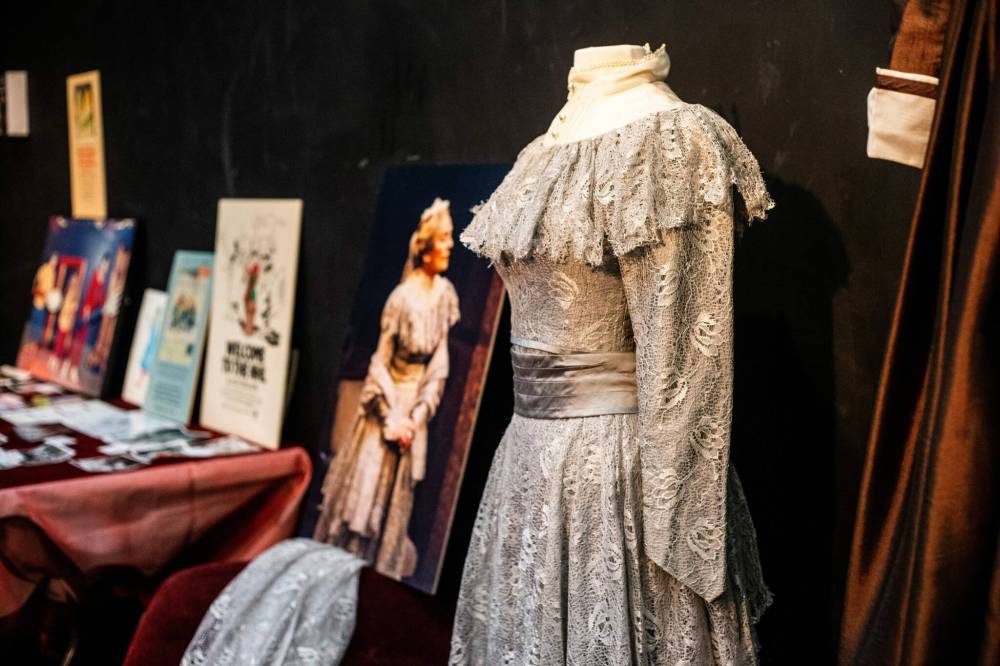
In the ensuing five decades, PTE — which is marking its 50th anniversary this season — established itself as a central hub of performance and Prairie life. To mark the occasion, Johnston and the rest of PTE staff dove into the archive: 5,000 photographs, hundreds of costumes, handbills, posters, props and memories telling the story of a once-fledgling company that has become an elder statesperson of Winnipeg’s artistic community.
MIKAELA MACKENZIE / WINNIPEG FREE PRESS
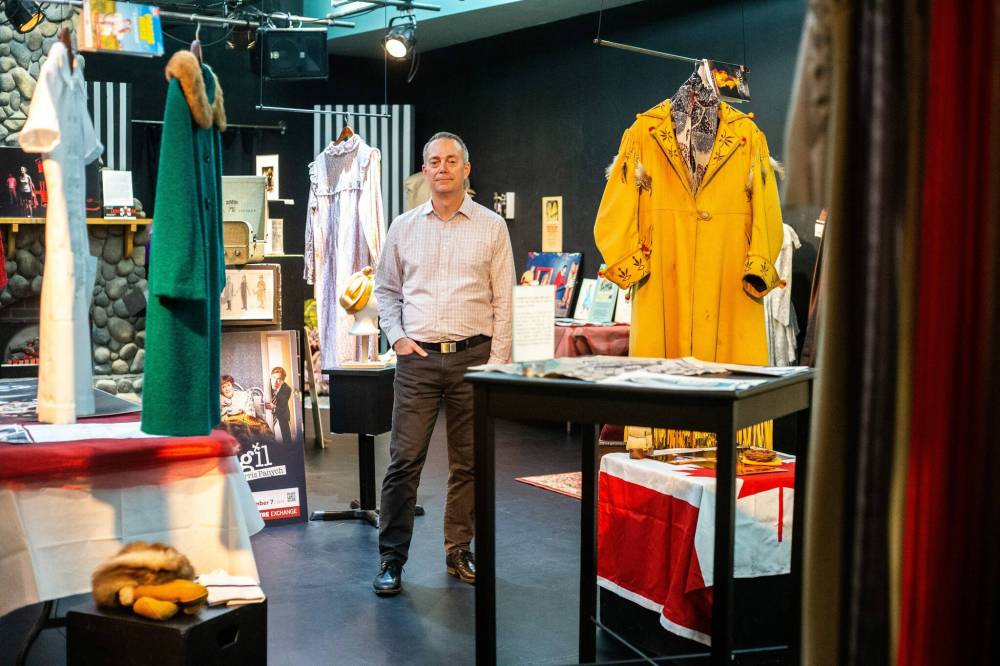
                                Everything we could fit in here is in here,’ says Carman Johnston, director of development for Prairie Theatre Exchange, of the exhibit brought together to celebrate the organization’s 50th anniversary

MIKAELA MACKENZIE / WINNIPEG FREE PRESS

Everything we could fit in here is in here,’ says Carman Johnston, director of development for Prairie Theatre Exchange, of the exhibit brought together to celebrate the organization’s 50th anniversary

Inside Portage Place, where PTE has been headquartered since 1989, Johnston and company transformed a small studio into a large shrine to the company’s past.

“Everything we could fit in here is in here,” says Johnston, who joined PTE’s staff in 2002.

He isn’t kidding: the room is bursting with pieces of the past that show off the organization’s range.

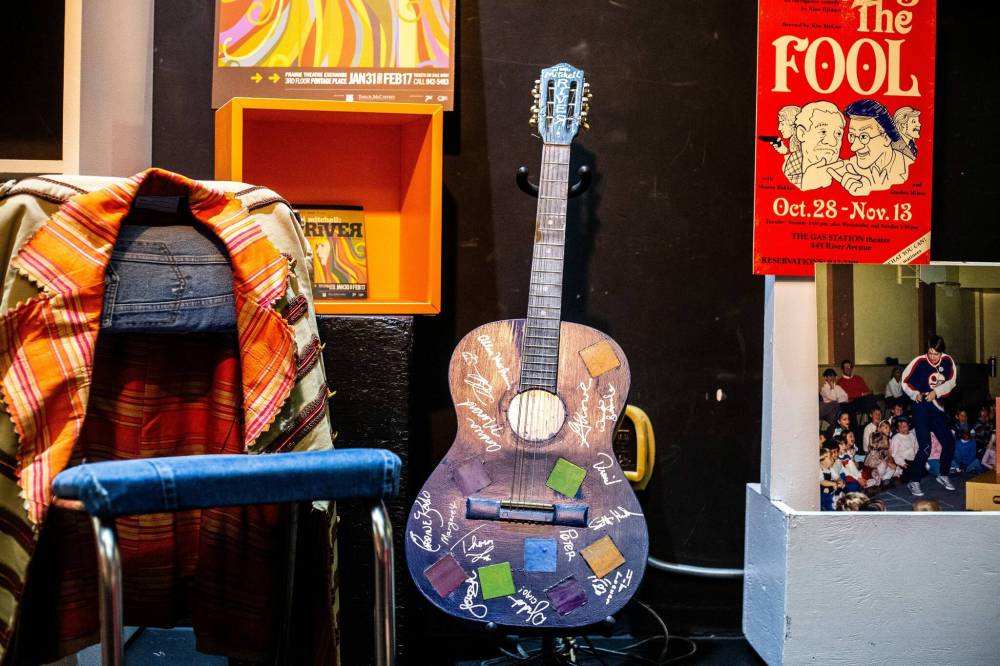
In one corner, dedicated to the company’s adaptations of Robert Munsch, Johnston gestures toward a dragon, a paper-bag princess dress and a Fart, each stars of various Munsch stories. In almost every corner is Doreen Brownstone, the legendary Manitoba actor who has starred in more PTE shows than would fit in a paragraph. There is the guitar used in Joni Mitchell: The River, based on the Canadian icon’s music.

The names and works of playwrights, actors, lighting directors, costumers and stage designers all receive proper attention: a stunning example is a fireplace designed by Roger Schultz for a production of The Flyfisher’s Companion. Nearby is a maquette — a miniature stage design — for the Apartheid drama “Master Harold” … and the Boys, expertly crafted down to the finest detail.

MIKAELA MACKENZIE / WINNIPEG FREE PRESS
                                A hat from the production of Unity (1918).

MIKAELA MACKENZIE / WINNIPEG FREE PRESS

A hat from the production of Unity (1918).

As Johnston walks around the room, it becomes quite clear that theatre is an act of community: photographs of cast and crew hard at work mingle with newspaper clippings and reviews, which commingle with sketches of costumes and characters.

It also becomes clear that as time elapses, theatre elongates and stretches itself to fit the freshly established confines of new eras and expectations. In many cases, Johnston’s tour illuminates how theatre can be a proactive voice for social change.

One case in point is the 1981 production of The Ecstasy of Rita Joe, to which a table and small exhibit are dedicated. In Rita Joe, a simple yet powerful creative choice was made: Indigenous actors were cast to portray the play’s Indigenous characters.

“After grasping the perspective that theatre could be an instrument of change and after witnessing (former artistic director Gord McCall’s) courage to embrace change, my world was drastically altered and redirected,” wrote actor and singer Tom Jackson, who made his theatre debut in Rita Joe.

When it came to filling the room, Johnston says it would have been impossible to have included everything. For a theatre company that started out in a dingy building on Princess Street, that’s a beautiful problem to have half a century after its first day.
MIKAELA MACKENZIE / WINNIPEG FREE PRESS
                                A guitar from the production of Jodi Mitchell: The River.

MIKAELA MACKENZIE / WINNIPEG FREE PRESS

A guitar from the production of Jodi Mitchell: The River.

ben.waldman@freepress.mb.ca
MIKAELA MACKENZIE / WINNIPEG FREE PRESS
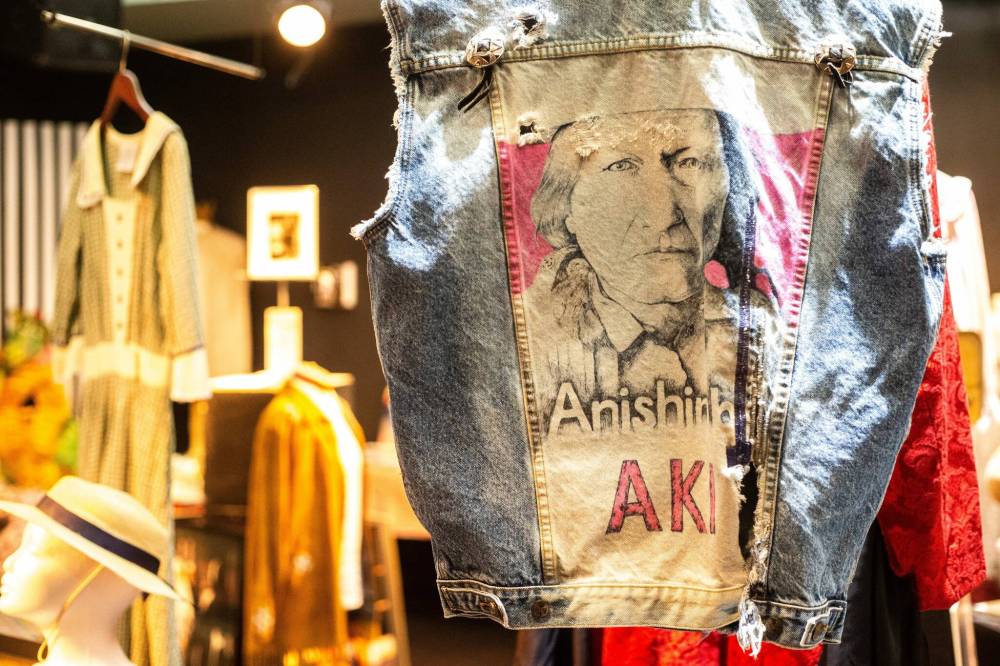
                                A vest from the production of The Rez Sisters.
MIKAELA MACKENZIE / WINNIPEG FREE PRESS

A vest from the production of The Rez Sisters.

MIKAELA MACKENZIE / WINNIPEG FREE PRESS
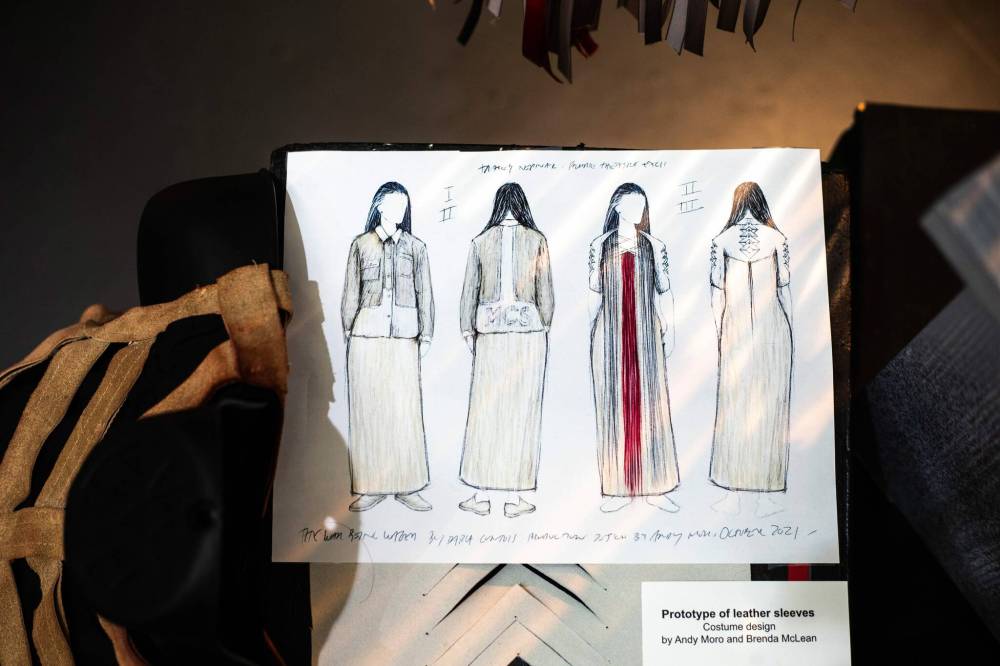
                                Wardrobe sketches from the production of The War Being Waged.
MIKAELA MACKENZIE / WINNIPEG FREE PRESS

Wardrobe sketches from the production of The War Being Waged.

MIKAELA MACKENZIE / WINNIPEG FREE PRESS
                                The 50th anniversary exhibit at Prairie Theatre Exchange.

MIKAELA MACKENZIE / WINNIPEG FREE PRESS

The 50th anniversary exhibit at Prairie Theatre Exchange.

Ben Waldman

Ben Waldman
Reporter

Ben Waldman covers a little bit of everything for the Free Press.

Our newsroom depends on a growing audience of readers to power our journalism. If you are not a paid reader, please consider becoming a subscriber.

Our newsroom depends on its audience of readers to power our journalism. Thank you for your support.

Report Error Submit a Tip

More Stories

‘We know we’re not going to beat Mother Nature’: Ice prep begins at Princess Auto Stadium for Heritage Classic

Mike McIntyre 7 minute read Preview

‘We know we’re not going to beat Mother Nature’: Ice prep begins at Princess Auto Stadium for Heritage Classic

Mike McIntyre 7 minute read 5:56 PM CDT

Derek King typically has ice in his veins.

But the Manitoban admits there may be a few more butterflies than usual as he prepares for the ultimate home game — the 2026 Heritage Classic between the Winnipeg Jets and Montreal Canadiens.

“This is so exciting to be back,” King, the NHL’s vice-president of hockey operations and facilities operations, said Tuesday afternoon.

“It’s definitely going to be a fun event to be part of.”

Read
5:56 PM CDT

White-supremacist highway sign casts pall on Steinbach city council campaign

Matthew Frank 4 minute read Preview

White-supremacist highway sign casts pall on Steinbach city council campaign

Matthew Frank 4 minute read 7:41 PM CDT

The RCMP is investigating a white-nationalist sign near Steinbach with racist messaging and alleged links to a known Canadian far-right group.

A sign hanging on a overpass at the intersection of Highways 1 and 12 read: “STEINBACH VOTES WHITE NOT BROWN,” according to photos posted on social media.

Also written was the name Nationalist-13, a men’s-only neo-Nazi group, also known as NS-13, primarily based in Hamilton, Ont. The Free Press couldn’t independently verify if the group is associated or who hung the sign.

“On Oct. 13, the Steinbach RCMP were made aware of this sign and have opened an investigation,” a spokesperson said in an email statement. They also said the sign has been removed.

Read
7:41 PM CDT

Herd ushers in new era of men’s hoops with roster of newcomers

Joshua Frey-Sam 7 minute read Preview

Herd ushers in new era of men’s hoops with roster of newcomers

Joshua Frey-Sam 7 minute read 7:16 PM CDT

The stage is new. The role, however, is a familiar one to Taven Vigilance.

For the first time since his days as a highly touted high school recruit at Oak Park, Vigilance will be asked to help drive the Manitoba Bisons offence this season.

An elevated role for the 6-7 guard, entering his third year comes as the Bisons turn the page to a new era of the men’s basketball program, having lost all five of its starters from a season ago.

Vigilance spent this summer honing his craft, knowing this opportunity was coming. He focused on his ability to dribble off a screen, in particular, which is a common demand of Bison ball-handlers who need to understand how to decisively read defenders off the pick.

Read
7:16 PM CDT

Biting down on the hard reality of the food business

Eva Wasney 5 minute read Preview

Biting down on the hard reality of the food business

Eva Wasney 5 minute read Wednesday, Nov. 10, 2021

The restaurant industry is beginning to find its footing again after months of upheaval, but should we be celebrating a return to normal? Corey Mintz doesn’t think so.

The Toronto-born food reporter has penned a new book on the pitfalls of the business for those who sell, make, pick, deliver and eat food. The Next Supper: The End of Restaurants as We Knew Them, and What Comes After is the culmination of all the unsavoury things Mintz has learned while working in and writing about restaurants.

“I kind of got to a level of conspiracy theory where the inside of your head… looks like there’s a bunch of red strings and you’re constantly telling people, ‘All these things are related, man, they’re all connected,” Mintz says while sitting in the living room of his Wolseley bungalow. “I felt like, there’s all these things wrong in the restaurant industry and I can’t do it piecemeal — I kind of want to talk about the whole thing, all at once.”

The author moved from Toronto to Winnipeg last summer with his wife and young daughter. It was a long simmering decision spurred on by the realities of pandemic life in a big city.

Read
Wednesday, Nov. 10, 2021

Media Literacy & Learning

0 minute read Tuesday, Oct. 28, 2025

Israel and Palestine: 30 wasted years

Gwynne Dyer 5 minute read 2:00 AM CDT

Here is how the high command of the Israel Defence Forces (IDF) laid down the rules for “remotely” killing suspected Palestinian activists in the densely populated Gaza Strip after the surprise Hamas attack on Israel on Oct. 7, 2023.

Israeli forces were told that up to 20 Palestinian civilians could be killed in a strike against a single suspected member of Hamas, even one of the lowest rank and importance. For a more “senior” Hamas member, the permissible number of non-combatants who could be ‘accidentally’ killed in the process went up to 100.

The order went out only hours after the attack, when there were not yet any IDF troops on the ground in Gaza and all strikes had to be remote, but most strikes have remained remote right down to the present because using drones and artillery keeps Israeli casualties very low.

The drone operators or artillery gunners who delivered the high explosives did not choose the targets themselves. An AI system called Lavender did that, using a network of surveillance devices that generated tens of thousands of likely targets, some known by name, some just “acting suspiciously.” Human operators spent about 20 seconds confirming each one.