Chianti optional Fava beans transformed into tofu thanks to process developed at Winnipeg’s Prairie Research Kitchen

At first glance, the off-white brick looks like any other block of tofu. For staff at Red River College Polytechnic’s Prairie Research Kitchen, however, the unassuming rectangle made from fava beans is a new frontier in plant-based protein and the culmination of years of work.

Read this article for free:


or

Already have an account? Log in here »

To continue reading, please subscribe:

Subscribe and receive a limited-edition Free Press branded hat or tote.

Digital Subscription

One year of digital access for only $205*

  • Enjoy unlimited reading on winnipegfreepress.com
  • Read the E-Edition, our digital replica newspaper
  • Access News Break, our award-winning app
  • Play interactive puzzles

*First annual payment billed as $205.00 + GST for one year. This annual subscription will automatically renew at $233.00 + GST every 52 weeks (10% off the regular annual price of $259.35). Offer available to new and qualified returning subscribers only. Cancel any time.

To continue reading, please subscribe:

Add Free Press access to your Brandon Sun subscription for only an additional

$1 for the first 4 weeks*

  • Enjoy unlimited reading on winnipegfreepress.com
  • Read the E-Edition, our digital replica newspaper
  • Access News Break, our award-winning app
  • Play interactive puzzles
Start now

*Your next Brandon Sun subscription payment will increase by $1.00 and you will be charged $17.95 plus GST for four weeks. After four weeks, your payment will increase to $24.95 plus GST every four weeks.

Hey there, time traveller!
This article was published 07/05/2022 (1591 days ago), so information in it may no longer be current.

At first glance, the off-white brick looks like any other block of tofu. For staff at Red River College Polytechnic’s Prairie Research Kitchen, however, the unassuming rectangle made from fava beans is a new frontier in plant-based protein and the culmination of years of work.

“To the best of my knowledge, this is the first ever commercialized soy-free tofu,” research co-ordinator Kyle Andreasen says. “Getting this product to market has been the highlight of my time here… it’s been really exciting to be part of it.”

The fava tofu is being manufactured and distributed by Big Mountain Foods in Vancouver, but the product has strong local ties. It was developed in the food science lab on the top floor of Red River’s Paterson Global Foods Institute and is made from Canadian beans processed by Prairie Fava in Glenboro.
MIKAELA MACKENZIE / WINNIPEG FREE PRESS
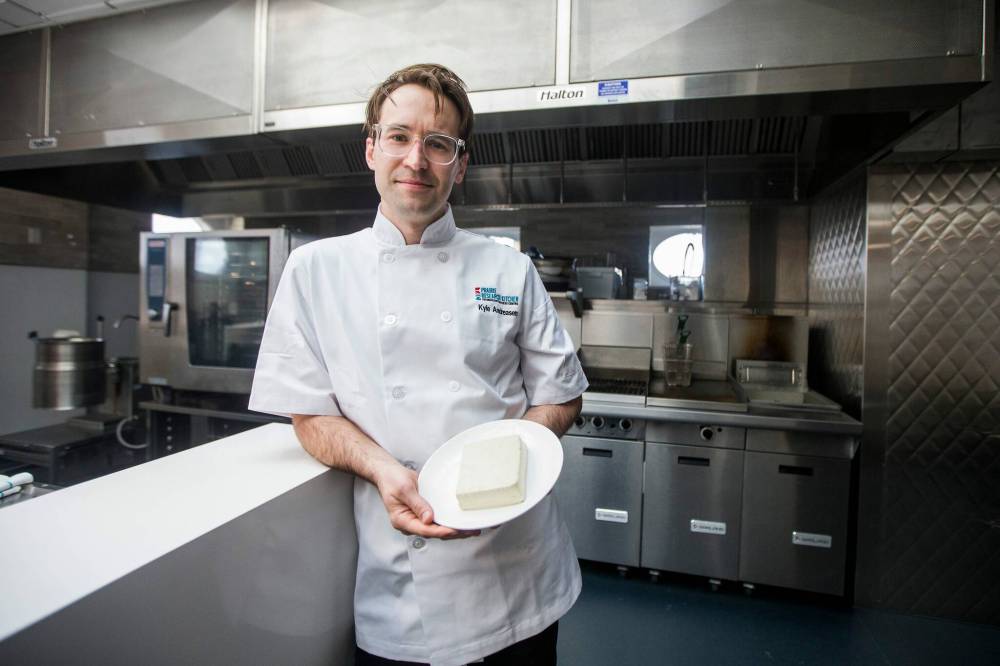
Kyle Andreasen, a chef by trade, is a reseach co-ordinator at the Prairie Research Kitchen at Red River College Polytechnic.
MIKAELA MACKENZIE / WINNIPEG FREE PRESS Kyle Andreasen, a chef by trade, is a reseach co-ordinator at the Prairie Research Kitchen at Red River College Polytechnic.

Soy has long been the standard for plant-based protein, but growing demand has created an opportunity for new beans to enter the market.

“I think it’s important to give people options,” Andreasen says. “Some people have food allergies, some people have preferences.”

While fava beans share a lot of similarities with soy — they’re both high-protein, high-fibre pulses — turning them into tofu is slightly more complicated. Tofu is traditionally made from coagulated soy milk, the curds of which are pressed into a block (similar to cheese-making). Fava tofu follows the same process, although making fava milk is a bit trickier.

“It’s just a slightly different route to get to the same end product,” says Andreasen, adding that the exact methodology is a protected trade secret.

The Prairie Research Kitchen was established in 2013 and is made up of a team of chefs, food scientists and culinary students who work with businesses to create and market new food products. Andreasen, a chef by trade and a graduate of Red River’s culinary program, worked in local restaurants for a decade before taking a job with the research centre to satisfy his curiosity about food development.
MIKAELA MACKENZIE / WINNIPEG FREE PRESS
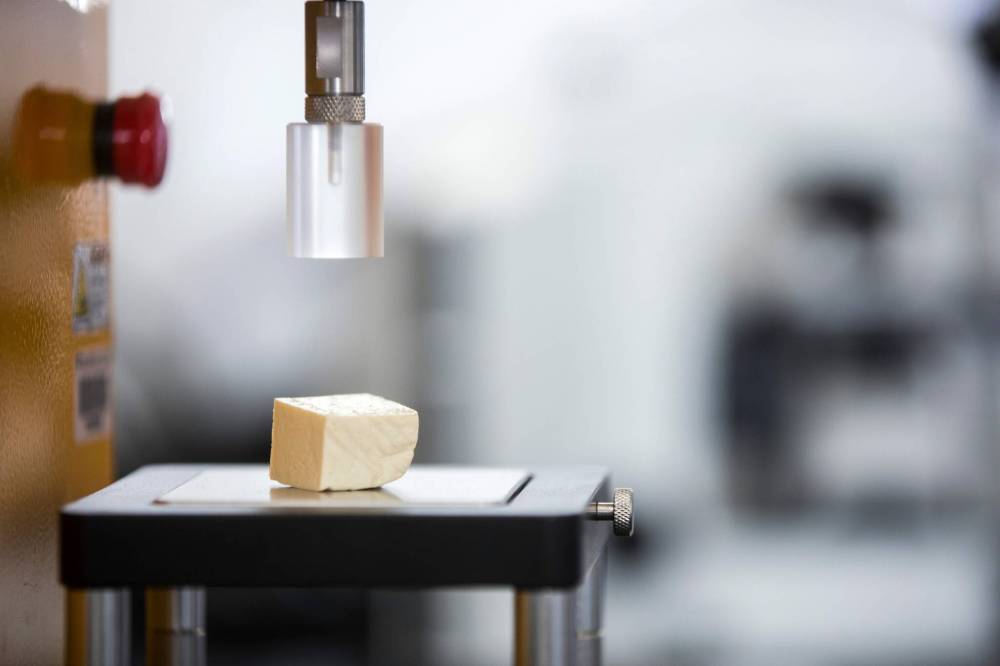
Fava bean tofu sits in a texture-analyzing machine at Red River’s Prairie Research Kitchen.
MIKAELA MACKENZIE / WINNIPEG FREE PRESS Fava bean tofu sits in a texture-analyzing machine at Red River’s Prairie Research Kitchen.

As lead for the fava tofu project, he was tasked with coming up with a formula that was scalable and delicious.

“It doesn’t matter how interesting it is, if it doesn’t taste good and work, it doesn’t matter that it exists,” Andreasen says. Suffice it to say, he’s eaten a lot of tofu over the last two years.

“Some people say that tofu doesn’t taste like anything and I would beg to differ. These ingredients taste like the raw product and I think that fava tofu tastes delicious — it’s a really mild flavour.”

Fava tofu can be prepared and eaten in the same ways as its soy counterparts.

For Hailey Jefferies, co-founder and chief executive officer of Prairie Fava, tofu is a natural next step for a bean she’s been championing since 2016.

Supplied
Prairie Fava, located in Glenboro, processes Canadian-grown fava beans to create flour, split and whole beans, flakes and grits.
Supplied Prairie Fava, located in Glenboro, processes Canadian-grown fava beans to create flour, split and whole beans, flakes and grits.

“At the time plant-based protein was just starting to become quite popular… pea protein was on the rise, and I thought, ‘Why not fava?’” says Jefferies who runs the vertically integrated company alongside her husband Cale’s family farm and seed business, Jefferies Seeds.

Prairie Fava works with contract farmers across Manitoba, Saskatchewan and Alberta to grow their own variety of fava beans, which are then processed at the company’s facility in Glenboro, a municipality 180 kilometres southwest of Winnipeg. The goal is to find new applications for fava, which has, in the past, largely been exported for canning or used in livestock feed.

“Farmers wanted to grow them due to how beneficial they are to the soil — they’re one of the top nitrogen fixing crops,” Jefferies says, referring to a process that allows some plants to pull nitrogen from the air. “But they struggled to find a market for them.”

Prairie Fava produces flour, split and whole beans, grits and flakes that can be used in a variety of food products. Jefferies hopes the new tofu line will get more farmers interested in growing fava beans.

The development of Big Mountain Foods’ soy-free tofu was made possible by an investment from Protein Industries Canada. The product is set to make its grocery store debut this month.

Supplied 
Prairie Fava co-founder and CEO Hailey Jefferies has been championing fava beans since 2016.
Supplied Prairie Fava co-founder and CEO Hailey Jefferies has been championing fava beans since 2016.

eva.wasney@freepress.mb.ca

Twitter: @evawasney

Eva Wasney

Eva Wasney
Arts Reporter

Eva Wasney is a reporter for the Winnipeg Free Press.

Our newsroom depends on a growing audience of readers to power our journalism. If you are not a paid reader, please consider becoming a subscriber.

Our newsroom depends on its audience of readers to power our journalism. Thank you for your support.

Report Error Submit a Tip

More Stories

Dark money drags democracy toward the abyss

Russell Wangersky 6 minute read Saturday, Sep. 12, 2026

There’s an object lesson playing out to the south of us, and not exactly the one you may be thinking about.

It’s not the obvious one of “don’t elect a federal leader who has a clear history of caring about his own grievances before he thinks about the needs of his citizens,” or more simply, “don’t elect someone who is less an agent of change than he is an agent of chaos.”

No, the lesson playing out to the south of us — one likely to have an impact on U.S. midterm elections later this fall as well as the last U.S. presidential election — is that there is a clear danger in allowing dark money to fuel political campaigns.

There are estimates that political action campaigns — or PACs — will once again dump billions of U.S. dollars into the mix, funding advertising campaigns and other political campaign efforts, and steamrolling less-funded efforts.

Mourinho’s return to Real Madrid a classic rebound

Jerrad Peters 6 minute read Preview

Mourinho’s return to Real Madrid a classic rebound

Jerrad Peters 6 minute read Friday, Aug. 14, 2026

Not quite a month ago, nearly two million people lined the streets of Madrid to see the World Cup paraded by the Spanish national team. It might as well have been another lifetime.

By the time the Plaza de Cibeles was swept up and sprayed down, the country’s attention had shifted to the only thing — or person — it seemed anyone wanted to be talking about: José Mourinho.

And they haven’t stopped talking about him. He hasn’t let them.

On June 11, the same day the World Cup kicked off in Mexico City, Mourinho was appointed head coach of Real Madrid for a second time. In his initial stint at the sport’s biggest club, which had ended 13 years prior, he’d won the Copa del Rey his first season, La Liga in his second and nothing in his third.

Read
Friday, Aug. 14, 2026

Letters, Sept. 14

7 minute read 2:00 AM CDT

Transit troubles and passes

Re: Growing pains? Maybe, but it’s worth it, Think Tank, Sept. 10.

Worth it for who? Our transit system has been undergoing growing pains for the past year, ever since city staff completely messed up the system with their redesign.

The net result of those changes is reduced ridership, leading to a projected deficit of $18 million in revenues this year (not including the capital costs of those changes). Add that to the annual $126-million subsidy to operate Winnipeg Transit and that’s $144 million being paid annually by Winnipeg taxpayers.

Today’s horoscope

Georgia Nicols 4 minute read Yesterday at 2:00 AM CDT

MOON ALERT: Caution! Avoid shopping (except food and gas) and important decisions after 9 a.m. today. After that, the moon moves from Libra into Scorpio.

ARIES (March 21-April 19)

Discussions with partners, spouses and close friends will be exciting but unpredictable. You might also meet a real character — someone exciting. Alternatively, someone you know might do something to surprise you. Check moon alert!

TAURUS (April 20-May 20)

Why is Cuba embracing freer markets?

Peter McKenna 5 minute read Preview

Why is Cuba embracing freer markets?

Peter McKenna 5 minute read Friday, Jul. 24, 2026

As long as Donald Trump is entangled in a war with Iran, Cuba is probably safe from being next on his hit list.

But if the mercurial U.S. president can somehow extricate himself from the Persian Gulf trap, then all bets are off. One thing is certain: Trump is not going to give up the idea of getting his greedy hands on the Caribbean island.

In response to Trump’s threats of military invasion, the beleaguered Cuban government is understandably in full panic mode. Right now, it is just trying desperately to keep its head above water as the situation on the ground in Cuba deteriorates further with each passing day.

Not all of the blame for the country’s current humanitarian crisis can be laid at the feet of the Trump White House. The Cuban political leadership deserves its fair share of blame for poor economic and financial management, for too much emphasis on expanding the tourism market, and for not enough attention on modernizing the electrical grid and attracting much-needed foreign investment.

Read
Friday, Jul. 24, 2026

Canada overlooks scores of workers

Krista Carr and Jonathan Lai 4 minute read Wednesday, Jul. 22, 2026

Canada has a labour shortage and a labour surplus at the same time. Canada’s labour force shortages are no longer a temporary challenge. Across the country, “help wanted” signs are everywhere.

A report this spring by RBC Economics said the situation will be exacerbated by retirements and changes in immigration policy.

Employers across the country say they can’t find enough workers. There is a solution, however, that continues to be overlooked. Roughly three-quarters of working-age Canadians with an intellectual disability or autism remain unemployed or underemployed despite being ready, willing and able to work. These two realities should not exist side by side.

For decades, many employers have overlooked this talented and motivated group of workers, often due to misconceptions about workplace accommodations or assumptions about productivity. The result is a labour market that is leaving approximately 500,000 capable individuals on the sidelines while businesses simultaneously report difficulty finding reliable employees.