Concert hall to get $12.5-million renovation

Advertisement

Advertise with us

The Centennial Concert Hall is getting a $12.5-million facelift.

Read this article for free:


By clicking the button above, an account will be created and you will begin to receive some of our recommended newsletters. You may opt out of any newsletter by visiting your Email and Communication Preferences page or by clicking "unsubscribe" at the bottom of any email.

or

Already have an account? Log in here »

To continue reading, please subscribe:

Digital Subscription

One year of digital access for only $1.44 a week*

  • Enjoy unlimited reading on winnipegfreepress.com
  • Read the E-Edition, our digital replica newspaper
  • Access News Break, our award-winning app
  • Play interactive puzzles

*Billed as $5.77 plus GST every four weeks. After 52 weeks, price increases to the regular rate of $19.95 plus GST every four weeks. Offer available to new and qualified returning subscribers only. Cancel any time.

To continue reading, please subscribe:

Add Free Press access to your Brandon Sun subscription for only an additional

$1 for the first 4 weeks*

  • Enjoy unlimited reading on winnipegfreepress.com
  • Read the E-Edition, our digital replica newspaper
  • Access News Break, our award-winning app
  • Play interactive puzzles
Start now

*Your next Brandon Sun subscription payment will increase by $1.00 and you will be charged $17.95 plus GST for four weeks. After four weeks, your payment will increase to $24.95 plus GST every four weeks.

Hey there, time traveller!
This article was published 09/03/2021 (2059 days ago), so information in it may no longer be current.

The Centennial Concert Hall is getting a $12.5-million facelift.

An iconic venue since its construction in downtown Winnipeg in 1967-1968, the concert hall has been home to local institutions such as the Winnipeg Symphony Orchestra, the Manitoba Opera and the Royal Winnipeg Ballet, while welcoming scores of popular performers spanning half a century — from Johnny Cash to Dolly Parton to Drake.

But nearly 53 years since the hall held its opening ceremonies, the building is in need of some key upgrades — namely the removal and reinstallation of 40,000 square feet of stone cladding — hence the province’s award Monday of the hefty renovations tender to Bockstael Construction.
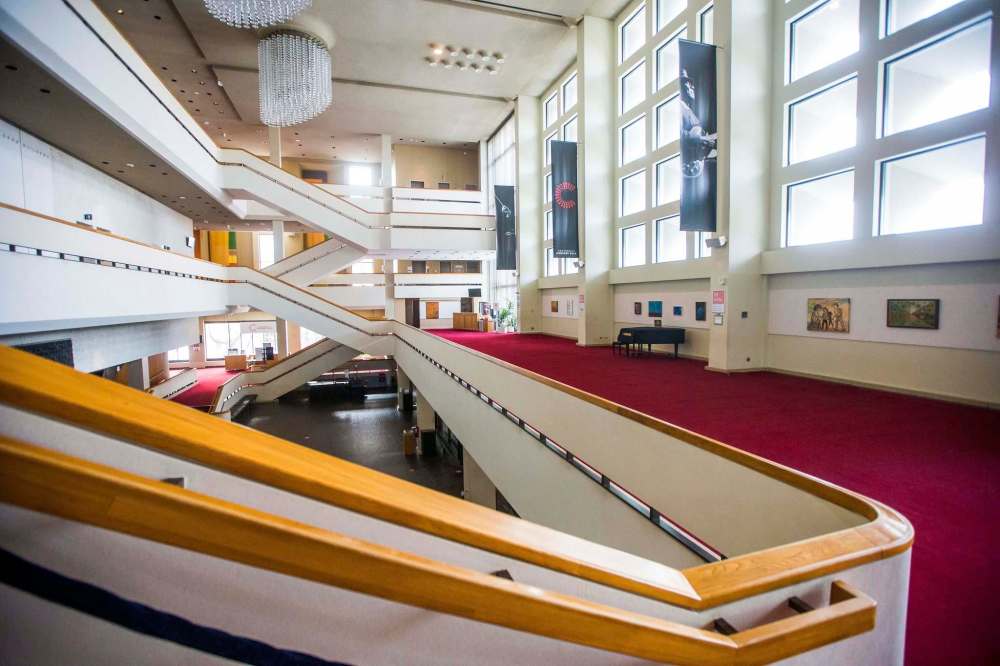
MIKAELA MACKENZIE / WINNIPEG FREE PRESS
The carpet, which will be replaced while the hall is closed, at the Centennial Concert Hall.
MIKAELA MACKENZIE / WINNIPEG FREE PRESS The carpet, which will be replaced while the hall is closed, at the Centennial Concert Hall.

“The concert hall was built more than 50 years ago, and the time has come to restore and reinstall the building’s iconic Tyndall cladding and make upgrades to the roof system, windows and doors,” said central services minister Reg Helwer Monday in a joint release with sport, culture and heritage minister Cathy Cox.

From the top down, the hall will be getting some much-needed renovations, the province said: a new roof drainage system, the remediation of “any hazardous materials as required,” new windows and doors, and the addition of fixed fall-protection infrastructure.

“The investment builds on other work in recent years and will ensure the building will be able to operate for many years to come,” Helwer added.

That work has been ongoing, but over the course of the last year, with public events on hold owing to the COVID-19 pandemic, the concert hall has undergone an extensive series of aesthetic and structural upgrades that otherwise might not have been completed until further in the future.

The nearly 5,000 square-foot Piano Nobile level is having its carpeting removed, with its sublevel of hardwood flooring — an original design feature — getting a restoration. About 50,000 square feet of new carpeting is being installed on the venue’s staircases and hallways, replacing the red carpeting that covered the ground for over three decades. Improved exterior lighting has been installed, as have wall-protecting bumper strips near the back entrance.

Other investments and changes were more directly driven by the pandemic: new touchless washroom fixtures are being installed, and colour-coded doors are meant to control inward and outward flow. Meanwhile, portable backpack foggers have been purchased for disinfection of public spaces before, during, and after events.

As work goes on, Cox said the tender will help the building “maintain its designation as a building with potential historical significance” and “ensure it remains a cornerstone of Manitoba’s cultural community in the years ahead.”

According to the concert hall’s website, the building was conceived as an idea in 1960, aimed at commemorating the country’s centenary and to “initiate a broad scheme of urban renewal” in the Point Douglas area. It was built at a cost of $8 million, with funding from all three levels of government, however the bulk (nearly $7 million) came through private and corporate donations.

It was designed by architecture firms Green Blankstein Russell, Moody Moore and Partners, and Smith Carter Searle and Associates, with renowned American theatre designer George Izenour and pioneering acoustics firm Bolt, Beranek and Newman serving as consultants.

The province anticipates the current renovation project will be complete by 2022, assuming no unexpected delays, and on-budget, presuming no unforeseen costs.

For the time being, the concert hall is not hosting audiences for the performances on its stage. Instead, its tenants are streaming upcoming shows, such as the Royal Winnipeg Ballet’s Visions of Swan Lake, or the Winnipeg Symphony Orchestra’s Mozart, Cimarosa & Bartok, for fans to watch at home.

ben.waldman@freepress.mb.ca

Ben Waldman

Ben Waldman
Reporter

Ben Waldman covers a little bit of everything for the Free Press.

Our newsroom depends on a growing audience of readers to power our journalism. If you are not a paid reader, please consider becoming a subscriber.

Our newsroom depends on its audience of readers to power our journalism. Thank you for your support.

History

Updated on Tuesday, March 16, 2021 8:49 AM CDT: Minor copy editing changes

Report Error Submit a Tip

More Stories

AI and the quiet erosion of human judgment

Rod Lastra 5 minute read 2:00 AM CDT

In 1986, Paul Simon sang of “days of miracle and wonder” in the song The Boy in the Bubble, from his Graceland album. It was hardly a hymn to progress. Scientific ingenuity coexisted with violence and vulnerability. The world was becoming more technologically capable but not necessarily wiser.

Four decades later, I find the sentiment difficult to improve upon. Since ChatGPT’s release in November 2022, predictions about AI have arrived in rapid succession. Sam Altman, Dario Amodei, Elon Musk and others in the tech industry’s so-called “broligarchy” have fuelled recent headlines about approaching “superintelligence” and futures ranging from human flourishing to catastrophe. The advances are real but the predictions often carry more confidence than evidence. The future, it seems, is permanently scheduled for an upgrade.

Yet a more immediate question risks being lost — as AI systems become more capable and we delegate increasingly complex work to them, will our capacity to understand, question and oversee their outputs keep pace?

That question begins with understanding what we are delegating. AI is not a single technology. Specialized systems have helped scientists predict protein structures. ChatGPT relies on general-purpose language models trained on vast datasets. The most advanced systems are often called “frontier models”. They can write, translate, analyze and converse across subjects, but fluency does not guarantee accuracy. Success at one task does not establish competence at another.

Lula’s historic Brazilian election victory

Peter McKenna 5 minute read Preview

Lula’s historic Brazilian election victory

Peter McKenna 5 minute read Yesterday at 2:01 AM CDT

This was supposed to go down as one of the closest presidential elections in Brazilian history — until it wasn’t. In the end, 80-year-old leftist President Luiz Inácio (Lula) da Silva of the Workers Party bested (by some four million votes) Flávio Bolsonaro, the hard-right Liberal Party leader and senator, by a lopsided 3.5 per cent of the popular vote.

Speaking of Brazilian history, it rarely happens that the second-place finisher in the first round ends up winning the second, run-off contest in such a decisive manner. More significant, Lula has now won an unprecedented (non-consecutive) fourth term as an elected Brazilian president.

While Bolsonaro has waffled on making a concession speech (like his father in 2022), the writing on the wall shows clearly that he lost badly. He has evidently taken issue with a ruling by a justice of the Supreme Court that extended polling hours country-wide by an additional two hours in light of high voter turnout and other interruptions.

Flávio’s supporters, many galvanized around the “never Lula” camp, were desperate for change — even if it meant the kind of change that could turn Brazil on its head. So Lula resorted to one of the oldest political tricks in the campaign handbook — namely, using fear of an anti-democratic Bolsonaro to swing voters to his side (along with a host of last-minute announcements involving financial incentives to Brazilians). With a right-leaning Congress, voters were understandably worried that Flávio would go about systematically dismantling Brazil’s democratic ethos and institutions.

Read
Yesterday at 2:01 AM CDT

Construction disruption frustrates

Editorial 4 minute read Preview

Construction disruption frustrates

Editorial 4 minute read 2:00 AM CDT

It’s an all too familiar story.

Small businesses that are already facing all the trials and travails they must regularly face — the hard slog of attracting customers in an internet-shopping world; the high costs for bricks-and-mortar locations, such as rent and insurance; a weak economy; and the difficulties of attracting and keeping staff — suddenly have to deal with a new problem.

The City of Winnipeg and its deathly slow road-construction schedule.

For most of us, it’s a time-wasting irritant. But for businesses facing lengthy street-construction projects, it’s a business strangler.

Read
2:00 AM CDT

One-day conference for health-care technology

Free Press staff 1 minute read Yesterday at 2:01 AM CDT

Indigenous leaders and bioscience professionals are gathering this week to promote health-care technology in northern communities.

Bioscience Association Manitoba is hosting its second annual Indigenous Health Innovations conference on Thursday, a day after the World Indigenous Business Forum ends its Winnipeg tenure.

“We fly a lot of people in the North to get access for care for things that technology can actually give them,” said Andrea Ladouceur, Bioscience Association Manitoba’s president.

For example, Manitobans may hop on a plane for a strep throat test when they don’t need to, she said.

Fact Check

1 minute read Thursday, Nov. 30, 2023

Fact Check

Having problems with the form?Contact Us Directly |

La lang di Michif ta-pashipiikan

By Melissa Martin and Ruth Bonneville 24 minute read Preview

La lang di Michif ta-pashipiikan

By Melissa Martin and Ruth Bonneville 24 minute read Saturday, Sep. 25, 2010

CAMPERVILLE, MAN. -- Seated in the living room of her tiny, impeccably ordered house, Grace Zoldy takes a little girl's hand and begins a language lesson.

"La viande," the woman says, her hazel eyes dancing under a fringe of silver bangs. "That means meat."

"Deux poisson," she says next, a nod to the goldfish circling a nearby tank. The little girl likes to come watch them. "Two fish."

The sounds are familiar to anyone who took elementary-school French. But Zoldy is not French, and her words aren't either: they are something rare, something studied in universities in countries that Grace, when she was learning these words as a toddler in Camperville, didn't know existed.

Read
Saturday, Sep. 25, 2010