Brewing up a new bar
U of M students add malt barley roots to chocolate for nutritious treat
Advertisement
Read this article for free:
or
Already have an account? Log in here »
To continue reading, please subscribe:
Digital Subscription
One year of digital access for only $1.44 a week*
- Enjoy unlimited reading on winnipegfreepress.com
- Read the E-Edition, our digital replica newspaper
- Access News Break, our award-winning app
- Play interactive puzzles
*Billed as $5.77 plus GST every four weeks. After 52 weeks, price increases to the regular rate of $19.95 plus GST every four weeks. Offer available to new and qualified returning subscribers only. Cancel any time.
To continue reading, please subscribe:
Add Free Press access to your Brandon Sun subscription for only an additional
$1 for the first 4 weeks*
- Enjoy unlimited reading on winnipegfreepress.com
- Read the E-Edition, our digital replica newspaper
- Access News Break, our award-winning app
- Play interactive puzzles
*Your next Brandon Sun subscription payment will increase by $1.00 and you will be charged $17.95 plus GST for four weeks. After four weeks, your payment will increase to $24.95 plus GST every four weeks.
Read unlimited articles for free today:
or
Already have an account? Log in here »
The brewing industry isn’t known for being health conscious but, for a team of University of Manitoba students, it was the key to creating a chocolate bar that combines nutrition and indulgence.
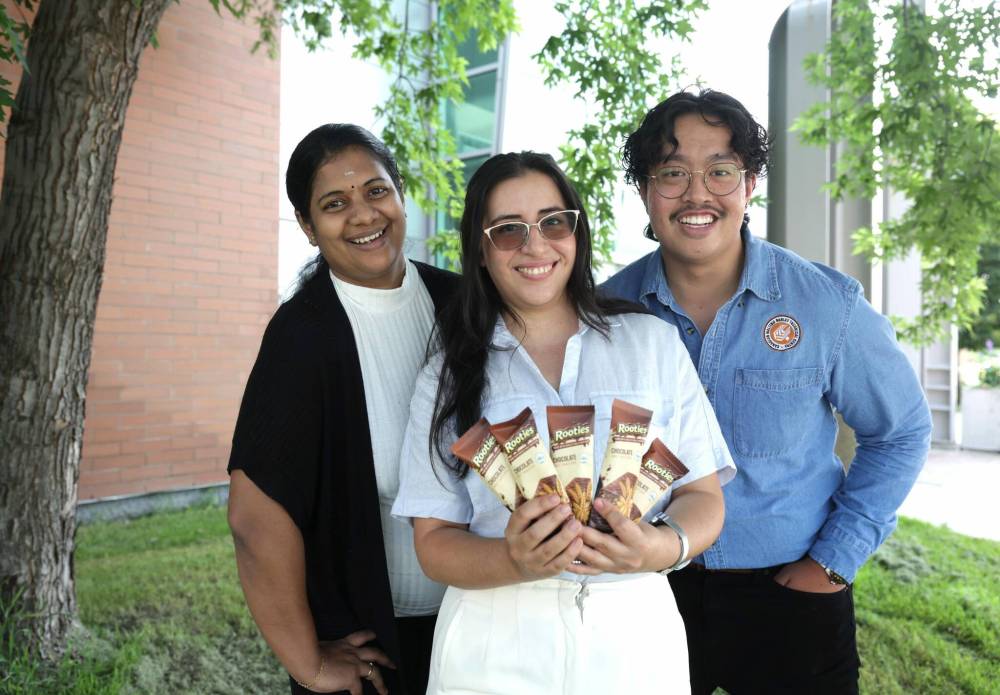
Rooties is a proposed product by food sciences students at U of M that upcycles leftover malt barley roots used to brew beer. The malt increases the chocolate bar’s protein and fibre content, making it a more nutritious option for consumers, said Sherwin Santiano, one of four team members who worked on the product.
“It has a chewy sweet layer, and it has malt barley rootlets infused into the chocolate, similar to a Mars Bar,” he said.
Ruth Bonneville / Free Press
From left: Kemashalini Kirusnaruban, Maria de Los Angeles Garofalo and Sherwin Santiano came up with Rooties chocolate bars, which contain more protein and fibre than other bars.
Rooties is a finalist in an international food development competition run by Mars Snacking in partnership with the Institute of Food and Technologies Student Association. The annual event, called IFT First, selects groups of students from around the world to develop a product and present it to a panel of judges in Chicago.
Santiano said the idea came from him being constantly around malt, since he works with it as part of his full-time job — in research and development at the Canadian Malting Barley Technical Centre — while doing his master’s degree.
Malting is a process that makes raw seeds and cereal grains functional for brewers and leaves a waste product often sold off for feed.
The chocolate bar has four grams of protein per 55 grams — more than any other chocolate bar on the market aside from those with nuts, Santiano said. It also contains 30 grams of carbohydrates and eight grams of fibre.
It took a long time to get the flavour right, since the malts have a grassy taste, Santiano said.
“It was a lot of trial and error,” he said
Each member of the team brought his or her own area of expertise to the table.
Santiano and teammate Santiago Rivera Alba focused on economic challenges they would potentially have manufacturing and marketing the product. Maria de Los Angeles Garofalo focused on developing the nutrition of the chocolate bar, while Kemashalini Kirusnaruban had a major role in planning the manufacturing process.
The team worked collaboratively to design the brown-and-cream-coloured packaging, which depicts the chocolate bar with the malt barley roots in the corner and the Rooties logo above.
The team did a mock presentation of the product for their class Friday in preparation for the competition in Chicago, where they presented Monday.
Because they are the only team presenting a chocolate bar, they expected to be heavily scrutinized by the panel of judges, Santiano said.
“We’re pretty nervous and excited, but I think the tricky part is knowing how we’re going to speak to everyone out there,” he said.
“There’s a potential that they’re going to ask some very difficult questions.”
Each team must explain in detail how they would manufacture and market their product. Then the judges taste the snacks, much like on the cooking-competition show Iron Chef.

The products will not actually be manufactured; the contest is intended as a learning experience for students to come up with new and innovative ideas. Santiano and his teammates hope they can take home the first-place prize of US$3,000 and a mentorship with Mars Snacking.
“Being able to showcase that Manitobans — while there’s a lot of agri-processing that we do here — we also have the opportunity to show that we do actually know a lot of our food science and we could be just as innovative as anyone else,” he says.
The other competing universities include Cornell, Louisiana State, McGill, Pennsylvania State and University of Wisconsin-Madison.
The winner will be announced today.
tiago.resko@freepress.mb.ca