Poilievre might want to tone down glee over slumping economy
Read this article for free:
or
Already have an account? Log in here »
To continue reading, please subscribe:

Digital Subscription
One year of digital access for only $205*
- Enjoy unlimited reading on winnipegfreepress.com
- Read the E-Edition, our digital replica newspaper
- Access News Break, our award-winning app
- Play interactive puzzles
*First annual payment billed as $205.00 + GST for one year. This annual subscription will automatically renew at $233.00 + GST every 52 weeks (10% off the regular annual price of $259.35). Offer available to new and qualified returning subscribers only. Cancel any time.
To continue reading, please subscribe:
Add Free Press access to your Brandon Sun subscription for only an additional
$1 for the first 4 weeks*
- Enjoy unlimited reading on winnipegfreepress.com
- Read the E-Edition, our digital replica newspaper
- Access News Break, our award-winning app
- Play interactive puzzles
*Your next Brandon Sun subscription payment will increase by $1.00 and you will be charged $17.95 plus GST for four weeks. After four weeks, your payment will increase to $24.95 plus GST every four weeks.
Read unlimited articles for free today:
or
Already have an account? Log in here »
It was hard to pin down in exact terms the tone of Conservative Leader Pierre Poilievre’s comments.
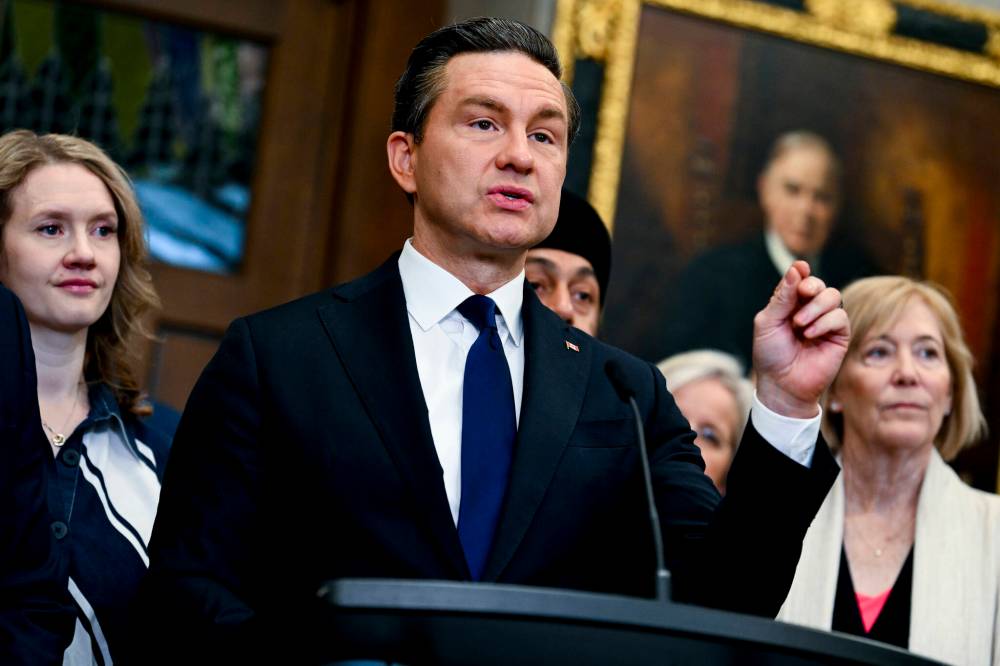
Addressing reporters in Ottawa earlier this week, Poilievre was cranking up the political air-raid siren about a “devastating” report from Statistics Canada showing that the country’s economy had shrunk for two consecutive quarters.
Poilievre said the report confirmed there was a “Liberal recession,” a downturn caused by, and beyond the influence of, a Liberal government. The Tory leader also, without citing examples, complained that many other countries were introducing policies to avoid a recession while Canada was sitting on its hands.
“They’re (the Liberals) building a recession, and they’re building excuses,” Poilievre said later in the House of Commons as his party tried unsuccessfully to trigger an emergency debate.
Poilievre’s tone and expression? It was a mix of glee and bloodlust, much like the excited smirk on the face of a hockey goon who is doing everything they can to bait an opposing player into a scrap. Unfortunately for Poilievre, Prime Minister Mark Carney spent much of the same day smirking like the opposing player who refuses to be baited into that scrap.
The prime minister acknowledged that not only had Canada’s economy slowed down, but he was not surprised about the turn of events. According to Carney, the downturn was the inevitable result of the combined forces of punishing tariffs imposed by the United States, conflict in the Middle East that has played havoc with oil prices, and a dramatic cut in immigration.
“You have these cross-currents as the economy is being fundamentally transformed,” Carney told reporters. “We’re going to continue to work. We’re making progress, but there’s more to be done.”
Poilievre seized on the fact that Carney would not actually say the world ‘recession’ when asked point blank. However, while the Tory leader seems gratified that Canada is in a recession, just about everyone else thinks its way too early to come to that conclusion.
Less politically motivated analysis was provided the day before by Carolyn Rogers, the deputy governor of the Bank of Canada, who said two quarters of contraction qualified as a “technical recession,” but warned against overreaction.
“Two quarters of annualized contraction in GDP does meet one definition of a recession, but simply the fact that you have to put the term ‘technical’ in front of it sort of tells you that you need to really look past that one indicator,” Rogers told a parliamentary committee.
Unfortunately for Canadians, ignoring sober data is one of Poilievre’s greatest strengths.
It’s fair to say that opposition parties and leaders in our parliamentary system always run the risk of sounding like a broken record where everything is bad, the government is at fault, and only God or some other supreme being can save us from these idiots.
Even so, the constant rush to assign political blame to every problem is not just bad for public debate, it’s ultimately bad for the Conservative party.
Poilievre very nearly became prime minister by claiming, without a shred of evidence, that former PM Justin Trudeau had single-handedly triggered the affordability crisis. He constantly claimed that stimulus spending by the Trudeau government had prompted the crushing inflation that came in the years following the COVID-19 pandemic.
None of that was true, but the lofty perch the Tories occupied in opinion polls suggested it was working. Until, you know, it didn’t work.
Take away Trudeau, install Carney, and suddenly Poilievre’s rants fell on deaf ears. The Tory leader lost his Ontario seat in last year’s federal election, and had to win a new seat in Alberta and fight to remain at the helm.
It’s not clear if Poilievre has learned any lessons through that near-death experience. If he had, then he might realize that the whole issue of recession is not safe ground for the Tories. In particular, there is consensus among most economists that deep cuts to immigration — focused on temporary residents — has contributed significantly to the slowdown.
The Trudeau government rushed too quickly to admit more temporary residents to stimulate economic activity following the worst years of COVID-19. When Trudeau pivoted and began reducing the number of temporary workers and international students, there were warnings it would ultimately stall economic growth.
Well, those warnings turned out to be true. Canada’s population shrunk last year for the first time ever, and that has contributed to our precarious economic situation.
The joke here is that Poilievre’s relentless fear-mongering about how immigrants were triggering higher inflation was key to convincing Trudeau to reverse course. Poilievre largely got what he and his party wanted, and now it’s turning into a drag on the economy.
Recognizing that, Poilievre should wait to see if the Carney government collapses with its “stay the course” rhetoric.
A more mature opposition leader would realize that if Canada ends up in an official recession, the Carney government would shoulder a lot of the anger and blame.
That leader might also acknowledge that in some ways, he’s only getting (in part) what he asked for.
dan.lett@freepress.mb.ca

Born and raised in and around Toronto, Dan Lett came to Winnipeg in 1986, less than a year out of journalism school with a lifelong dream to be a newspaper reporter.
Our newsroom depends on a growing audience of readers to power our journalism. If you are not a paid reader, please consider becoming a subscriber.
Our newsroom depends on its audience of readers to power our journalism. Thank you for your support.