Electrifying return
Jeep Cherokee is back from hiatus — as hybrid

Advertisement
Read this article for free:
or
Already have an account? Log in here »
To continue reading, please subscribe:

Digital Subscription
One year of digital access for only $205*
- Enjoy unlimited reading on winnipegfreepress.com
- Read the E-Edition, our digital replica newspaper
- Access News Break, our award-winning app
- Play interactive puzzles
*First annual payment billed as $205.00 + GST for one year. This annual subscription will automatically renew at $233.00 + GST every 52 weeks (10% off the regular annual price of $259.35). Offer available to new and qualified returning subscribers only. Cancel any time.
To continue reading, please subscribe:
Add Free Press access to your Brandon Sun subscription for only an additional
$1 for the first 4 weeks*
- Enjoy unlimited reading on winnipegfreepress.com
- Read the E-Edition, our digital replica newspaper
- Access News Break, our award-winning app
- Play interactive puzzles
*Your next Brandon Sun subscription payment will increase by $1.00 and you will be charged $17.95 plus GST for four weeks. After four weeks, your payment will increase to $24.95 plus GST every four weeks.
Read unlimited articles for free today:
or
Already have an account? Log in here »
Hey there, time traveller!
This article was published 27/02/2026 (192 days ago), so information in it may no longer be current.
WESTLAKE VILLAGE, Calif. — Aside from light-duty pickup trucks, no automotive segment in Canada is bigger than the compact SUV — dominated by such nameplates as Toyota RAV4, Nissan Rogue, Mazda CX-5, Subaru Forester and others.
So it was puzzling when Stellantis pulled the plug on the Jeep Cherokee in 2023. The official line on why speaks volumes even though it appears to say little: “It was a decision taken by the previous management team.”
Well, the vehicle that arguably launched the segment is back, and in a big way. While the Cherokee name was first applied to a full-size, two-door Jeep in 1974, the model most people think about is the compact version launched in 1984.
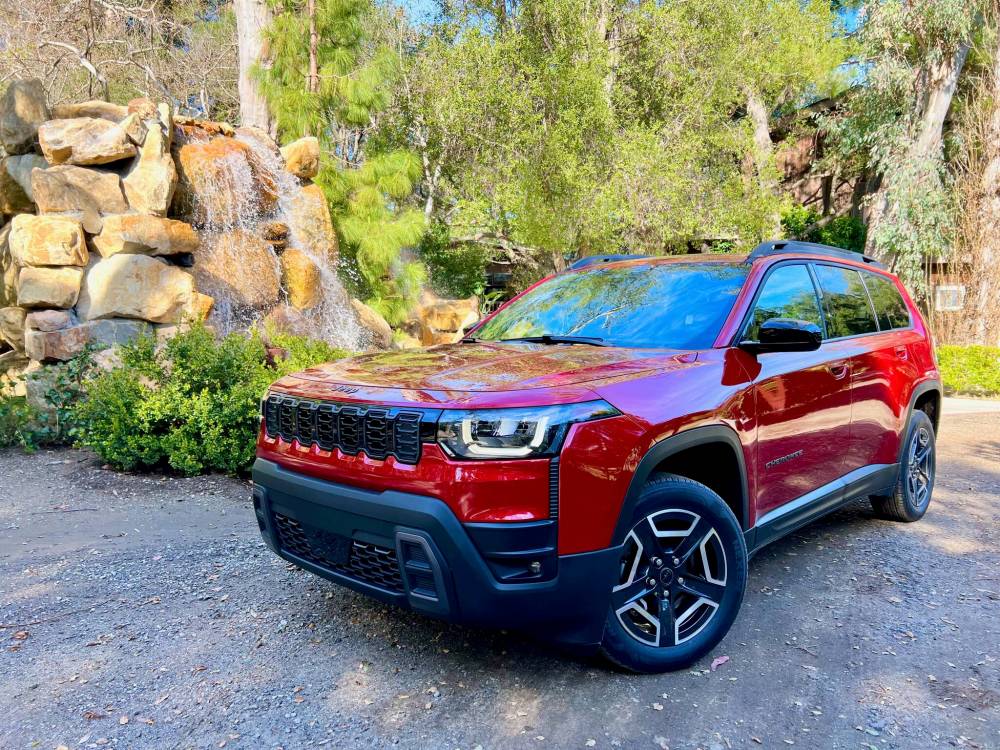
Kelly Taylor / Free Press
Jeep ended the Cherokee compact SUV in 2023 for mysterious reasons. New Stellantis management has revived it, as a hybrid.
The 2026 Jeep Cherokee joins the growing ranks of the partially electric. It is available as a hybrid only.
A 1.6-litre turbocharged four-cylinder is bolted to a combined two-motor electric drive and planetary gearset continuously variable transmission.
The result is an extraordinarily powerful and frugal compact SUV, with an average fuel economy of 6.3 litres per 100 km despite having plenty of torque to get up to L.A.-area freeway speeds with aplomb. If you’ve ever driven on SoCal speedways — I mean freeways — you know that’s no small task.
As a regular hybrid electric vehicle, the electric part is invisible to the driver: there’s no charging port, no need to install a charging unit in the garage. The only clue is that instead of a tachometer, you have a meter that shows whether the vehicle is using power or storing it, via regenerative braking.
Four-wheel drive is accomplished the old-fashioned way, with a transfer case that splits power front-to-rear.
This differs from many hybrid SUVs that use electric motors to drive the rear wheels independently from the front. The vehicle disconnects the rear driveshaft when not in use to reduce fuel usage.
Automatic four-wheel drive is standard, with Selec-Terrain, which allows drivers to change vehicle parameters to suit driving needs: Auto is for everyday driving; Sport is for more aggressive driving, while Snow limits wheelspin and Sand/Mud maximizes wheelspin, in each case ideal for not getting stuck.
The transfer case is single-speed, so there’s no ultra-low gearing for serious off-roading.
The decision to use a planetary gearset transmission is a good one: among continuously variable transmissions, this design feels the best and should, due to its design, prove more reliable than the steel-band-and-pulley designs of other CVTs.
The combination of electric motors and planetary gearset transmission shows itself on acceleration: you can slow down for a corner and lay into the throttle on exit for an almost seamless transition back to power. Much of that is due to the low-end response of electric motors, but there also doesn’t seem to be any of the hunting for the right gear combination you sometimes feel with steel-band CVTs or even automatics with a large number of gears.
As is the case for all other hybrids using planetary gearsets, reverse is entirely electric: these transmissions can only deliver torque in the same direction as the input, and gas engines don’t take kindly to running backwards. Using the electric motors solves that issue.
Supplied
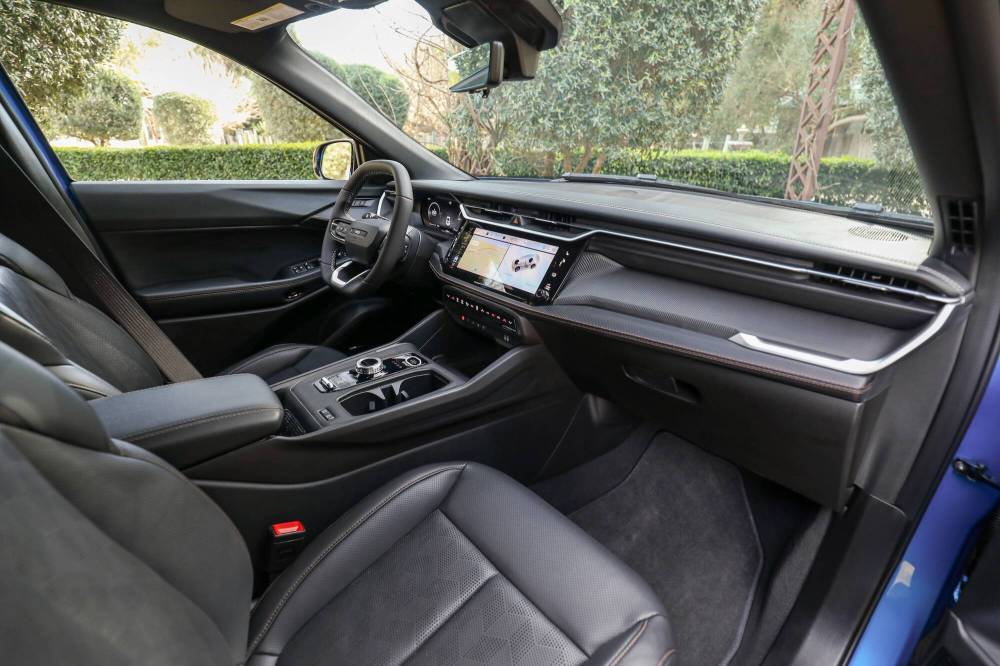
A long, low dash maximizes forward visibility over the hood for off-road driving.
The recent cold spell highlights another standard feature across all trim levels: heated seats.
Also standard are forward collision warning, adaptive cruise control and blind-spot monitors with rear cross-traffic alert. Available on higher trim levels is a 360-degree surround-view camera system.
The styling may not break any new ground, but stays true to the Jeep design language. A seven-slot grille at the front connects visually to LED headlights, while a standard two-box design follows. At the rear, a slight forward rake on the tailgate pays homage to that 1984 model while being shallow enough to maintain cargo space inside.
Inside is a quite attractive cockpit: the dash is kept low and linear, forming a straight line from door to door. The effect is as much functional as esthetic, as it allows a low forward angle of vision, which was demanded by the engineers.
A large touchscreen display handles many functions, from audio to some heating controls (heated seats, which are standard, and the optional heated steering wheel). The volume control is an actual knob (as well as in the steering wheel). Temperature, fan speed, A/C and automatic climate control are touch buttons below the screen with a haptic feel. (Once you are on the control, you push a bit to activate. It’s a nice touch.)
There are a few things I wasn’t crazy about. The door latches are operated electrically, and while the front doors have a mechanical lever as a redundancy in case of emergency, the rear doors do not.
As well, you can hide an elephant, it seems, in the blind spot created by the massive base of the A-pillar.
Towing for the Cherokee, across the range, is 3,500 pounds, or 1,588 kg, tied for best in class with some models of the Toyota RAV4, which is also a hybrid.
Speaking of that RAV4, the feel of the Cherokee outpaces it. While it’s a bit shy of the RAV4’s 236 horsepower, it seems to have more low-end torque. I’d have to do a back-to-back to be sure. While Toyota doesn’t specify torque, Stellantis compared the Cherokee’s 230 lb-ft to what it said was RAV4’s 163 lb-ft. The difference, if confirmed, was obvious.
Cherokee’s cargo space is average: 952.1 litres compared to RAV4’s 1,070 litres. But Cherokee is 100 L more than the new Mazda CX-5.
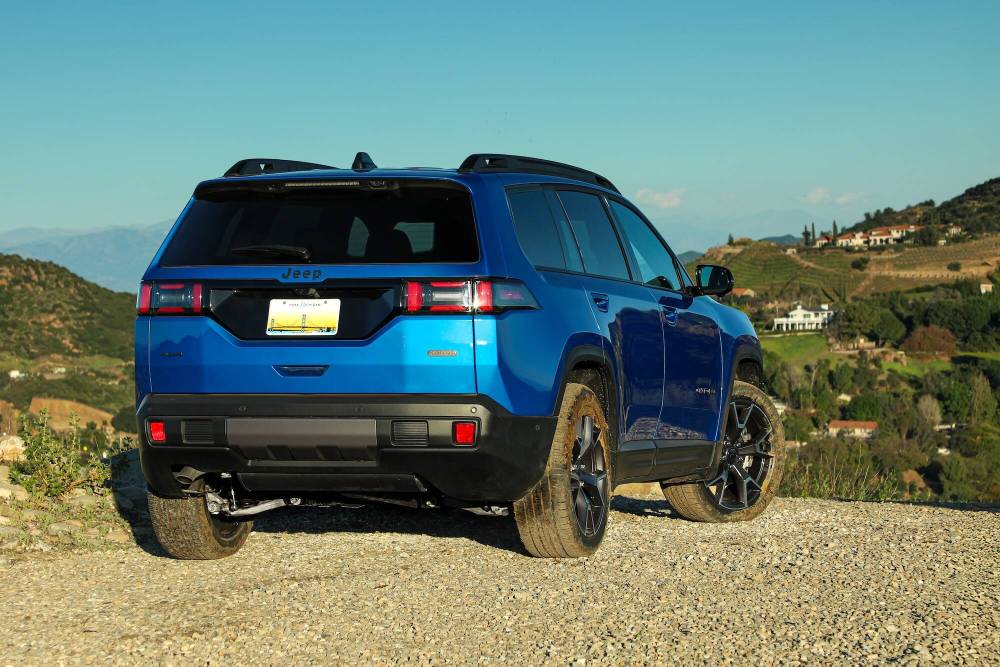
Supplied
The styling is a modern take on Cherokee design that pays homage to its 1984 beginnings.
Pricing is where Cherokee gets interesting: it starts at $42,390 incl. $2,295 destination fee and $100 air conditioning tax. That price doesn’t even cover currency conversion from the American price of $36,995, which works out to $50,600 or so depending on exchange. (That figure as of Feb. 20.)
There are four trim levels in Canada: Base, Laredo ($47,390), Limited ($52,390) and Overland ($56,390). All prices include $2,295 destination and $100 A/C tax.

A jump to Laredo gets some welcome winter-weather features: in addition to the standard heated seats on the base model, Laredo gets a heated steering wheel and remote start. Limited adds a power liftgate among other features, while the Overland upgrades to a hands-free liftgate, nine-speaker audio and dual-pane sunroof.
The tariff situation is also interesting, considering the Canadian government — in retaliation for Stellantis cancelling plans to build the Jeep Compass in Brampton, Ont. — reduced the amount of tariff relief it was granting to both Stellantis and General Motors. Cherokee is built in Mexico, not the U.S.
As well, much of the validation, as well as R&D, took place at Stellantis’s Automotive Research and Development Centre in Windsor, Ont.
Stellantis did not directly address questions about tariff exposure, saying only that pricing for each country is set independently according to market conditions.
kelly.taylor@winnipegfreepress.com
Our newsroom depends on a growing audience of readers to power our journalism. If you are not a paid reader, please consider becoming a subscriber.
Our newsroom depends on its audience of readers to power our journalism. Thank you for your support.
The specs
Engine: 1.6-L turbo four-cylinder, with 400-volt two-motor hybrid electric drive
Power: 210 hp (peak combined)
Torque: 230 lb-ft (peak combined)
Transmission: planetary gearset eCVT (continuously variable)
Layout: transverse-mounted front engine, all-wheel drive standard
Suspension: MacPherson strut (front); integral-link independent (rear)
Fuel economy (L/100 km, combined): 6.3 (official Energuide numbers pending)
Price: $42,390, incl. base MSRP; $47,390, Laredo MSRP; $52,390 Limited MSRP; $55,390, Overland MSRP. All prices include $2,295 destination fee and $100 A/C tax
Our newsroom depends on a growing audience of readers to power our journalism. If you are not a paid reader, please consider becoming a subscriber.
Our newsroom depends on its audience of readers to power our journalism. Thank you for your support.
Advertisement Advertise With Us
Advertisement Advertise With Us