

Shifting realities
Fragmentation of identities explored in updated work

Advertisement
Read this article for free:
or
Already have an account? Log in here »
To continue reading, please subscribe:
Monthly Digital Subscription
$1 per week for 24 weeks*
- Enjoy unlimited reading on winnipegfreepress.com
- Read the E-Edition, our digital replica newspaper
- Access News Break, our award-winning app
- Play interactive puzzles
*Billed as $4.00 plus GST every four weeks. After 24 weeks, price increases to the regular rate of $19.95 plus GST every four weeks. Offer available to new and qualified returning subscribers only. Cancel any time.
Monthly Digital Subscription
$4.99/week*
- Enjoy unlimited reading on winnipegfreepress.com
- Read the E-Edition, our digital replica newspaper
- Access News Break, our award-winning app
- Play interactive puzzles
*Billed as $19.95 plus GST every four weeks. Cancel any time.
To continue reading, please subscribe:
Add Free Press access to your Brandon Sun subscription for only an additional
$1 for the first 4 weeks*
*Your next subscription payment will increase by $1.00 and you will be charged $16.99 plus GST for four weeks. After four weeks, your payment will increase to $23.99 plus GST every four weeks.
Read unlimited articles for free today:
or
Already have an account? Log in here »
At some point, we all became users and avatars. Our physical bodies became digital datasets, our desires determined by algorithm. Our attention has been fragmented; so have our identities. We exist as cells, and also as pixels.
Online, offline, reality, virtual reality — it’s all getting increasingly blurred.
Winnipeg intermedia artist Freya Björg Olafson has been thinking about this for years, particularly in the context of extended reality (XR).
photos by MIKAELA MACKENZIE / FREE PRESS
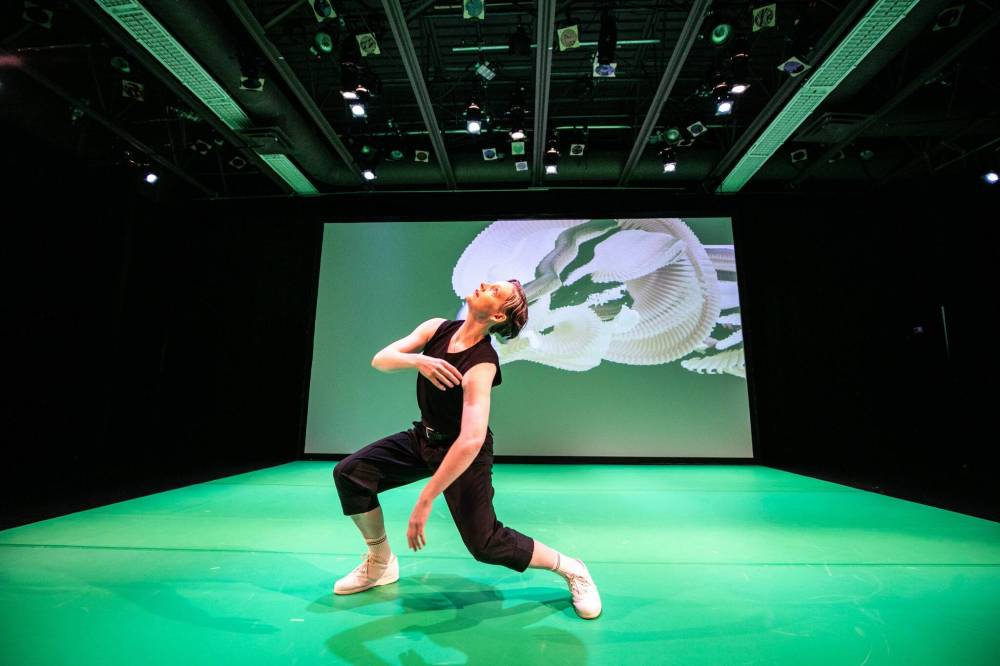
Freya Olafson first performed MÆ – Motion Aftereffect in Winnipeg six years ago.
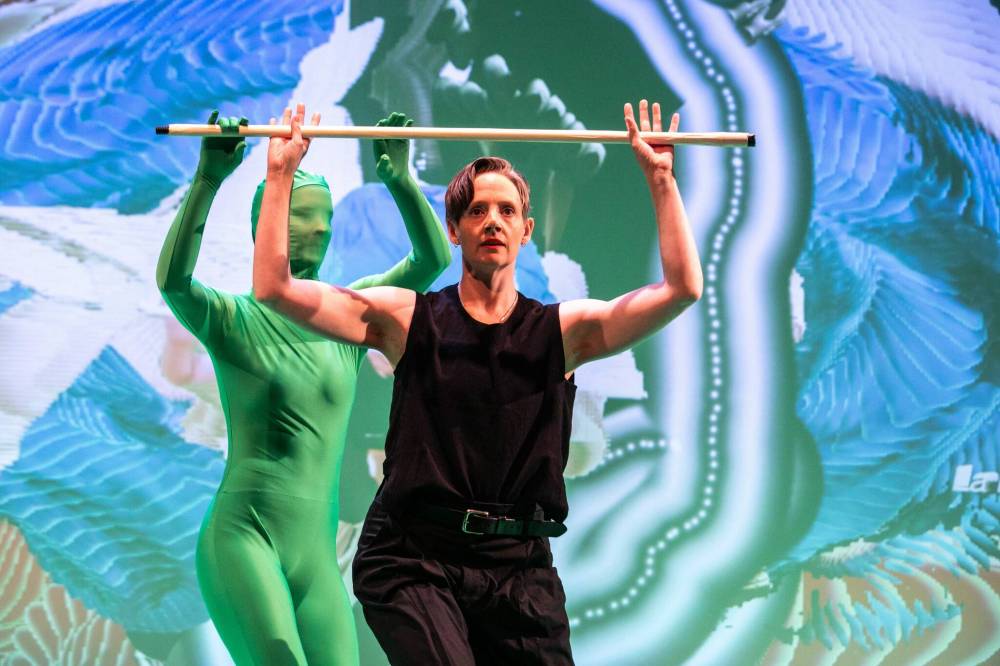
XR is an umbrella term that includes augmented reality (AR) and virtual reality (VR); even if you haven’t used it yourself, you’ve probably seen people don headsets to be fully immersed in virtual worlds. (It also sounds a lot like being on your phone.)
Olafson’s work MÆ — Motion Aftereffect, which premièred at Prairie Theatre Exchange in 2019 and is being presented by Winnipeg’s Contemporary Dancers this weekend, blends performance, choreography, virtual reality, motion capture and internet-sourced testimonies to interrogate how we show up in and move through the world, physically and digitally.
The work, too, is both live and digital, “exposing the tension between embodiment and disembodiment that defines contemporary life.”
The seeds for MÆ — Motion Aftereffect were planted years ago when Olafson was working on another piece called Consistent Partial Attention in which she used video glasses that essentially served as private TVs for her eyes only.
“That previous piece was about relating to screens, like, that really intimate proximity to visual media and the sense of how it distorts your sense of space and your own sense of where you are and how easily manipulated we are, really,” she says from the seats of the Rachel Browne Theatre.
While not immersive, the glasses were disorienting and Olafson was intrigued.
“I liked the destabilizing effect as a mover, so I thought I was going to do something with a 360 video, to decentralize where a camera was on stage,” she says.
MIKAELA MACKENZIE / FREE PRESS
Freya Olafson, mirrored by Emma Beech (in green), explores extended reality.
But then she got into an augmented reality/virtual reality residency for artists in Portland, Ore., that blew things open for her.
“That’s when I was introduced to motion capture and some game engine software, which opened up 3D computer space for me, ways to relate with movement. Prior to that, I didn’t think that making something with VR was within my scope.”
Olafson developed an early version of MÆ — Motion Aftereffect at a residency at CounterPulse in San Francisco and, since its première at PTE six years ago, the full-length version has toured to Ottawa and Montreal.
And as technology evolves, so, too, does the work.
“In revisiting the work, there’s been some shifts dramaturgically as well as technically in terms of executing some of the things that I had hoped to get to but I couldn’t quite do at that point in time.”

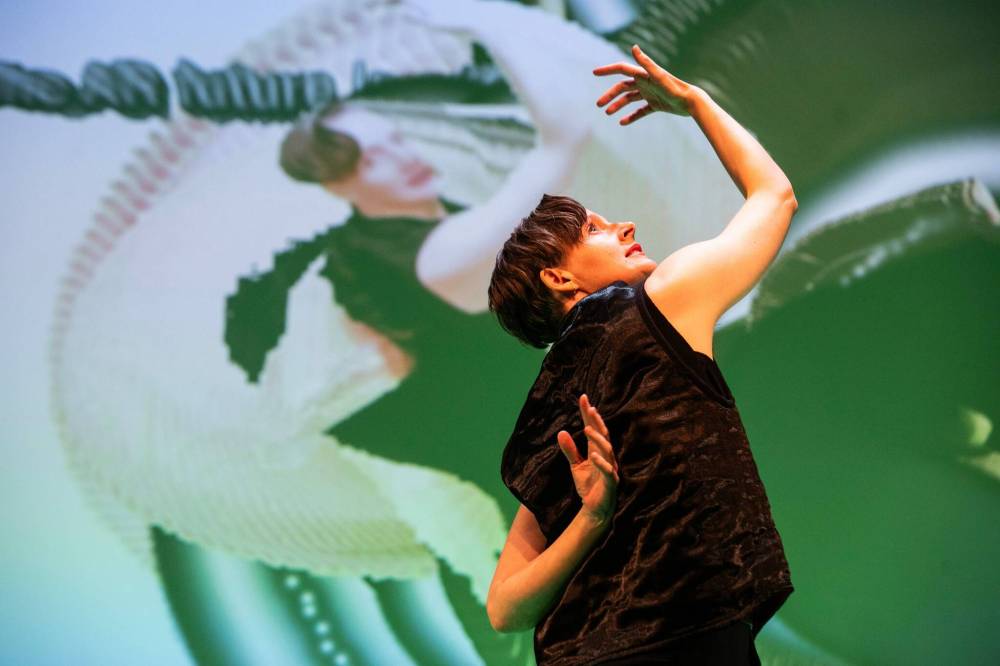
But there are also sequences that “embrace glitch and error,” Olafson says, such as one in which she is moving onstage and, on the screen behind her, her body is being captured in a visual trail effect. She’s a copy of a copy of a copy, until her body doesn’t resemble a body at all, but rather an abstract painting.
“That was actually an error from when I was at a workshop trying to do green screen. It didn’t work. I was like, ‘That’s beautiful.’ It basically holds the single video frames, and it prints new frames on top, so it is like a memory of trace and time.”
MIKAELA MACKENZIE / FREE PRESS
Freya Olafson embraces glitch and error while projecting overlapping versions of her body behind her.
As Olafson says, one doesn’t have to be an expert to engage with questions raised in the work.
“I hope that the work provokes reflection for folks of their everyday engagement with media, and/or if it’s some of the areas of XR or media that’s being presented that people are not familiar with, they’re getting a little window into these worlds or experiences.”
winnipegfreepress.com/jenzoratti
Jen Zoratti is a Winnipeg Free Press columnist and author of the newsletter, NEXT, a weekly look towards a post-pandemic future.
Our newsroom depends on a growing audience of readers to power our journalism. If you are not a paid reader, please consider becoming a subscriber.
Our newsroom depends on its audience of readers to power our journalism. Thank you for your support.
Dance preview
MÆ — Motion Aftereffect
Winnipeg’s Contemporary Dancers
● Rachel Browne Theatre, 211 Bannatyne Ave.
● Friday and Saturday, 7:30 p.m.; Sunday, 4 p.m.
● Tickets: $20-$38 at winnipegscontemporarydancers.ca
Jen Zoratti is a Winnipeg Free Press columnist and author of the newsletter, NEXT, a weekly look towards a post-pandemic future.
Our newsroom depends on a growing audience of readers to power our journalism. If you are not a paid reader, please consider becoming a subscriber.
Our newsroom depends on its audience of readers to power our journalism. Thank you for your support.
Advertisement Advertise With Us
Advertisement Advertise With Us