Chianti optional Fava beans transformed into tofu thanks to process developed at Winnipeg’s Prairie Research Kitchen

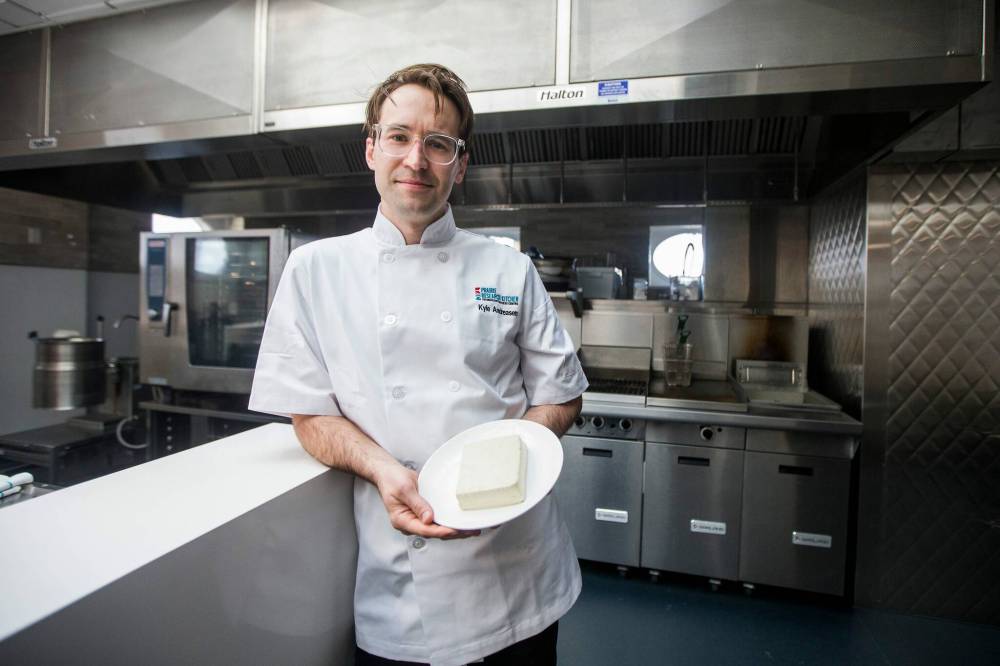
At first glance, the off-white brick looks like any other block of tofu. For staff at Red River College Polytechnic’s Prairie Research Kitchen, however, the unassuming rectangle made from fava beans is a new frontier in plant-based protein and the culmination of years of work.

Read this article for free:


or

Already have an account? Log in here »

To continue reading, please subscribe:

Subscribe and receive a limited-edition Free Press branded hat or tote.

Digital Subscription

One year of digital access for only $205*

  • Enjoy unlimited reading on winnipegfreepress.com
  • Read the E-Edition, our digital replica newspaper
  • Access News Break, our award-winning app
  • Play interactive puzzles

*First annual payment billed as $205.00 + GST for one year. This annual subscription will automatically renew at $233.00 + GST every 52 weeks (10% off the regular annual price of $259.35). Offer available to new and qualified returning subscribers only. Cancel any time.

To continue reading, please subscribe:

Add Free Press access to your Brandon Sun subscription for only an additional

$1 for the first 4 weeks*

  • Enjoy unlimited reading on winnipegfreepress.com
  • Read the E-Edition, our digital replica newspaper
  • Access News Break, our award-winning app
  • Play interactive puzzles
Start now

*Your next Brandon Sun subscription payment will increase by $1.00 and you will be charged $17.95 plus GST for four weeks. After four weeks, your payment will increase to $24.95 plus GST every four weeks.

Hey there, time traveller!
This article was published 07/05/2022 (1589 days ago), so information in it may no longer be current.

At first glance, the off-white brick looks like any other block of tofu. For staff at Red River College Polytechnic’s Prairie Research Kitchen, however, the unassuming rectangle made from fava beans is a new frontier in plant-based protein and the culmination of years of work.

“To the best of my knowledge, this is the first ever commercialized soy-free tofu,” research co-ordinator Kyle Andreasen says. “Getting this product to market has been the highlight of my time here… it’s been really exciting to be part of it.”

The fava tofu is being manufactured and distributed by Big Mountain Foods in Vancouver, but the product has strong local ties. It was developed in the food science lab on the top floor of Red River’s Paterson Global Foods Institute and is made from Canadian beans processed by Prairie Fava in Glenboro.
MIKAELA MACKENZIE / WINNIPEG FREE PRESS
Kyle Andreasen, a chef by trade, is a reseach co-ordinator at the Prairie Research Kitchen at Red River College Polytechnic.
MIKAELA MACKENZIE / WINNIPEG FREE PRESS Kyle Andreasen, a chef by trade, is a reseach co-ordinator at the Prairie Research Kitchen at Red River College Polytechnic.

Soy has long been the standard for plant-based protein, but growing demand has created an opportunity for new beans to enter the market.

“I think it’s important to give people options,” Andreasen says. “Some people have food allergies, some people have preferences.”

While fava beans share a lot of similarities with soy — they’re both high-protein, high-fibre pulses — turning them into tofu is slightly more complicated. Tofu is traditionally made from coagulated soy milk, the curds of which are pressed into a block (similar to cheese-making). Fava tofu follows the same process, although making fava milk is a bit trickier.

“It’s just a slightly different route to get to the same end product,” says Andreasen, adding that the exact methodology is a protected trade secret.

The Prairie Research Kitchen was established in 2013 and is made up of a team of chefs, food scientists and culinary students who work with businesses to create and market new food products. Andreasen, a chef by trade and a graduate of Red River’s culinary program, worked in local restaurants for a decade before taking a job with the research centre to satisfy his curiosity about food development.
MIKAELA MACKENZIE / WINNIPEG FREE PRESS
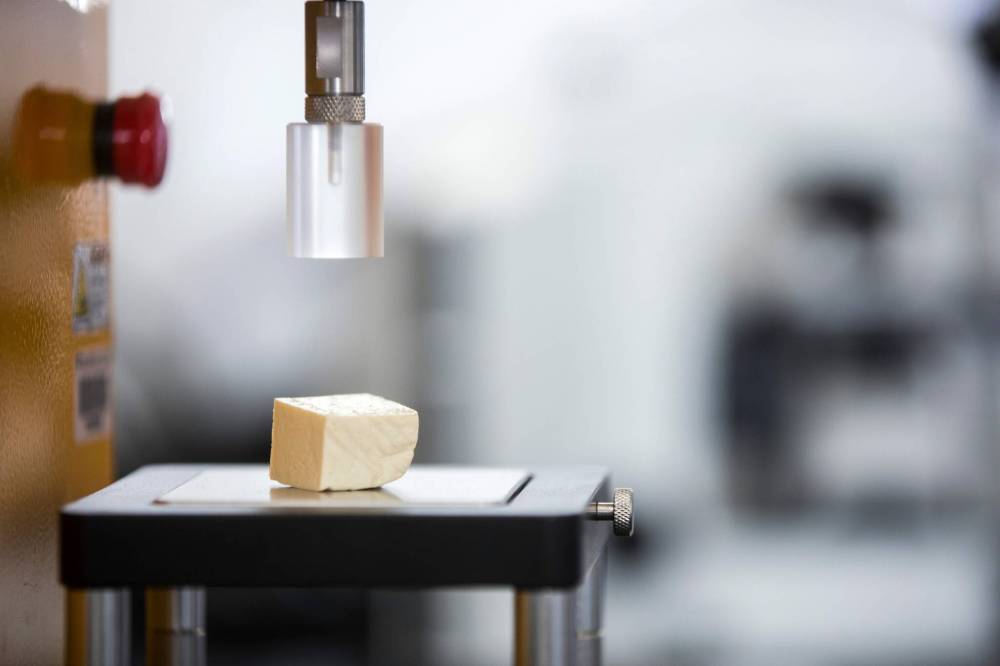
Fava bean tofu sits in a texture-analyzing machine at Red River’s Prairie Research Kitchen.
MIKAELA MACKENZIE / WINNIPEG FREE PRESS Fava bean tofu sits in a texture-analyzing machine at Red River’s Prairie Research Kitchen.

As lead for the fava tofu project, he was tasked with coming up with a formula that was scalable and delicious.

“It doesn’t matter how interesting it is, if it doesn’t taste good and work, it doesn’t matter that it exists,” Andreasen says. Suffice it to say, he’s eaten a lot of tofu over the last two years.

“Some people say that tofu doesn’t taste like anything and I would beg to differ. These ingredients taste like the raw product and I think that fava tofu tastes delicious — it’s a really mild flavour.”

Fava tofu can be prepared and eaten in the same ways as its soy counterparts.

For Hailey Jefferies, co-founder and chief executive officer of Prairie Fava, tofu is a natural next step for a bean she’s been championing since 2016.

Supplied
Prairie Fava, located in Glenboro, processes Canadian-grown fava beans to create flour, split and whole beans, flakes and grits.
Supplied Prairie Fava, located in Glenboro, processes Canadian-grown fava beans to create flour, split and whole beans, flakes and grits.

“At the time plant-based protein was just starting to become quite popular… pea protein was on the rise, and I thought, ‘Why not fava?’” says Jefferies who runs the vertically integrated company alongside her husband Cale’s family farm and seed business, Jefferies Seeds.

Prairie Fava works with contract farmers across Manitoba, Saskatchewan and Alberta to grow their own variety of fava beans, which are then processed at the company’s facility in Glenboro, a municipality 180 kilometres southwest of Winnipeg. The goal is to find new applications for fava, which has, in the past, largely been exported for canning or used in livestock feed.

“Farmers wanted to grow them due to how beneficial they are to the soil — they’re one of the top nitrogen fixing crops,” Jefferies says, referring to a process that allows some plants to pull nitrogen from the air. “But they struggled to find a market for them.”

Prairie Fava produces flour, split and whole beans, grits and flakes that can be used in a variety of food products. Jefferies hopes the new tofu line will get more farmers interested in growing fava beans.

The development of Big Mountain Foods’ soy-free tofu was made possible by an investment from Protein Industries Canada. The product is set to make its grocery store debut this month.

Supplied 
Prairie Fava co-founder and CEO Hailey Jefferies has been championing fava beans since 2016.
Supplied Prairie Fava co-founder and CEO Hailey Jefferies has been championing fava beans since 2016.

eva.wasney@freepress.mb.ca

Twitter: @evawasney

Eva Wasney

Eva Wasney
Arts Reporter

Eva Wasney is a reporter for the Winnipeg Free Press.

Our newsroom depends on a growing audience of readers to power our journalism. If you are not a paid reader, please consider becoming a subscriber.

Our newsroom depends on its audience of readers to power our journalism. Thank you for your support.
Report Error Submit a Tip

More Stories

Fava beans transformed into tofu thanks to process developed at Winnipeg’s Prairie Research Kitchen

Eva Wasney 5 minute read Preview

Fava beans transformed into tofu thanks to process developed at Winnipeg’s Prairie Research Kitchen

Eva Wasney 5 minute read Saturday, May. 7, 2022

At first glance, the off-white brick looks like any other block of tofu. For staff at Red River College Polytechnic’s Prairie Research Kitchen, however, the unassuming rectangle made from fava beans is a new frontier in plant-based protein and the culmination of years of work.

“To the best of my knowledge, this is the first ever commercialized soy-free tofu,” research co-ordinator Kyle Andreasen says. “Getting this product to market has been the highlight of my time here… it’s been really exciting to be part of it.”

The fava tofu is being manufactured and distributed by Big Mountain Foods in Vancouver, but the product has strong local ties. It was developed in the food science lab on the top floor of Red River’s Paterson Global Foods Institute and is made from Canadian beans processed by Prairie Fava in Glenboro.

Soy has long been the standard for plant-based protein, but growing demand has created an opportunity for new beans to enter the market.

Read
Saturday, May. 7, 2022

Banjo Bowl a big deal for new and returning faces

Ken Wiebe 7 minute read Preview

Banjo Bowl a big deal for new and returning faces

Ken Wiebe 7 minute read 6:16 PM CDT

Kenneth Womack never doubted this day would come.

For all of the twists and turns along this journey, Womack believed in himself and the work he’s been putting in on the road to becoming a professional football player.

So, as the Winnipeg Blue Bombers receiver gets set to make his CFL on Saturday afternoon against the Saskatchewan Roughriders in the Banjo Bowl, you can be sure he’s going to take a moment to savour the experience while doing his best to make it feel like any other game he’s played previously.

“Once I run out the tunnel, it’s all going to sink in,” Womack said after Friday’s walkthrough.

Read
6:16 PM CDT

Leadership turnover at Hydro not a concern: Kinew

Free Press staff 2 minute read Preview

Leadership turnover at Hydro not a concern: Kinew

Free Press staff 2 minute read Wednesday, Sep. 9, 2026

Premier Wab Kinew addressed the recent departure of Manitoba Hydro CEO Allan Danroth for the first time Wednesday, saying he’s not worried about turnover at the top of the province’s Crown jewel.

“I wish Mr. Danroth well,” Kinew said when asked about the resignation of the CEO hired just two years ago.

“I guess this is my first time addressing his departure, so I do want to thank him for his time with the Crown utility,” the premier said at an unrelated event. Danroth, who quit for personal reasons, replaced Jay Grewal, who was fired after the NDP formed government.

Kinew was asked if he has concerns about having a steady hand at the wheel of the province’s power company.

Read
Wednesday, Sep. 9, 2026

Chef friends bring London's culinary culture home to Winnipeg

Eva Wasney 5 minute read Preview

Chef friends bring London's culinary culture home to Winnipeg

Eva Wasney 5 minute read Tuesday, May. 11, 2021

The chefs are back in town and they’ve started their own London-inspired catering company.

Michael Robins, co-founder of Sous Sol, and Keegan Misanchuk, former chef de cuisine at Segovia, recently returned home to Winnipeg after several years of cooking in high-profile English kitchens. Their new private catering and pop-up venture, called Two Hands, brings together everything they learned during their culinary exchange and is emblematic of their focus on handmade food done well.

“I was just thinking about cooking,” Robins, 36, says of the inspiration behind the name. “And whether it’s fine dining or anything else, it all starts with your hands… and that’s the thing I love about cooking the most.”

So far, the pair have hosted a handful — pardon the pun — of pop-up events at local breweries and restaurants featuring everything from East London-style bagel sandwiches to Thai barbecue. They’ve also been channelling the British savoury-pie tradition with a recurring event called Proper Pies.

Read
Tuesday, May. 11, 2021

Fish will need to reel off two more wins at home

Mike McIntyre 4 minute read Preview

Fish will need to reel off two more wins at home

Mike McIntyre 4 minute read Wednesday, Sep. 9, 2026

THE ace did his part on the mound, save for a couple of costly mistakes.

Unfortunately for the Winnipeg Goldeyes and starting pitcher Landen Bourassa, a normally red-hot offence picked a bad time to go ice cold.

The end result was a 5-1 loss Wednesday night in North Dakota to the Fargo-Moorhead RedHawks, a defeat that quickly put the Fish on the brink of playoff elimination.

Winnipeg trails the best-of-three first-round series 1-0 and will now have to rattle off two straight victories to keep its season alive.

Read
Wednesday, Sep. 9, 2026

Hostile online platforms prove poisonous to much-needed genuine discourse, author argues

Reviewed by Donald Benham 5 minute read Preview

Hostile online platforms prove poisonous to much-needed genuine discourse, author argues

Reviewed by Donald Benham 5 minute read Saturday, Jun. 27, 2026

When Ray Robertson uses public transit, he realizes how different he is from the vast majority of modern human beings.

“Observe a bus full of near-comatose, infantilized commuters — heads lowered, fingers busy, eyes glazed,” Robertson writes in The Right to be Wrong.

“I don’t own a cellphone, perhaps my proudest act of social disobedience,” he declares.

Robertson has a large and varied body of written work, including nine novels, seven collections of non-fiction, a book of poetry and a book that inspired a film script. Born and raised in Chatham, he now lives in Toronto.

Read
Saturday, Jun. 27, 2026