

Bespoke, with an accent
River Heights tailor revels in turning out custom, handmade suits that 'fit like a second skin'
Advertisement
Read this article for free:
or
Already have an account? Log in here »
To continue reading, please subscribe:
Digital Subscription
One year of digital access for only $1.44 a week*
- Enjoy unlimited reading on winnipegfreepress.com
- Read the E-Edition, our digital replica newspaper
- Access News Break, our award-winning app
- Play interactive puzzles
*Billed as $5.77 plus GST every four weeks. After 52 weeks, price increases to the regular rate of $19.95 plus GST every four weeks. Offer available to new and qualified returning subscribers only. Cancel any time.
To continue reading, please subscribe:
Add Free Press access to your Brandon Sun subscription for only an additional
$1 for the first 4 weeks*
- Enjoy unlimited reading on winnipegfreepress.com
- Read the E-Edition, our digital replica newspaper
- Access News Break, our award-winning app
- Play interactive puzzles
*Your next Brandon Sun subscription payment will increase by $1.00 and you will be charged $17.95 plus GST for four weeks. After four weeks, your payment will increase to $24.95 plus GST every four weeks.
Read unlimited articles for free today:
or
Already have an account? Log in here »
Hey there, time traveller!
This article was published 06/06/2021 (1959 days ago), so information in it may no longer be current.
Nicholas Klein does not believe that clothes makes the man.
That may seem strange, considering he’s a fellow whose vocation and passion is for outfitting clients in dapper and dashing custom suits and garments — handmade by him alone.
“I would say that man makes the clothes,” Klein, the 28-year-old owner of Lagioia & Klein Bespoke Tailor Shop, said during a during a physically distanced, masked-up weekend-afternoon interview.
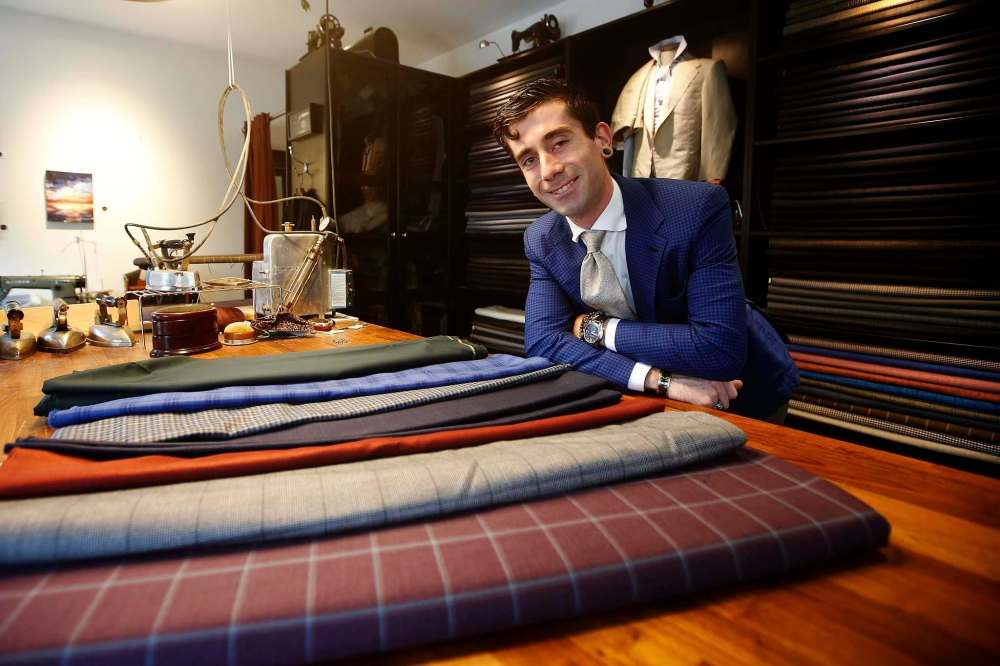
“Whatever I make for you won’t look good on anyone else,” Klein said, seated in his backyard patio next to his Academy Road shop in a garage next to his house. “So you make that suit look good, not the other way around.”
The reporter first heard of Klein in mid-April, when getting a haircut at Waltz On In Barber Shop. He asked the barbers if they knew of a local tailor who could fix the tattered lining of his vintage fringe jacket, and they wholeheartedly recommended Klein. Klein had outfitted one of the barbers for his wedding.
Upon realizing that he and Klein were virtually neighbours — Lagioia & Klein was less than 200 metres away from the reporter’s house — he took his jacket in a few days later. After chatting with Klein for more than half an hour, the reporter just knew this fascinating, unreasonably-handsome fellow just needed to have a feature written about him. (Klein did a great job fixing the jacket lining and it looks like new, if you were wondering.)
So, first things first: what the heck is a “bespoke” tailor and how is it different than a regular tailor?
Bespoke is a term that refers to something that is both handmade and 100 per cent made for a certain individual, usually by one person, Klein explained.
For example, a handmade garment or piece of jewelry can be homemade but that doesn’t mean it’s custom.
“It’s not made for you in particular, like they were in a workshop and they made a bunch of them and that’s it,” Klein said.
Conversely, something that is custom made doesn’t mean it’s handmade.
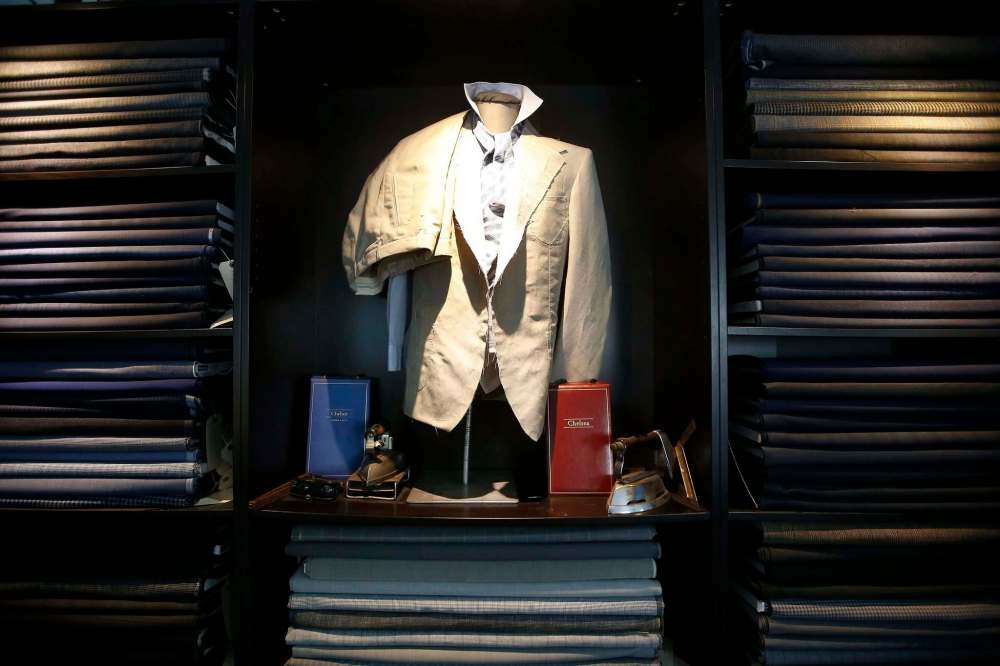
“If someone takes your measurements and has the suit made for you overseas, that’s custom made but it is not handmade,” he said. “It’s still made on a machine, it’s made in a factory.”
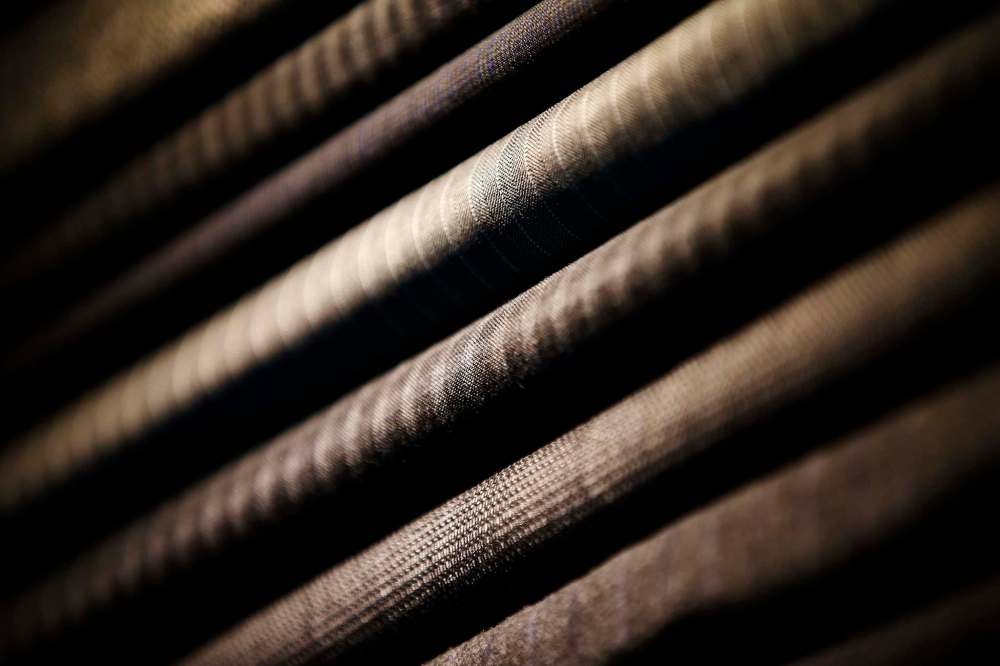
Bespoke suits are “handmade, made for you, one-of-a-kind.” They’re meant to fit like a “second skin,” and are made of high-quality imported fabrics from European mills such as Vitale Barberis Canonico, which is located in the Biella region north of Turin and has existed since 1663.
Klein’s shop is modest in size, being a garage and all, but is warm and welcoming. A central work bench is complemented with vintage sewing machines and supplies all around, soccer on the television, and an espresso-maker behind the register. (In non-COVID times, he’ll make you a homemade cappuccino, espresso, or latte during a fitting, a skill he picked up from friends at the now-defunct Aurora Pizzeria And Café, where he used to go almost every day.)
It was his goal to make the shop like the ones he visited while travelling in Europe. He realized there was nothing like them in Winnipeg.
“There are very nice, very well put-together suit stores (in Winnipeg), but I wanted to create a tailor shop that was very reminiscent of a few of the shops I’d seen in Italy. I wanted that experience to be unique,” he said.
The process of making a bespoke suit in the shop from start to finish is intensive and highly personalized. Each suit can take between 30 and 60 hours, multiple fittings and consultations with a client, and six weeks or more to make.
After he takes measurements, Klein puts together the suit in a way that it can actually be taken apart for changes after an initial fitting. That’s unlike custom tailor shops, where suits are made overseas and come back as finished garments, then altered without being fully taken apart, Klein said.
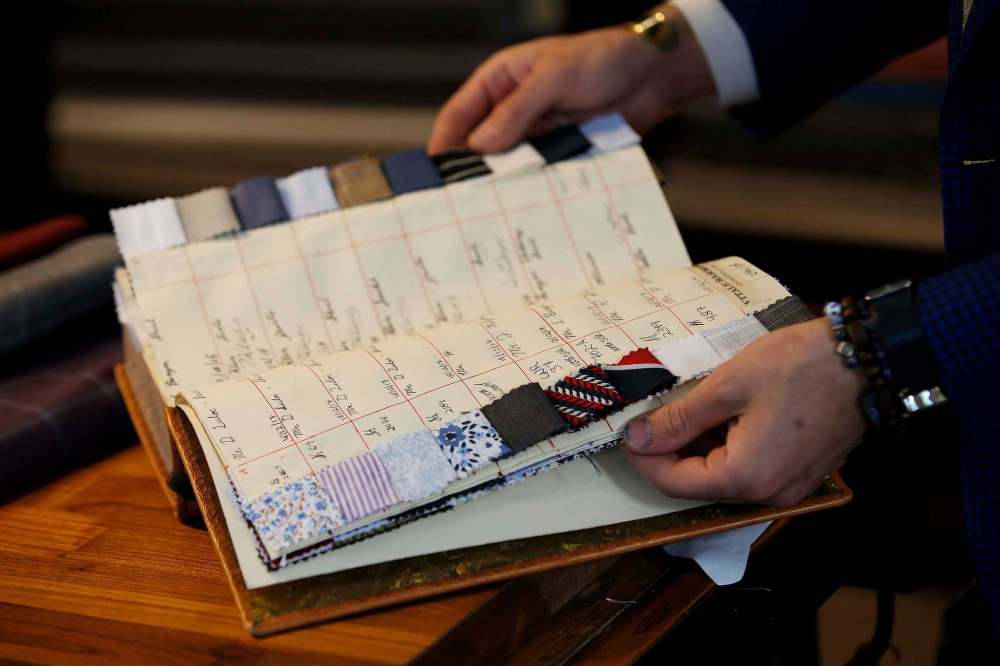
“That’s never going to be as accurate to a person’s body as when you can try something on, note all the changes, then take every panel back apart, and properly see all those lines that you have to recut, and sew it back together in a new pattern from start to finish again,” Klein said.
Becoming skilled enough to do this is not something that comes overnight. Klein’s journey has spanned a decade.
You’re probably wondering by now why the shop, opened two years ago, bears the names “Lagioia & Klein” rather than just “Klein.” Lagioia refers to Giovanni Lagioia, the masterful Italian tailor Klein spent countless hours sewing and stitching under as an apprentice.
Klein worked at a suit store in Polo Park about a decade ago, while pursuing a degree to become a teacher. What he really wanted, he explained as his two-year-old goldendoodle Stitch barked at passerby, was to work in a certain higher-end clothing store that had its own tailoring service.
He thought he’d have a better shot at getting hired there if he knew tailoring ABCs, such as how to pin a garment and mark it with chalk.
That’s when he approached Giovanni Lagioia, owner of Giovanni’s Custom Tailors in South Osborne, to teach him some things.
After learning how to make a tie and do basic alterations, Klein felt ravenous for more and more knowledge from Lagioia. He still has the first pair of pants he made under Lagioia’s wing and freely admitted the left side of the pants, done by Lagioia, looks a lot better than the right side.
He never ended up applying for the job at the higher-end store, instead forming a deep bond with Lagioia as his apprentice.
Klein graduated and got a half-time teaching job at Churchill High School, just a couple minutes’ walk away from Lagioia’s store. He spent the mornings teaching and the afternoons with Giovanni, plying his craft.
“It felt like I almost could have been in Italy,” Klein said. “It was hot, I was wearing a suit, and he would talk so much about his growing up in Italy, and his childhood there, and him learning from his boss in Italy. I would spend hours and hours with him and we’ve talked on every subject you could imagine.”
Then in the evenings, he’d go home and both plan lessons for his students and work on his own tailoring projects until the wee hours of the morning.
Two years ago, Klein quit teaching to open Lagioia & Klein, honouring his mentor not just by putting Lagioia’s name on his business, but putting it ahead of his own.
“There isn’t a single garment that comes out of my shop, there isn’t a single alteration, there isn’t a machine, isn’t a thread in that shop, that wouldn’t be because of him,” Klein said.
“The years I spent with him were the best thing, the biggest blessing in my life,” Klein said. “He’s like another father to me…”
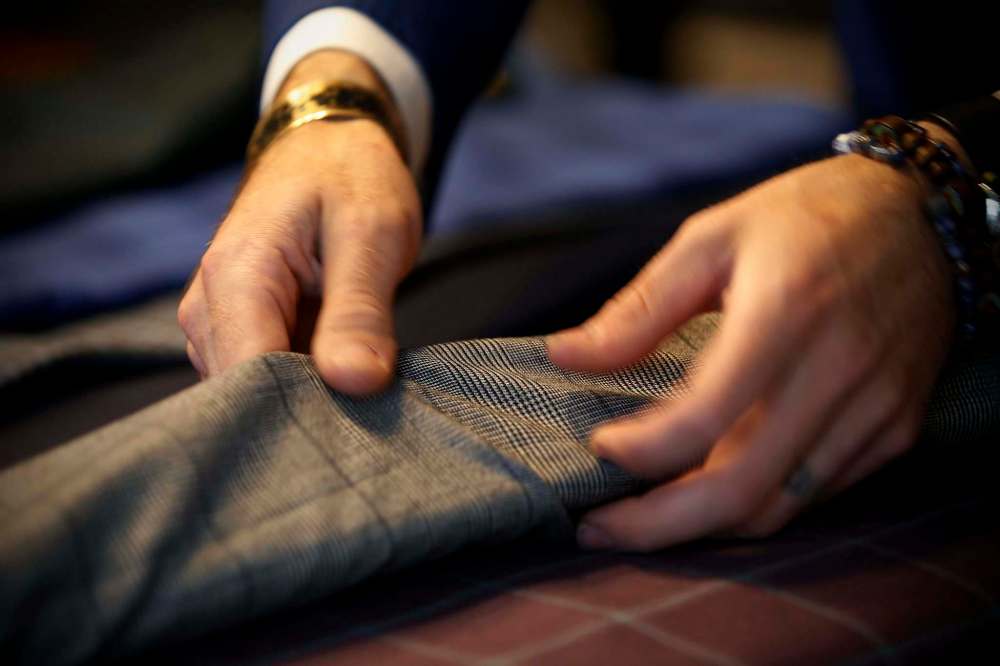
Lagioia could dish out tough love at times. Klein recalls Lagioia would make him take apart the scraps he messed up on and start over, instead of giving him fresh scraps to start from scratch on.
But Klein never doubted that Lagioia had the best for him at heart.
“He imparted so much in work ethic, in values, in culture. He’s my best friend.
“If I don’t either stop in the shop or call him for three days, I’ll get a call, he’ll be concerned. That’s the kind of relationship we have.”
Klein operated his shop full-time until COVID-19 arrived and people mostly stopped going places or doing things that required much more than sweatpants, if any pants at all.
In the fall, he went back to Churchill to teach middle-school math and science — yes, he considers himself the young, cool teacher, in case you were wondering — and works his shop evenings and weekends.
Klein said there’s still a market for bespoke apparel, despite there not being many business meetings, graduations, or weddings at the present.
“I’m lucky — having both jobs means that I’m not in a place where the shop is slow and that’s all I’ve got,” he said. “I really can’t complain, if I’m overly busy, if I’m working 16-hour days, I can’t complain.”
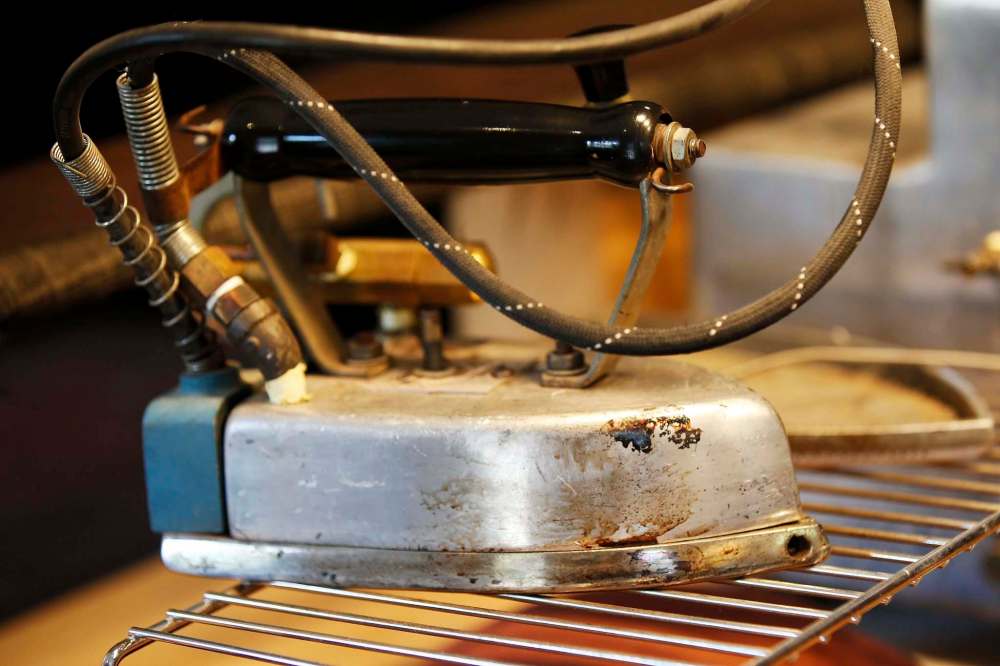
Klein said he has a wonderful group of customers and he still has plenty of work, even if he has to do virtual fittings using Facetime.
For customers who enjoy participating in the bespoke process, clothing is much more than something to just throw on.
“They know the passion I have is woven into that garment, and they take that everywhere they go,” Klein said. “There’s a life to that garment and some people understand it, and that’s why they come.”
He also includes a matching homemade mask for anyone who orders a suit or shirt.
“People love that. They’re like ‘you wouldn’t believe the conversation starter that is.’”
Klein considers bespoke tailoring a true art form, not unlike cooking. It’s something that takes — in addition to a deft, practised hand — a keen eye, acute observational skills, and enough confidence to know when you can break the rules.
“With bespoke, there are no rules — sometimes the numbers say this but I know instinctively sometimes it has to be a little bit different because what I saw in the slope of someone’s shoulder, or the arc of their back, or anything that could change that.”
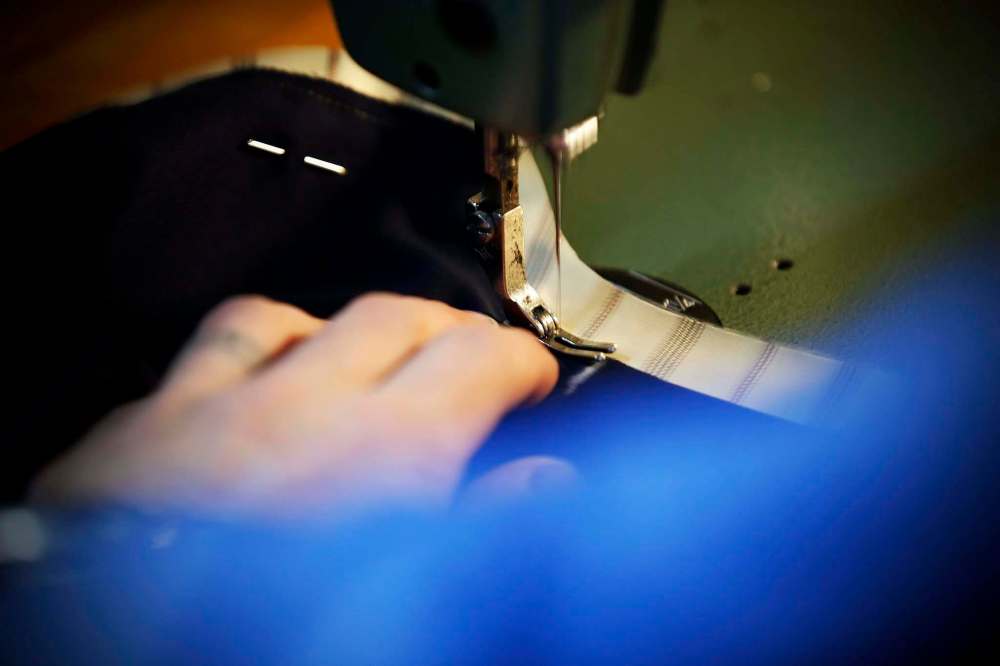
Another thing it takes to be successful is the ability to develop that true personal connection with the client.
Measurements don’t tell you everything,” Klein said, such as the way a person’s posture will dictate how a suit looks on or fits them. “That needs to be taken into account, not just numbers.”
Idle chit-chat on an initial visit, for example, has a deeper purpose: Klein won’t be able to make a suit that fits perfectly without surreptitiously sizing a person up when they’re at ease.
“It’s funny — the moment you pull out a measuring tape, no one stands naturally,” he said.
“People go stiff and they start to think about it and it’s not natural anymore. So you need to have a good conversation with someone outside of measuring to even get the slightest idea of posture. You need to talk about cars, interests… what they do for work, why they need a suit, before you even start measuring… people become too self-conscious.”
Finding out what a person needs the suit for — for work, for pleasure, as a statement piece — is also important. A lot of suit stores make constructing suits a checklist, Klein said, and that’s one of his pet peeves.
“If you just make it a checklist — ‘would you like this, would you like that’ — people can start to pick things that sound cool to them, but in practice, it’s not going to look the way they want.”
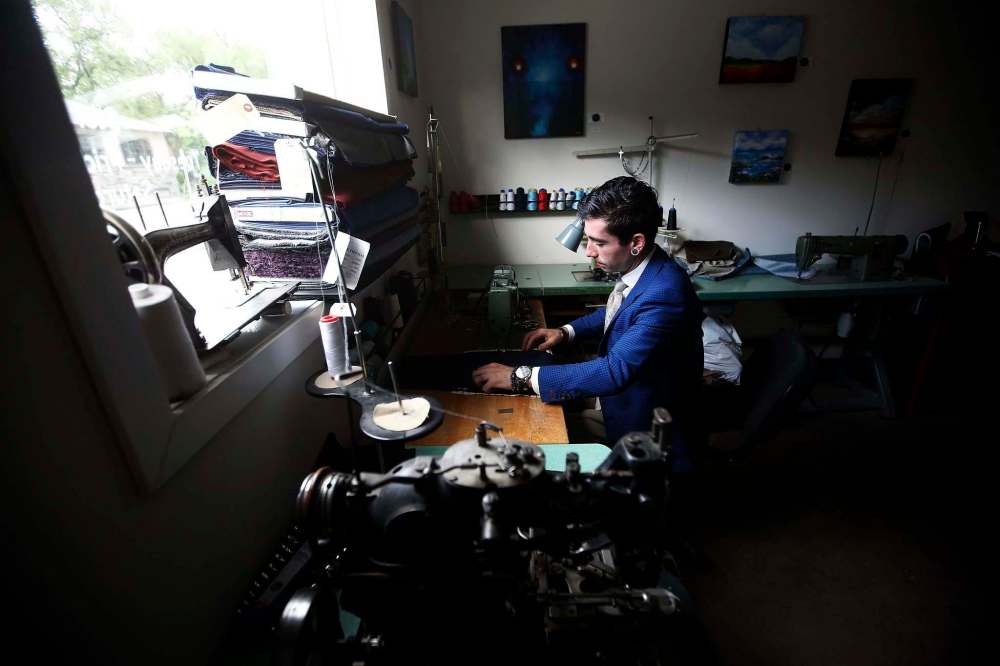
Bespoke tailoring is about guiding a customer to a suit that fits their personality and one that can be worn indefinitely rather than one that’s trendy today but might look horribly dated a few years down the line.
“It’s not just about the style of the day. If I make you a suit, it’s going to last forever,” he said. “What I tell people is that I can get you into a suit that feels like a second skin — both in fitting and in the personality of the suit — it doesn’t matter if it’s got wide legs or tapered or pleats or straight-cut, or two-button, or three-button or one-button or wide lapels or narrow lapels.”
“It doesn’t matter what’s in style. If that suit fits you, you’re going to exude a level of confidence and people will gravitate to that.”
Klein’s main goal is for the person in the suit — not the suit itself — to be the focal point. He said he wants “everything in that suit to point to the person,” for someone to say “‘you know, there was something about that person that was really captivating, but I don’t know what it was.”
“I’d much rather that than someone to walk away going ‘you know, all I saw was that person’s jacket because it was so overpoweringly obnoxious. It was all I could see… it was so clear that the person wanted me to see their jacket and not them,’” he said.
“I would rather the person come first.”

That’s why he’s content with his little shop and doesn’t have any grandiose expansion or hiring plans, (but does want it to be a full-time endeavour again.)
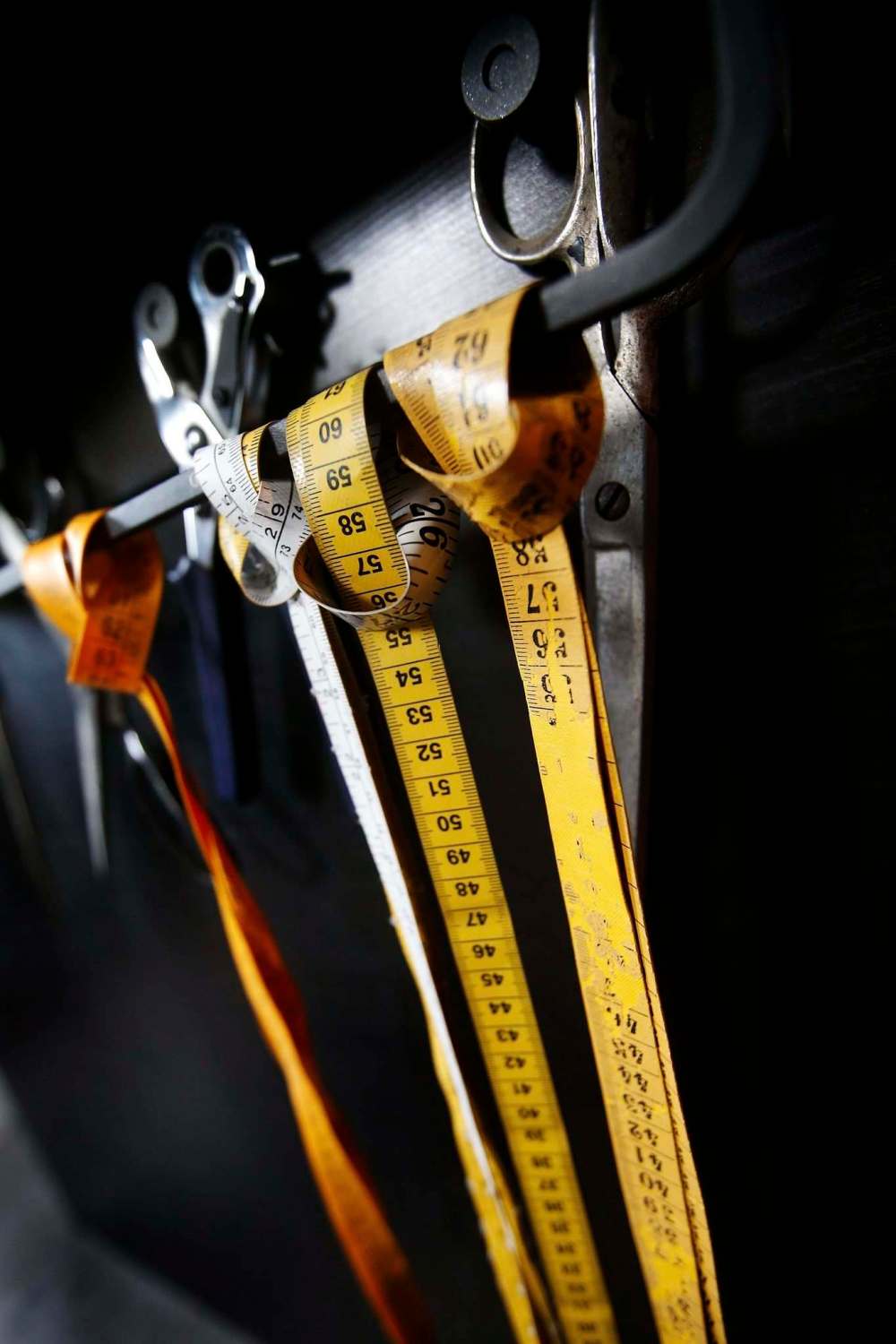
“People start to dream for me,” he said. “It’s funny because I think they miss what the dream really is. I’m not a business person by nature. I didn’t go to Asper School of Business. I didn’t want to be a business owner. I wanted to be a tailor.”
Sewing is like therapy for Klein, so the idea of owning multiple locations or only having to do some of the work because people work under him, “appeals absolutely zero to me…” he said.
“I want to be the person that measures the person but I also want to be the person sewing the button holes and putting the pockets in your garment.”
declan.schroeder@freepress.mb.ca
This shoemaker’s son is not barefoot
When asked for a word or phrase that describes his personal sense of style, Nicholas Klein couldn’t find one, eventually settling on simply “Nicholas Klein style.”
Just as you shouldn’t trust a skinny chef, you probably shouldn’t trust a bespoke tailor with a poor wardrobe. Klein’s is “stupidly large,” as he estimates he owns about 30 suits, more than 150 ties, and 40-plus pairs of dress shoes.
“It’s not healthy,” he laughed.
He personally prefers Italian-style suits, which are light in construction and generally navy, light blue, tan or grey. Almost unbelievably, none of his 30-plus suits are black and he’s never made a black suit for himself.
During an interview on his backyard patio on a sunny but windy Saturday afternoon, he wore a handmade white dress shirt with the sleeves rolled up, a paisley Brioni tie he scored at Value Village, pinstriped blue pants rolled up at the bottom, navy woven loafers sans socks, and a homemade purple floral mask.
Klein likes going out well-dressed, but that doesn’t mean he always dresses in a full suit.
There’s a time and place for everything, Klein said, and if you wear a suit everywhere you go — like to a pub with your pals when they’re all wearing T-shirts and jeans — it will lose its impact and you’re going to look pretentious.
“There are ways to dress down suits,” he said, noting his wardrobe is built so he can do just that. “If you want to wear a nice blazer with a pair of jeans and a T-shirt, or you want to wear a nice dress shirt with some jeans, or a pair of dress pants with a t-shirt, there’s a lot of ways you can take one or two pieces from a suit and still wear it in a setting where people look at you and go ‘that’s really well-put-together, but not over-the-top.’”
For his job as a teacher at Churchill High School, some days he wears a full suit, but other days he wears ripped black skinny jeans and a T-shirt.
“It keeps the kids guessing, that’s for sure!”
Related Articles
Warm and fuzzy for Winnipeg winter



Advertisement Advertise With Us
Advertisement Advertise With Us