Clear need, uncertain will Other nations are finding effective ways to address homelessness; as the problem continues to grow here, political promises offer little comfort
Read this article for free:
or
Already have an account? Log in here »
To continue reading, please subscribe:
Digital Subscription
One year of digital access for only $1.44 a week*
- Enjoy unlimited reading on winnipegfreepress.com
- Read the E-Edition, our digital replica newspaper
- Access News Break, our award-winning app
- Play interactive puzzles
*Billed as $5.77 plus GST every four weeks. After 52 weeks, price increases to the regular rate of $19.95 plus GST every four weeks. Offer available to new and qualified returning subscribers only. Cancel any time.
To continue reading, please subscribe:
Add Free Press access to your Brandon Sun subscription for only an additional
$1 for the first 4 weeks*
- Enjoy unlimited reading on winnipegfreepress.com
- Read the E-Edition, our digital replica newspaper
- Access News Break, our award-winning app
- Play interactive puzzles
*Your next Brandon Sun subscription payment will increase by $1.00 and you will be charged $17.95 plus GST for four weeks. After four weeks, your payment will increase to $24.95 plus GST every four weeks.
Read unlimited articles for free today:
or
Already have an account? Log in here »
Hey there, time traveller!
This article was published 31/12/2020 (2118 days ago), so information in it may no longer be current.
”I am writing this to my brothers and sisters, the mamas and the babies that are starting to die at alarming rates. Something needs to change. Teach these babies to share and to love first because this world never loved us, we ‘other’ people.”— Desirae
The only hint of yuletide colours is the red-and-white Canadian flag fluttering atop the old firefighter museum just off the Main Street strip.
Otherwise, this morning — Christmas morning — is quiet, indistinguishable from the previous day and the one that follows.
Life on the strip
The costs of homelessness — both in fiscal resources and human misery — are difficult to fathom. And the problem, which has has plagued Winnipeg for decades, is growing.
In order to better understand the issue, the Free Press spent the past year documenting life on the streets and in the shelters.
The costs of homelessness — both in fiscal resources and human misery — are difficult to fathom. And the problem, which has plagued Winnipeg for decades, is growing.
In order to better understand the issue, the Free Press spent the past year documenting life on the streets and in the shelters, interviewing advocates, community activists and academics, reviewing research papers, shadowing social-service workers and consulting people with expertise gained through lived experience.
The result is Life on the Strip: A year-long examination of Main Street homelessness.
At the start of each instalment is a quote from Desirae, one of the people profiled in this series. She lives on the streets of Winnipeg in a tent. The quotes are excerpted from an essay she wrote and submitted to the Free Press.
Our final chapter returns to what remains of the homeless camps on Christmas Day.
See the full series at wfp.to/lifeonthestrip.
The sun is slowly rising and there’s a chill in the air. A black bird flies above, its caws piercing the silence as it spreads its wings against the sky.
Fences cordon off the spaces where the encampments stood, the metallic wiring criss-crossing and rendering inaccessible plots of public land where people once tried their best to forge something akin to a home.
But the cycle of life down on the strip continues its ebb and flow.
Since the city last dismantled the camps, people have returned, although not in the same numbers. Unless steps are taken to address the root causes of homelessness once and for all, it seems likely they always will.
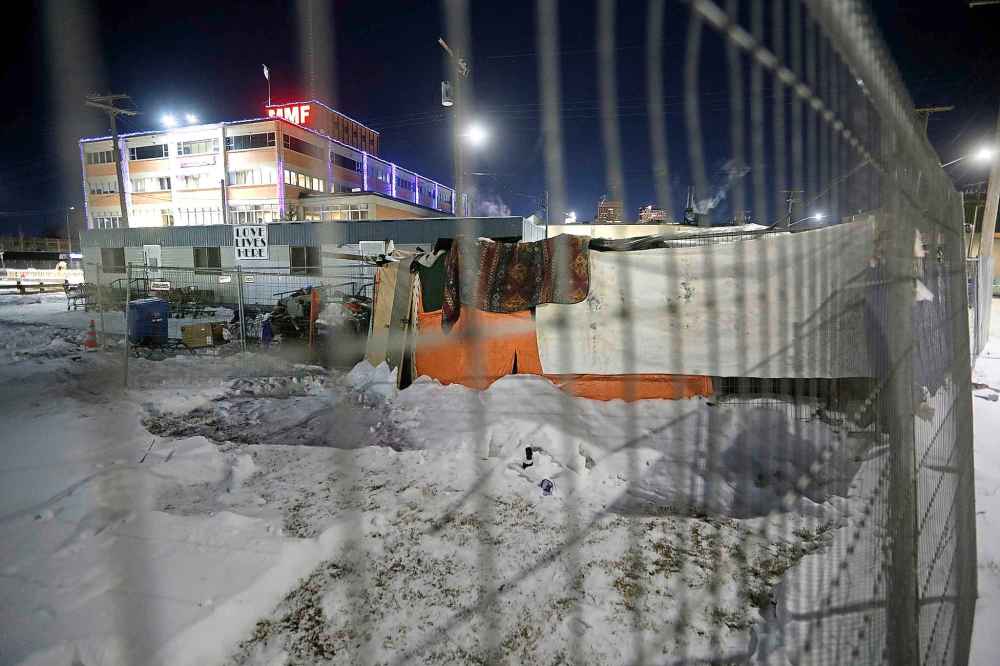
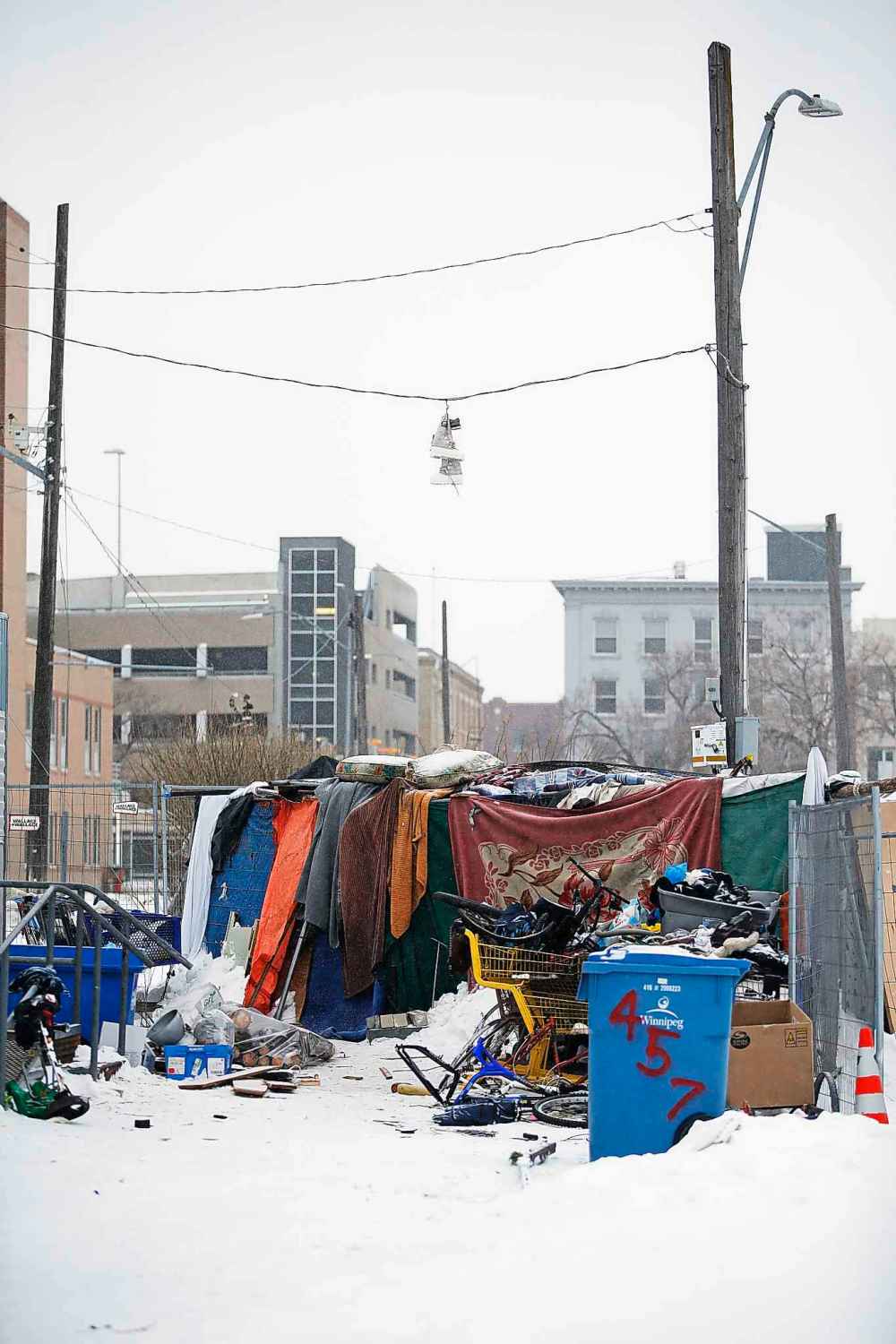
Behind the Manitoba Metis Federation building, pressed up against the fence near the sidewalk, a ramshackle structure has been built from scavenged materials. Boxes and blankets, tarps and clothes, old newspapers and thrown-away food litter the ground.
Nearby, a young man — skinny, with scruffy facial hair and loose-fitting clothes — walks down the road. He limps with each step, mumbling something that can’t be heard. He has to repeat himself three times before his words are audible.
“Do you have any speed for sale?” he asks.
When told no, he apologizes and walks away.
The largest camp left standing has formed near the corner of Higgins Avenue and Maple Street, flanking the firefighter museum, where there’s no fencing to block off the land. There are three tents, a lean-to and a garbage bin for fires.
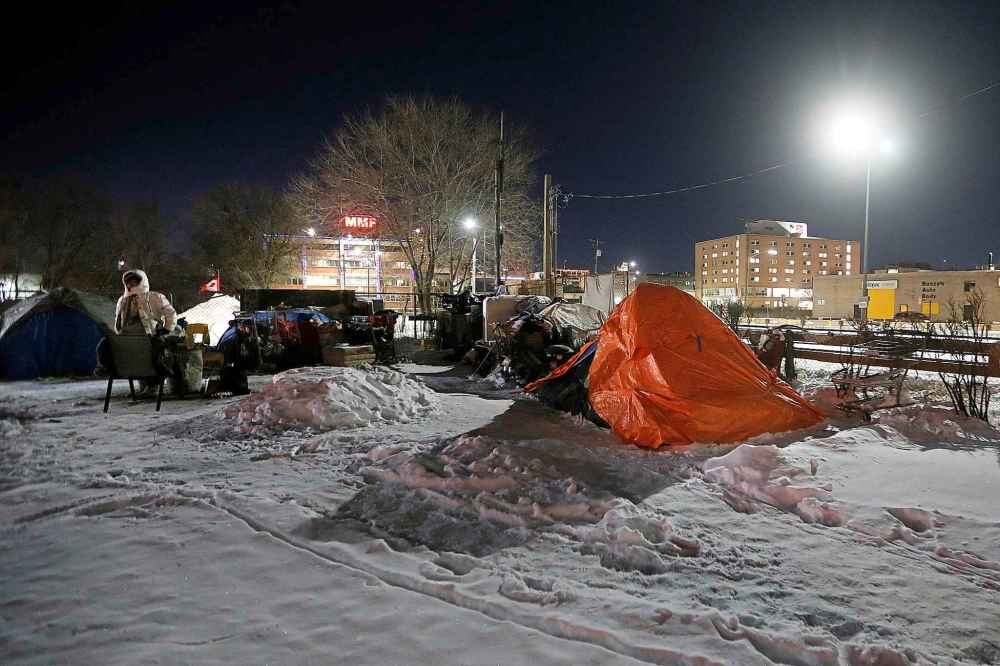
At the site of the camp where Desirae and Kyle once lived, there’s a single makeshift shelter covered in tarps — orange and blue, purple and green. There’s a man and woman rummaging through the items on the ground, next to several discarded shopping carts.
Do they know where Desirae is? The man ignores the question, but the woman stops what she’s doing, turns around and shakes her head no. She says she hasn’t seen Desirae in a while and doesn’t know where she’s staying these days.
No one on the strip seems to know where she is.
●●●
The moon and sun hang in opposite ends of the sky.
It’s mid-afternoon and a man dressed in a Santa costume has turned up on the strip to try to spread some Christmas cheer. He pops out of his vehicle and hands out bags of McDonald’s food to hungry people before heading on his way.
He’s one of many Winnipeggers who come out on Christmas to try to ease the burden of the homeless with small gestures of kindness. Over the coming hours, several vehicles pull onto side streets and people distribute free food, clothing and hygiene products.
The sound of birds chirping brightly fills the air and people linger outside the shelters — some wearing masks, some not.
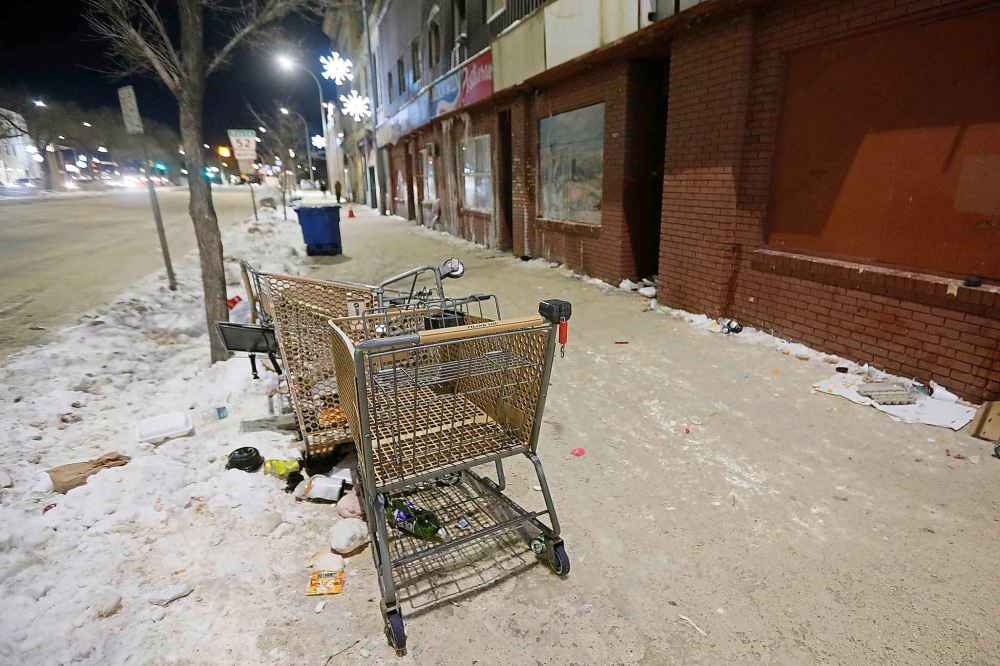
Behind the Salvation Army, a person rummages through an industrial garbage bin, and down Martha Street, a man pushes a shopping cart through the snow, coughing loudly as he goes.
Not too far away, on the corner of the street, a woman has been standing in the same spot for several hours, hardly moving.
“She doesn’t stay here anymore,” says another woman, standing outside one of the camps, when asked if she knows who Desirae is and where she’s might be.
It’s possible Desirae moved into one of the shelters to escape the coming cold. It’s also possible that when the city last broke up the encampments, she moved on somewhere else where she’d be less likely to be bothered by authorities.
As the authors of the 2018 Winnipeg Street Census wrote in their final report: “Invisibility is a survival strategy for people experiencing homelessness.”
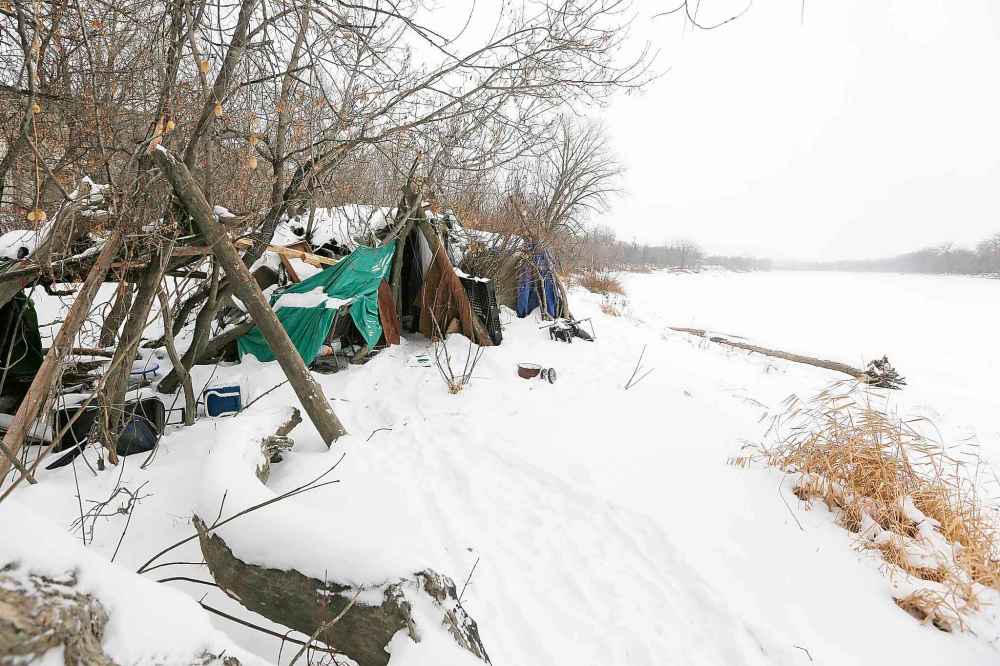
Desirae has not responded to the most recent email from the Free Press, and repeated efforts to track her down at the camps around the Main Street strip have been unsuccessful.
As the afternoon stretches on, an SUV pulls into the loop behind the MMF building and a woman gets out holding a bag of donations. She walks over to the makeshift shelter pressed up against the fence and shouts: “Hello, is anybody there?”
There’s no answer, so she leaves the bag on the ground, hoping someone in need will come across it, and walks back to the vehicle shrugging her shoulders at the driver.
●●●
The moon glows in the dark of night.
As the final hours of Christmas 2020 tick away, things remain relatively quiet on the strip. The people are few and far between and the side streets feel empty and hollowed out.
A black garbage bag is stuck in the bare branches of a tree on the corner of the road, fluttering against the moon like a depressing, surrogate kite.
The Love Lives Here mission, which for years has served up free suppers on Tuesdays and Thursdays out of an old trailer, sits dark and empty. The volunteers had to temporarily halt services in the fall due to the pandemic.
For many people living on the streets, it made a bad situation worse. It meant two fewer guaranteed meals each week.
A pair of boots and a pair of sneakers hang from a power line near the trailer, tangled up together and dangling in the air. Down the street, three people huddle outside the front door of the Mount Royal Hotel.
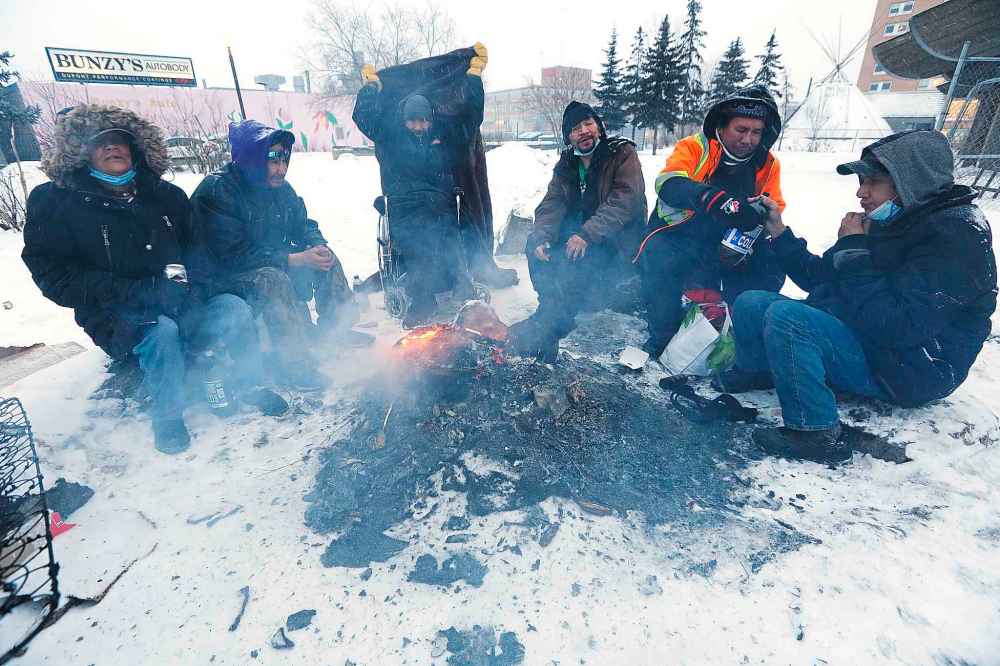
Behind the Thunderbird House, cardboard boxes and wooden pallets burn in a makeshift fire pit, and a few people sit close with palms out, warming themselves as the glow from the flames pushes back against the night.
The problem and the desperate needs of people here is clear as ever, staring this city straight in the face.
It’s not unique to Winnipeg: sizable homeless encampments have sprouted across the country. And while the situation is dire, it’s also not without solutions.
In September’s throne speech, the federal Liberals promised to put an end to chronic homelessness in Canada once and for all. Of the total number of people in the country with no place to go, it’s estimated 15 per cent are chronically homeless.
A chronic problem
Twenty-one per cent of the city’s homeless population reported being homeless for 10 years or more, according to the 2018 Winnipeg Street Census.
The majority of them said they have experienced multiple episodes of homelessness in their lives.
The number is worse in Winnipeg, where the latest street census found 21 per cent of respondents reporting they had been homeless for 10 years or more, with the majority saying they had experienced multiple episodes of homelessness throughout their lives.
Gregg Olsen, a professor at the University of Manitoba, whose work focuses on social inequality, wrote a report with Lars Benjaminsen, a colleague from Denmark, that took a comparative, cross-national look at homelessness.
What they found was the Nordic countries, which feature strong social safety nets, have made the greatest progress in addressing the crisis.
“Nations with more developed housing and homelessness policies have been much more successful in addressing homelessness. The incidence and severity of homelessness is markedly worse in nations with higher levels of poverty and less-developed and inclusive welfare states,” the authors wrote.
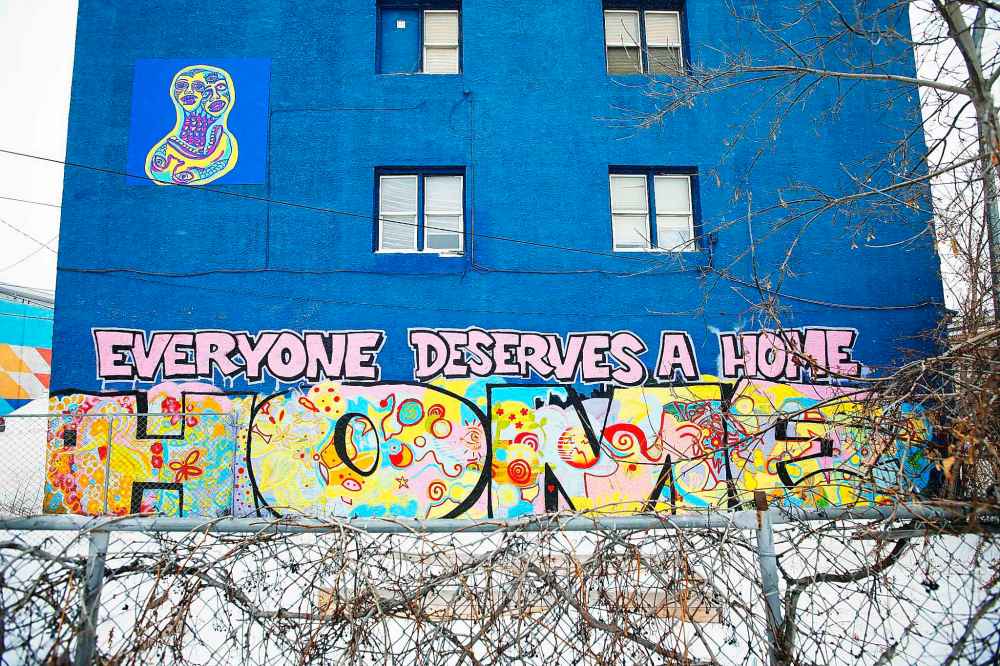
“Finland in particular has experienced a remarkable, steady decline in its level of homelessness since 1987, in part because of its commitment to eradicating homelessness and its emphasis on a ‘housing first’ approach.”
The central question Canadian society must confront is whether housing is a fundamental human right. If it is, then the current situation, which sees hundreds of thousands of Canadians homeless in any given year, is intolerable.
“In every child who is born, under no matter what circumstances, and of no matter what parents, the potentiality of the human race is born again,” wrote James Agee, a journalist who documented the lives of poor sharecroppers in the American South during the Great Depression.
“And in him, too, once more, and of each of us, our terrific responsibility towards human life.”
And come morning, when most of us are curled up warm in our beds, all around this city, all around our home, Winnipeggers — fellow citizens —will be asleep in tents and bus shacks.
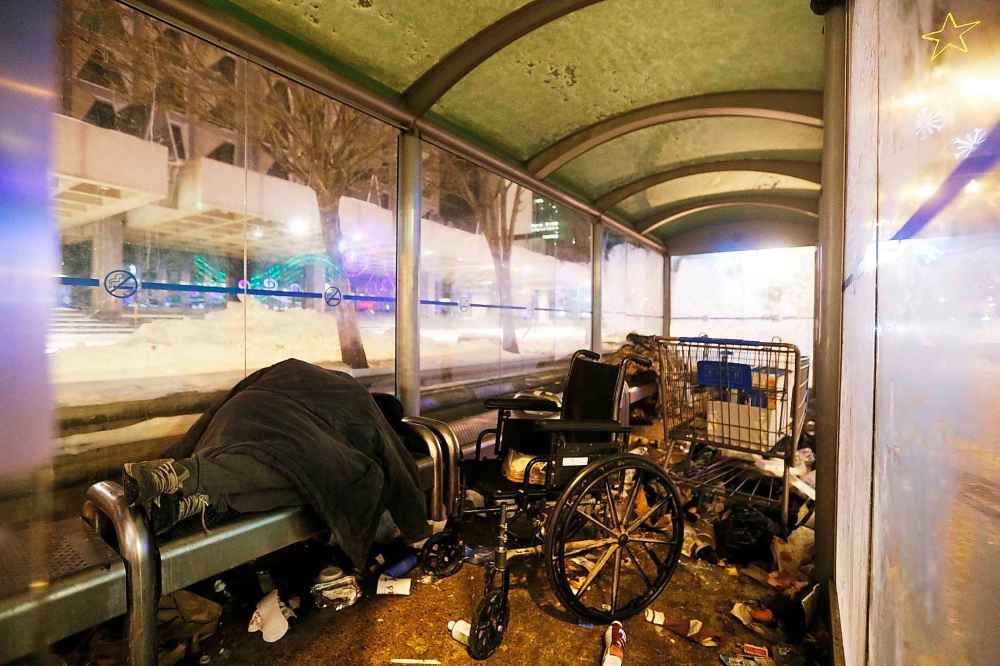
On the Main Street strip and down the side streets, along Portage Avenue and St. Anne’s Road, from St. Boniface to Osborne.
So much need out in the open.
And a long winter to come.
ryan.thorpe@freepress.mb.ca

Ryan Thorpe likes the pace of daily news, the feeling of a broadsheet in his hands and the stress of never-ending deadlines hanging over his head.
Our newsroom depends on a growing audience of readers to power our journalism. If you are not a paid reader, please consider becoming a subscriber.
Our newsroom depends on its audience of readers to power our journalism. Thank you for your support.