A changing menu Shifting climate means there are differences in the seal population that makes up the biggest part of polar bears' diet, differences in the fish the seals eat
Read this article for free:
or
Already have an account? Log in here »
To continue reading, please subscribe:
Digital Subscription
One year of digital access for only $1.44 a week*
- Enjoy unlimited reading on winnipegfreepress.com
- Read the E-Edition, our digital replica newspaper
- Access News Break, our award-winning app
- Play interactive puzzles
*Billed as $5.77 plus GST every four weeks. After 52 weeks, price increases to the regular rate of $19.95 plus GST every four weeks. Offer available to new and qualified returning subscribers only. Cancel any time.
To continue reading, please subscribe:
Add Free Press access to your Brandon Sun subscription for only an additional
$1 for the first 4 weeks*
- Enjoy unlimited reading on winnipegfreepress.com
- Read the E-Edition, our digital replica newspaper
- Access News Break, our award-winning app
- Play interactive puzzles
*Your next Brandon Sun subscription payment will increase by $1.00 and you will be charged $17.95 plus GST for four weeks. After four weeks, your payment will increase to $24.95 plus GST every four weeks.
Read unlimited articles for free today:
or
Already have an account? Log in here »
Hey there, time traveller!
This article was published 30/10/2020 (2185 days ago), so information in it may no longer be current.
At the break of dawn, Jillian St. George bundles up to head out on the water — it’s time to do some fishing. Even in August, the wind and occasional stretches of rain make for a frigid morning.
St. George, a biological sciences master’s student at the University of Manitoba, sits shotgun as the boat crashes through the waves at the mouth of Hudson Bay, where the Churchill River flows in.
She’s not fishing for subsistence or even enjoyment. She’s fishing so she can better understand how harbour seals are using the Churchill River and what kind of fish they’re eating.
“The objective is to see what proportion of the diet is marine, versus freshwater,” St. George says. At this critical location where Hudson Bay meets the freshwater river, she wants to know how animals are moving between the two systems.
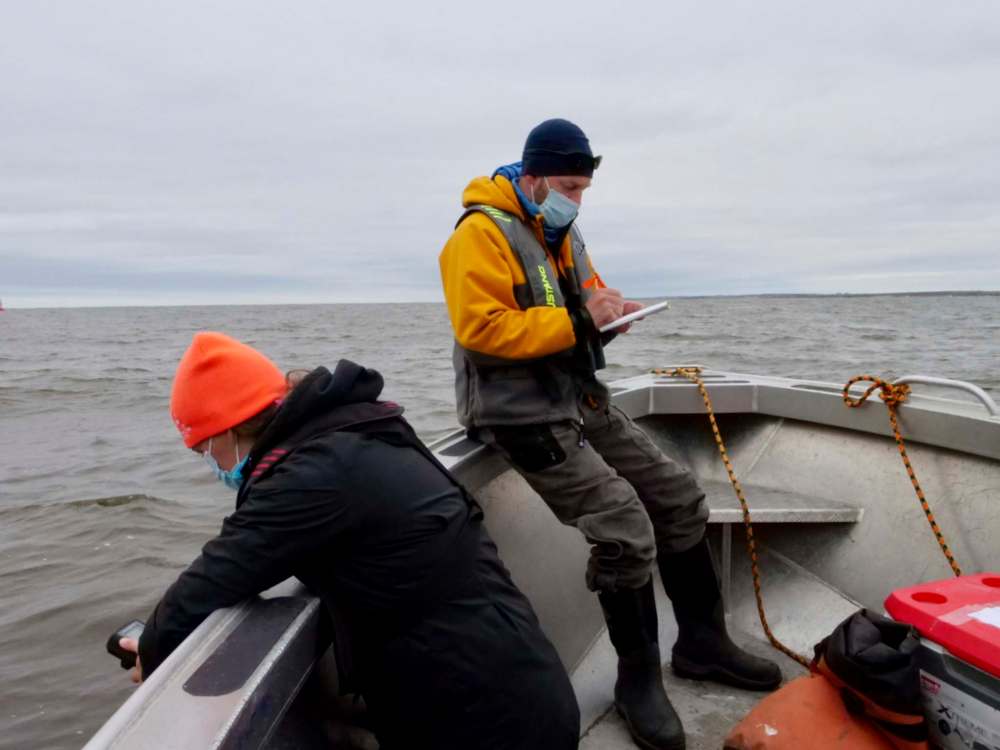
“This is our second season, so we’re just trying to get more of the prey database. So, trying to collect more fish, invertebrates, we’re also collecting vegetation,” she says.
Using different samples from fish and seals, she can monitor how the diet shifts over seasons. Next year, the hope is to be able to deploy geolocator tags and backpacks on the seals to track their movement.
St. George’s research is one piece of the puzzle that will answer questions about how harbour seals use the Churchill River. Her adviser Stephen Petersen, the director of conservation and research at the Assiniboine Park Conservancy, is looking over time and across projects to more broadly understand what’s happening to seal populations in this region as a result of climate change and other environmental factors.
He joins St. George today for the fishing expedition. He throws his line over the side of the boat with a piece of raw bacon attached. The water sloshes the side of the boat as a lone polar bear prowls along the shoreline nearby.
Petersen is primarily interested in ringed and harbour seals.
“We’ve been trying to figure out how the two populations might be changing,” Petersen said.
“We’ve been trying to figure out how the two populations might be changing.”
– Stephen Petersen
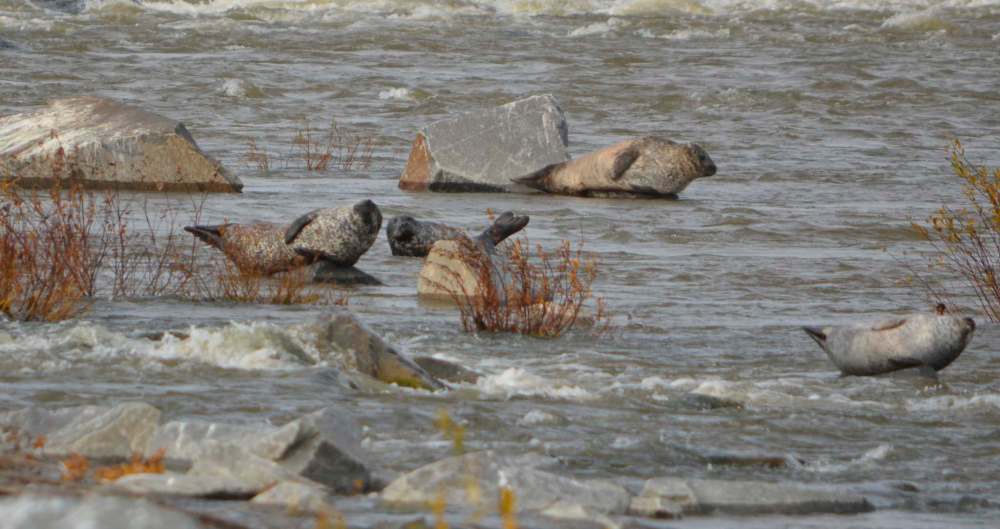
Harbour seals tend to be found in more temperate waters. They’re limited in their northern range since they’re poorly adapted to sea ice and have difficulty maintaining breathing holes. As such, in this region, they’re less common than the ringed seal, but that ratio could be shifting.
Research Petersen conducted with some of his other students, published in 2018 in Polar Biology, showed that the local harbour seal population is increasing as sea ice decreases.
“When there’s less ice on the bay, it’s usually also looser ice, so there’s more options to get away from polar bears, then the ice breaks up early enough that they can get into the rivers and pup when there’s no polar bears around. So, they basically escape predation as pups,” Petersen says.
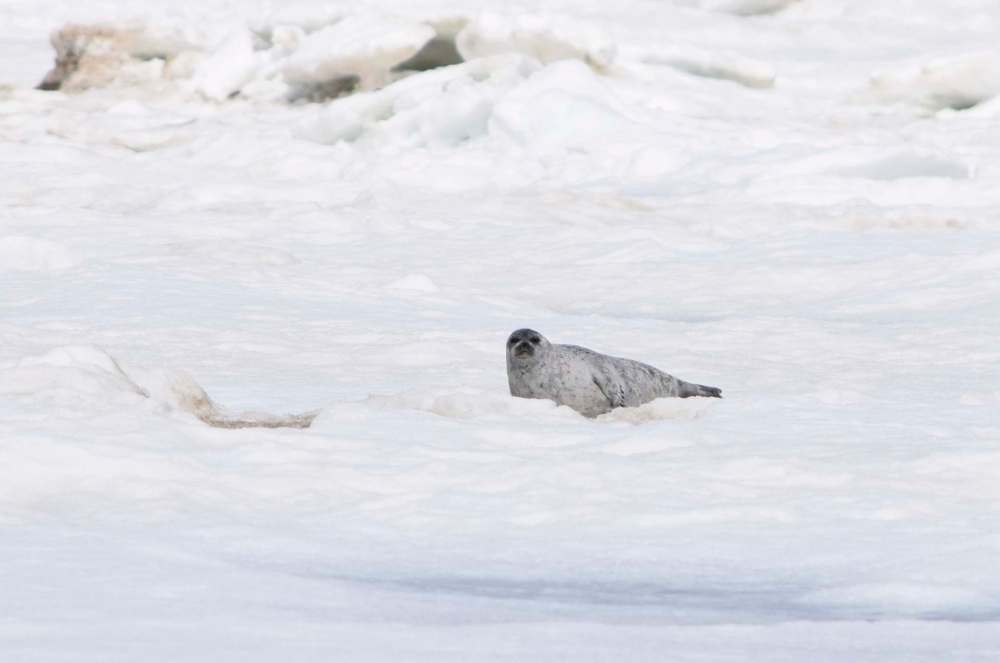
Meanwhile, research efforts are ongoing with regards to the ringed seal population, but surveys of the animal are more difficult and more expensive to conduct — and a changing climate is making it more difficult still.
In the past, the seals would haul out (a period of time where the typically waterbound animals come onto land or ice to rest, reproduce or moult) in the spring as the ice is breaking up, Petersen explains. When the animals are out of the water it’s obviously easier to try to count them.
“Now, because the ice is breaking up earlier, when we try and fly surveys, we get weathered out quite often because there’s more open water, so there’s more fog, so you can’t do the surveys,” Petersen says.
“So the ringed seal counts have been declining but we don’t know if it’s a decline in the number of ringed seals, or a change because the ice is breaking up.”
Having pursued data collection on the ringed seal population for six years now, it’s a matter of the research team crunching the numbers and seeing if there is any correlation to ice break up and other factors at play in the ecosystem.
As the interview relocates to the Lazy Bear cafe, Petersen presses his hands against his coffee mug to warm them after a fruitless morning of fishing.
“You know, as things change, it’s not going to go from this certain ecosystem to an empty ecosystem. It’s going to transition to some new state,” he says.
“So, maybe it’s less ringed seals and more harbour seals; different kinds of fish are going to switch over, and those kinds of things. And understanding how those things are changing helps manage, adapt, contribute to our understanding of what’s going on. And it’s nice here because we’ve got this little window — because of the location and the time — to understand the ecosystem before we add in heavy anthropogenic (human-caused) impacts, like more shipping, more people on the landscape; all of these things are changing, as well.”
“You know, as things change, it’s not going to go from this certain ecosystem to an empty ecosystem. It’s going to transition to some new state.”
– Stephen Petersen
Whatever those shifts are, they will have cascading consequences that are still poorly understood. Seals in the western Hudson Bay are the most important food source for the stars of the show, after all.
Nick Lunn, a research scientist with Environment and Climate Change Canada, studies polar bears in this region. Sea-ice decline caused by climate change is the primary concern for the health of the polar bear population. However, other factors are likely playing into the population’s decline as well, including how other levels of the food chain are being impacted. Tracking apex predators often gives researchers a good sense of the health of other animals in the ecosystem.
Ringed seals comprise between 55 and 80 per cent of a bear’s diet, Lunn says, while adult males are more likely to also feast on a third, much-larger species, the bearded seal. But the possible deterioration of the ringed seal population might be another factor leading to the decline of the polar bear population.
“Just like how polar bears aren’t as fat as they used to be, there’s some evidence that ringed seals also aren’t as fat as they used to be,” Lunn says.
Meanwhile as the population of harbour seals ticks upward, that species is showing up in polar bear diets more often, he says.
● ● ●
Steve Ferguson, a scientist with Fisheries and Oceans Canada, says research has demonstrated that in bad ice years ringed seals, in particular, are susceptible to diseases, because the sea ice is where they moult.
“If that’s not able to occur because the ice is gone there seems to be all these other problems there,” Ferguson says.
However, the overall population has remained fairly stable so far.
“We’re seeing some changes in body condition for seals, and we’re seeing some problems like up and down years that we didn’t see before,” he says. “So, we know some bad stuff is going on but we haven’t been able to show that the actual numbers have decreased.”
Anecdotally, Inuit hunters who supply biological samples to Fisheries and Oceans Canada from seals killed in Nunavut have said that depending on the season, they are noticing differences in the quality and taste of seals they catch.
Poor sea ice years and limited food availability more immediately result in poor body condition in seals when compared to larger animals such as the bears or the whales. To complement St. George’s research, Ferguson says he’s tracked changes in the kinds of fish appearing in seals’ diets.
“There was a time when we could get Arctic cod in Hudson Bay and that’s pretty rare now. But now we’re seeing a lot more capelin and sand lance, especially in the diet of the seals. The capelin have also become important for the beluga whales. And this is pretty unusual if you go to more northern areas where the seals and whales live. They would pretty much focus on Arctic cod.”
“We know some bad stuff is going on but we haven’t been able to show that the actual numbers have decreased.”
– Steve Ferguson, Fisheries and Oceans Canada scientist
While more diverse food sources aren’t necessarily a bad thing, the biggest benefit of eating the Arctic cod is that they’re very lipid-rich, Ferguson says. Without that fish in their diet, it could be that seals have a more difficult time building up fat.
The same way Grizzly bears, red foxes and meadow voles are expanding their ranges northward on land, a similar “borealization” of the aquatic environment is being witnessed, where fish accustomed to more temperate environments are now able to make this region home, he says. But other traditionally Arctic species are becoming less common, if not disappearing from these parts, altogether.
“My main focus is on marine shift,” he says. “So, I’m interested in knowing how this works, the mechanisms of change. We know the planet is warming up. We know places like Hudson Bay — at least for Arctic marine mammals — is going to be one of the first places that we’re going to see some major changes…
“So the shifts in where the whales and seals will be able to live is of interest to me. That’s what we’re trying to follow, trying to understand and then make some predictions for other areas.”
sarah.lawrynuik@freepress.mb.ca