

Tragic theatre
Building's collapse killed four firefighters

Advertisement
Read this article for free:
or
Already have an account? Log in here »
To continue reading, please subscribe:
Monthly Digital Subscription
$1 per week for 24 weeks*
- Enjoy unlimited reading on winnipegfreepress.com
- Read the E-Edition, our digital replica newspaper
- Access News Break, our award-winning app
- Play interactive puzzles
*Billed as $4.00 plus GST every four weeks. After 24 weeks, price increases to the regular rate of $19.95 plus GST every four weeks. Offer available to new and qualified returning subscribers only. Cancel any time.
Monthly Digital Subscription
$4.99/week*
- Enjoy unlimited reading on winnipegfreepress.com
- Read the E-Edition, our digital replica newspaper
- Access News Break, our award-winning app
- Play interactive puzzles
*Billed as $19.95 plus GST every four weeks. Cancel any time.
To continue reading, please subscribe:
Add Free Press access to your Brandon Sun subscription for only an additional
$1 for the first 4 weeks*
*Your next subscription payment will increase by $1.00 and you will be charged $16.99 plus GST for four weeks. After four weeks, your payment will increase to $23.99 plus GST every four weeks.
Read unlimited articles for free today:
or
Already have an account? Log in here »
Hey there, time traveller!
This article was published 18/10/2015 (3765 days ago), so information in it may no longer be current.
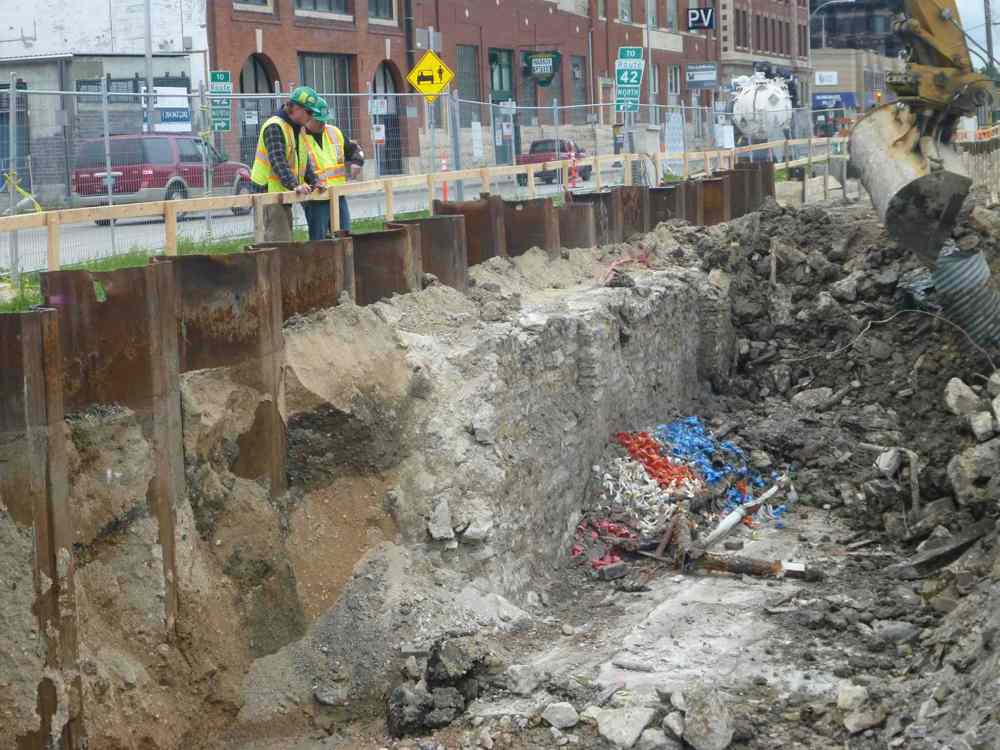
There is a powerful new development taking shape at the intersection of Adelaide Street and Notre Dame Avenue. Manitoba Hydro is driving the piles for its $62-million Adelaide substation, which will serve downtown for decades to come. During the excavation phase this summer, workers unearthed the remnants of an important building from the city’s past: the Winnipeg Theatre, which was razed by a spectacular and deadly fire Dec. 23, 1926.
The theatre was built in 1883 as Victoria Hall. It was one of the city’s first large-scale meeting places, featuring a number of commercial spaces on the main floor and an upstairs assembly hall that could seat up to 1,400. The project was financed by Thomas McCrossan, an established dry-goods merchant from Ontario who couldn’t resist the lure of Winnipeg’s land boom of the early 1880s.
From the time it opened, Victoria Hall played a more important role in the early history of the fledgling city than McCrossan could have imagined.

Winnipeg’s first city hall, built on an old creek bed in 1876, had long suffered from foundation issues, and in April 1883 had to be torn down. Desperate for temporary space in which to relocate city services, council opted to lease Victoria Hall until the new “gingerbread” city hall opened in 1886.
After the city moved out, the newly arrived Salvation Army set up their first headquarters and worship space on the main floor.
One man who figured prominently in the ownership of the building was Corliss P. Walker, of Walker Theatre fame. In 1897, he and wife, Harriet, bought the hall, by that time known as the Bijoux Opera House, and spent $75,000 to turn it into a proper theatre with a full-sized stage, sloping floors and seating for 800. They rechristened it the Winnipeg Theatre, and it became the central hub of their small vaudeville circuit until the construction of the Walker Theatre in 1907.
Even after their custom-built theatre opened, Walker retained a one-third ownership of the Winnipeg Theatre until early 1926, when the ownership group went bankrupt. At the subsequent auction sale, Walker was the only bidder, paying $28,000 — a fraction of the assessed value.
The reason for the great deal was the theatre, with its brick veneer on timber-frame construction, was considered a fire trap. Ever since the 1903 Iroquois Theatre fire in Chicago that killed more than 600 people, cities across North America were wary of theatres built in the previous century. In 1916, while the Winnipeg Theatre was undergoing a major renovation, there was debate at city hall as to whether it should be allowed to reopen at all.
In 1926, the city upgraded its building bylaw to force theatre owners to put in new fire-protection measures, including more hose stations, a sprinkler system behind the proscenium and a fire alarm. The city’s major theatres complied, with the exception of the Winnipeg Theatre. On Dec. 8, 1926, a representative from the theatre appeared before the civic safety committee to argue because it only hosted occasional events, it should be exempt from the new rules, at least until a permanent theatre group moved in.

Alderman James Simpkin noted churches, which also offered occasional performances, had already been forced to comply with the bylaw and quipped, “It is just as unpleasant to be burned to death in a church as it is a theatre.” The request was referred to a subcommittee for further study, but that report would never be produced. Two weeks later, the Winnipeg Theatre was gone.
At around 10 a.m. on the morning of Dec. 23, 1926, the fire department began receiving calls reporting smoke was coming from the Winnipeg Theatre. Crews from Fire Hall No. 2, located on Smith Street at York Avenue, were the first to respond.
Despite the thick, black smoke, some of the men made their way into the theatre lobby. While there, the roof of the building collapsed, and the walls of the building started to bow. At that point, fire chief J.E. Buchanan knew the building was doomed and ordered the men out. While they were in the process of evacuating, a large portion of wall from the Adelaide Street elevation collapsed onto the sidewalk below, burying some firefighters and temporarily trapping others in the lobby.
Ambulances and police cars took 10 men to hospital. When roll call was taken, three were not accounted for. It would take more than five hours before the burning rubble could be sifted through to find their bodies.
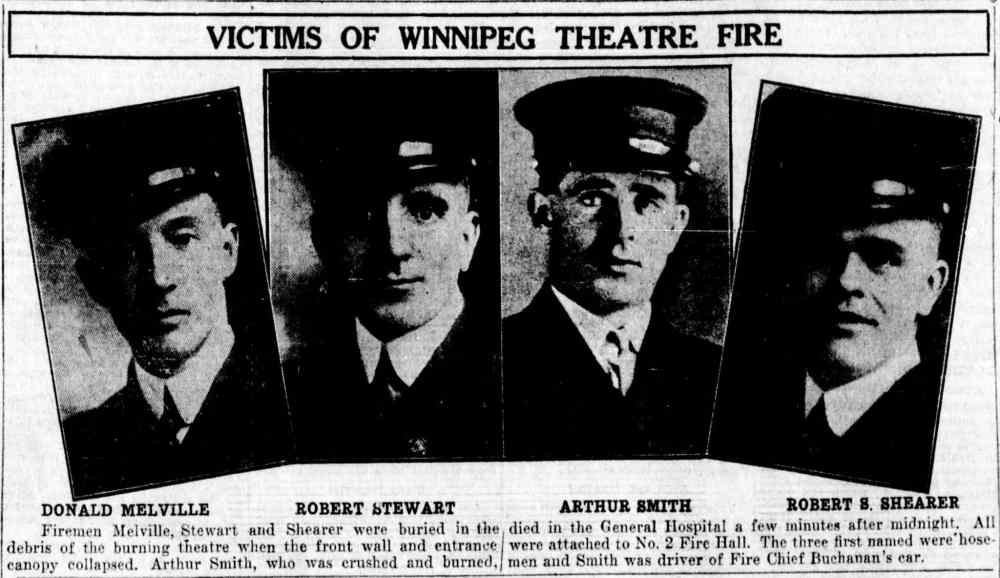
All three men were from Fire Hall No. 2, veterans of the First World War and had wives and small children: Donald Melville, 41, of Langside Street; Robert Stewart, 37, of Seymour Street; and Robert S. Shearer, 33, of Ashland Avenue. At around midnight, Arthur Smith, 38, of Strathcona Street, the driver of the fire chief’s car and also a veteran with children, died from injuries he sustained when struck by falling debris.
The city was shocked by the tragedy, the worst ever for Winnipeg’s fire department. The fact all four men left behind families spurred the creation of a widows and orphans fund. The fund raised more than $20,000 through individual donations and the receipts from special concerts and shows, which paid the families a small monthly income, then a $1,600 lump sum to each child when they turned 16.
The funeral for the four firefighters took place at St. Giles’ Church on Burrows Avenue on Dec. 27. The 1,100-seat church was packed, and hundreds more gathered outside. When the service was over, it took an hour-and-a-half for all of those assembled to file past the bodies, which lay in state.
Following the ceremony, each coffin was loaded onto a hose truck, and a lengthy cortège of firefighters, policemen, civic staff, loved ones and strangers slowly made its way to Elmwood. All four men are buried side by side.
In the aftermath of the tragedy, three investigations were held: one by the provincial fire commissioner, a coroner’s inquest and an operational review by the city. Most of their findings mirrored each other.
There was some finger-pointing as to whether the city should have allowed the theatre to remain open, and it was recommended the fire department and building inspection department work more closely together on potentially dangerous buildings. The fire chiefs on scene were also criticized for a lack of communication that allowed the men to go inside the building in the first place.

A rumour about a wild, all-night party at the theatre the night before the fatal fire led police to round up a number of men. It was later determined the soiree was little more than four musicians having drinks backstage.
The Walker Theatre’s caretaker, who was also responsible for the Winnipeg Theatre, had been inside the building less than half an hour before the first alarm call came into the fire department. He testified he checked the thermostat, went to the basement to fuel the boiler and then promptly left. Though the coroner’s jury suspected his testimony might not have been complete, the fact the fire likely started in a wall in the upper portion of the building, nowhere near the boiler or mechanical rooms, seemed to exonerate him.
Despite the three investigations, no cause was ever determined for the Winnipeg Theatre fire.
Christian Cassidy writes about local history on his blog, West End Dumplings.
Our newsroom depends on a growing audience of readers to power our journalism. If you are not a paid reader, please consider becoming a subscriber.
Our newsroom depends on its audience of readers to power our journalism. Thank you for your support.
Our newsroom depends on a growing audience of readers to power our journalism. If you are not a paid reader, please consider becoming a subscriber.
Our newsroom depends on its audience of readers to power our journalism. Thank you for your support.
Related Articles
‘I’ve basically been in this room for 3 1/2 years’: lengthy wait for new wheelchair decried

Advertisement Advertise With Us
Advertisement Advertise With Us
History
Updated on Monday, October 19, 2015 10:40 AM CDT: Photos added.