Stepping up for the planet The personal and the political take centre stage in Contemporary Dancers’ new season

Water runs and rages, flows and drips through the opening performance of Winnipeg’s Contemporary Dancers’ 59th season.

Read this article for free:


or

Already have an account? Log in here »

To continue reading, please subscribe:

Subscribe and receive a limited-edition Free Press branded hat or tote.

Digital Subscription

One year of digital access for only $205*

  • Enjoy unlimited reading on winnipegfreepress.com
  • Read the E-Edition, our digital replica newspaper
  • Access News Break, our award-winning app
  • Play interactive puzzles

*First annual payment billed as $205.00 + GST for one year. This annual subscription will automatically renew at $233.00 + GST every 52 weeks (10% off the regular annual price of $259.35). Offer available to new and qualified returning subscribers only. Cancel any time.

To continue reading, please subscribe:

Add Free Press access to your Brandon Sun subscription for only an additional

$1 for the first 4 weeks*

  • Enjoy unlimited reading on winnipegfreepress.com
  • Read the E-Edition, our digital replica newspaper
  • Access News Break, our award-winning app
  • Play interactive puzzles
Start now

*Your next Brandon Sun subscription payment will increase by $1.00 and you will be charged $17.95 plus GST for four weeks. After four weeks, your payment will increase to $24.95 plus GST every four weeks.

Hey there, time traveller!
This article was published 06/11/2023 (1027 days ago), so information in it may no longer be current.

Water runs and rages, flows and drips through the opening performance of Winnipeg’s Contemporary Dancers’ 59th season.

The Impossible Has Already Happened is a multimedia dance production that uses water as a vessel for discussing the human and environmental implications of climate change. The piece — which is currently touring through Western Canada — is an international collaboration between choreographers Claire O’Neil of Footnote Dance New Zealand and Jennifer Mascall of Vancouver’s MascallDance.

The pair started working together virtually amid the pandemic and quickly found common ground.

“We both use text in our work, we both work from improvisation, we both are interested in social dance,” Mascall says over the phone during a stop in Medicine Hat, Alta. “There were many, many similarities, though the esthetics are slightly different and that just adds a little bit of spice.”

One similarity, however, didn’t fit with a modern dance about a pressing modern issue.

“We were trained in this (tradition) of making conceptual and experimental work. And we both felt that it didn’t actually have a place in the 21st century,” says Mascall, who was born in Winnipeg. “What needs to be addressed now through art is how artists can partner with scientists, with people … to do what we can to help the environment.”

The choreographers consulted with marine biologists, activists and Indigenous elders to better understand the cultural, biological and environmental power of water. They set out to create an eclectic piece that would inspire movement in others.

“All the facts we give to people are not making a dent,” Mascall says. “(Artists need to) tell the story so people can feel it.”

Impossible opens in Winnipeg on Friday with a cast of dancers from Canada and New Zealand, including choreographer O’Neil and her 10-year-old daughter. The 60-minute performance is a blend of contemporary dance and theatre supported by live music from Métis fiddler Kathleen Nisbet.

Water is present, thematically, in large audio-visual projects and physically in ice lights designed to melt throughout the performance.

Jolene Bailie, artistic director of Winnipeg’s Contemporary Dancers (WCD), is looking forward to bringing an international production with global themes to a local audience.
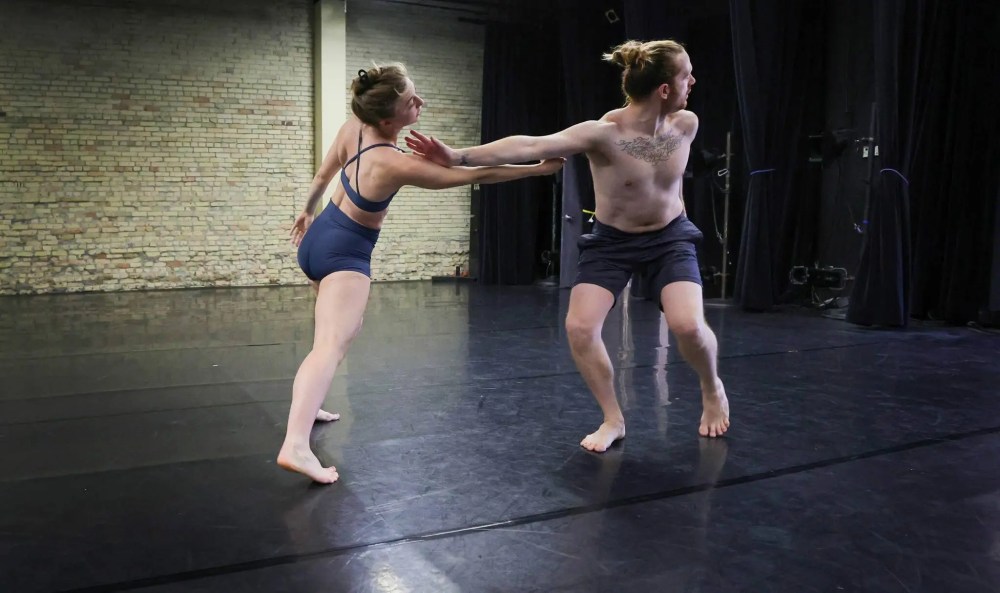
“We’ve been trying to bring in one show a season from elsewhere,” she says of the company’s programming goals. “The enormity of the climate crisis is overwhelming to a lot of us as individuals, so I think this is really relevant.”

WCD’s forthcoming season also includes two as-yet-unnamed new creations from Bailie and from Toronto-based Métis choreographer Jera Wolfe — who was first commissioned by the company in 2020, but was forced to present online amid the pandemic.

During a recent visit to Rachel Browne Theatre, Bailie was busy working on a duet that will be part of her May performance. As a choreographer, she aims to create one new dance per year. The process usually starts with casual, piecemeal rehearsals months out from opening night.

“It’s hard to walk into a big empty space with a bunch of people looking at you, like ‘OK, we’re going to make a (dance),’” Bailie says with a laugh. “We’ll have maybe some solos, duets, smaller group things already in existence before we bring the whole group together.”

The approach, says Bailie (whose work is known for its physicality), allows for collaboration and conditioning, “it’s like an airplane taking off instead of a helicopter.” Music is added in later stages.

Bailie’s current work-in-progress deals with decision-making and is a followup to last year’s new release, entitled retuning.

“Creation is also a process of accumulation; I always feel like the next work starts off where the previous work left off,” she says, “A lot of the work I create might be ambiguous or abstract — there’s always a desire to… understand what it means to be a human being.”

eva.wasney@winnipegfreepress.com

X: @evawasney

Eva Wasney

Eva Wasney
Arts Reporter

Eva Wasney is a reporter for the Winnipeg Free Press.

Our newsroom depends on a growing audience of readers to power our journalism. If you are not a paid reader, please consider becoming a subscriber.

Our newsroom depends on its audience of readers to power our journalism. Thank you for your support.


Report Error Submit a Tip

More Stories

Former Beer Mile world champion wins Manitoba Marathon

Taylor Allen 6 minute read Preview

Former Beer Mile world champion wins Manitoba Marathon

Taylor Allen 6 minute read Sunday, Jun. 17, 2018

Corey Gallagher has won another big race, but this time, he didn't have to chug a couple beers along the way.

Gallagher is a former beer mile world champion and record holder, a sport where you run four laps around a track and have to down a beer after each lap. But no beer was required on Sunday at the 40th annual Manitoba Marathon and the 31-year old Winnipeg native still led the pack, despite the fact it was the first time Gallagher had ever ran a full marathon. But the lack of experiene was no problem, as he was the first to cross the finish line inside Investors Group Field to win the men's full marathon at 2:37:48.5.

"This is pretty high up there," said an exhausted Gallagher, ranking his marathon victory to his 2014 Beer Mile world championship. "I was always scared of a full (marathon). I'm just happy to get it done and check it off the bucket list."

Gallagher ran the half marathon at the event for years, before missing the last three or four due to several injuries. Gallagher was just happy to finally be healthy enough to be competiting again, although he's not so sure if he will defend his title at next year's marathon as he said "nothing can prepare you for (a full marathon) properly."

Read
Sunday, Jun. 17, 2018

Of frogs, roses, kings and a Great Lake

Editorial 4 minute read Preview

Of frogs, roses, kings and a Great Lake

Editorial 4 minute read 2:01 AM CDT

A rose by any other name would smell as sweet, as the saying goes. Basically, if you change something’s name, you don’t actually change the nature of the thing.

That being said, if even 15 years ago an American president had called an entire news conference to announce he was renaming one of the Great Lakes by writing on a map with a red pen and issuing an executive order purporting to rename Lake Ontario as “Lake America,” all and sundry would question his mental health.

Maybe, after witnessing so much from Donald Trump, we’ve all just been hardened off and the foolish is now expected daily. Perhaps it’s the political equivalent of the fable of the boiling frog.

As the fable goes, drop a frog into a pot of boiling water and it will jump right out. But put the frog in room temperature water and bring the pot to a boil, the frog will stay until its death. (It’s unlikely the frog would actually wait.)

Read
2:01 AM CDT

Canada vs. the United States — evenly matched

Gwynne Dyer 5 minute read 2:00 AM CDT

Canada’s “trade war” with the United States, ignited on Aug. 21 when Prime Minister Mark Carney walked out of trade talks with the Trump administration, is not the foredoomed David vs. Goliath struggle it seems.

It’s really about sovereignty, not trade, and Canada stands a fair chance of winning.

“Winning” in this context, of course, can be defined as surviving with as little damage as possible despite the tenfold superiority in population and wealth of its giant neighbour. Canada has had more than two centuries of practice at that. If Carney can keep his nerve, it can do it again.

The tariffs that Trump has imposed on some Canadian products (and the precisely equal tariffs that Canada has slapped on some American imports) will cause some job losses and considerable economic pain in both countries. However, they only affect about five per cent of the US$872 billion of annual trade between the two countries.

Occupied Ukraine holds Kremlin-staged vote on joining Russia

Hanna Arhirova, The Associated Press 8 minute read Preview

Occupied Ukraine holds Kremlin-staged vote on joining Russia

Hanna Arhirova, The Associated Press 8 minute read Friday, Sep. 23, 2022

KYIV, Ukraine (AP) — A Kremlin-orchestrated referendum got underway Friday in occupied regions of Ukraine that sought to make them part of Russia, with some officials carrying ballots to apartment blocks accompanied by gun-toting police. Kyiv and the West condemned it as a rigged election whose result was preordained by Moscow.

Meanwhile, in a grim reminder of the brutality of the 7-month-old invasion, U.N. experts and Ukrainian officials pointed to new evidence of Russian war crimes. Kharkiv region officials said a mass burial site in the eastern city of Izium held hundreds of bodies, including at least 30 displaying signs of torture.

The referendums in the Luhansk, Kherson and partly Russian-occupied Zaporizhzhia and Donetsk regions were widely seen as a prelude to Moscow annexing the regions. The voting, which was overseen by authorities installed by Russia, is scheduled to run through Tuesday and is almost certain to go the Kremlin's way.

Authorities in the Kherson region said residents of a small Moscow-controlled area of the neighboring Mykolaiv province also will be able to vote, and that small area was “incorporated” into Kherson until all of Mykolaiv is taken over by Russian forces.

Read
Friday, Sep. 23, 2022

Tories likely to follow giant leap towards balanced budget with a step or two in other direction

Tom Brodbeck 5 minute read Preview

Tories likely to follow giant leap towards balanced budget with a step or two in other direction

Tom Brodbeck 5 minute read Friday, Sep. 27, 2019

The only problem with slashing the size of the deficit as much as the province did last year is it’s going be tough for government officials to explain why the shortfall will likely be higher this year — and maybe next year, too.

Last year’s deficit came in at a surprising $163 million, according to the province’s public accounts released Thursday. That’s well below the budgeted shortfall of $521 million. It’s great news. The sooner the province stops borrowing money to finance its daily operating costs, the closer it will be to paying down debt and freeing up more money for front-line services (and cutting taxes). It’s a major accomplishment for a government that, just three years earlier, inherited a deficit of $932 million and a debt that was growing at about $2 billion a year.

Considering government is so close to balance, it’s tempting to assume they could be back in the black as early as next year. After all, what’s $163 million in a $17.4-billion budget? It’s less than one per cent.

But there were some unique reasons why the deficit fell so dramatically last year, many of which were due to one-time events. The stars probably won’t align like that anytime soon. Which means this year's deficit, and maybe next year's, could be higher.

Read
Friday, Sep. 27, 2019

Leaked data prompts news backlash in Canada, U.S.

James McCarten, The Canadian Press 5 minute read Preview

Leaked data prompts news backlash in Canada, U.S.

James McCarten, The Canadian Press 5 minute read Friday, Feb. 18, 2022

WASHINGTON - Journalists in Canada and the United States, veterans of a daily grind that entails tracking down and chatting up newsmakers, politicians and ordinary citizens by whatever means necessary, are encountering a very different — and hostile — world as they work to learn more about supporters of the protests in Ottawa.

Reporters are being harassed, spammed, "doxxed" and even threatened for reaching out to donors to an online crowdfunding campaign that was targeted last week by hackers who disclosed the contact details of thousands of pro-trucker contributors.

"I actually had someone come to my door and leave a threatening note," said Bryan Schott, a political reporter with the Salt Lake Tribune who used the list to send emails to donors with Utah zip codes.

In Schott's case, along with countless others, people have been using social media to post screen shots of emails they've received from reporters — usually innocuous queries asking for confirmation that they had donated to the protesters and whether they'd agree to an interview.

Read
Friday, Feb. 18, 2022