|
Over the course of the last — what has it been, 19 months? — I’ve somehow managed to be the only one in our household to avoid getting a swab jammed up my nose for a COVID-19 test.
Just last week my daughter had her fourth or fifth COVID-19 test after developing a nasty cough, runny nose and sinus congestion. (Negative.) We thought we were out of the weeds until my son picked up many of the same symptoms two days ago. (Results of what I think was his sixth test are pending.)
What does the plight of my snotty kids have to do with food and drink? Well, as someone who, in a normal year (remember those?), sniffs and sloshes upwards of 2,000 wines a year, I’m always worried about catching a cold or anything that will impact my sense of smell or taste. And by all accounts, one of the most common symptoms of COVID-19 has been the loss of those senses.
Advertisement

U.K. wine writer (and friend of mine) Jamie Goode contracted COVID-19 in March 2020, and noted the ways in which it impacted his senses of taste and smell. His story, and those of other wine professionals who contracted COVID, are here. The impact on smell and taste can be significant and take quite a while to return to normal — if they do at all.
Obviously the loss of smell and taste is peanuts compared to the more serious impacts associated with COVID-19, particularly as we come to understand more about the long-term effects of the novel coronavirus. But for those of us whose livelihood includes using said senses, it’s still cause for concern.
Case in point: The oenological boot camp of the 2021 WineAlign National Wine Awards of Canada, where I tasted roughly 400 Canadian wines over the course of the five days. (More about that here.)
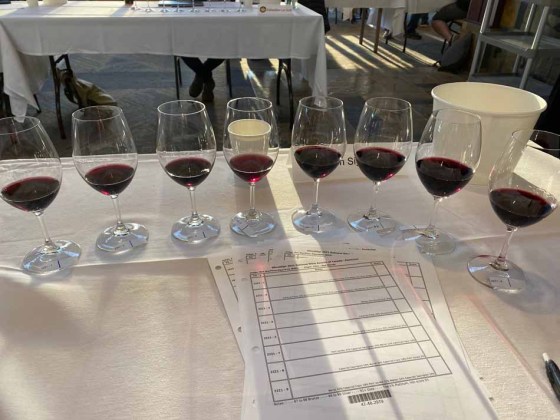
Nothing like starting your day with a lineup of eight big Canadian red blends, then doing that again 9-10 times a day for five days. (Ben Sigurdson / Winnipeg Free Press)
Every morning, when the first flight of 8-10 wines were brought to our judging tables at 8:30 a.m., I’d do a bit of a self-assessment, first sniffing my way through all of them before tasting to see if I could pick up aromatic differences between, say, a bunch of Merlots. And, thankfully, each time I was able to pick up subtle variations between the wines. (We were also subject to daily temperature checks and other safeguards throughout the competition.)
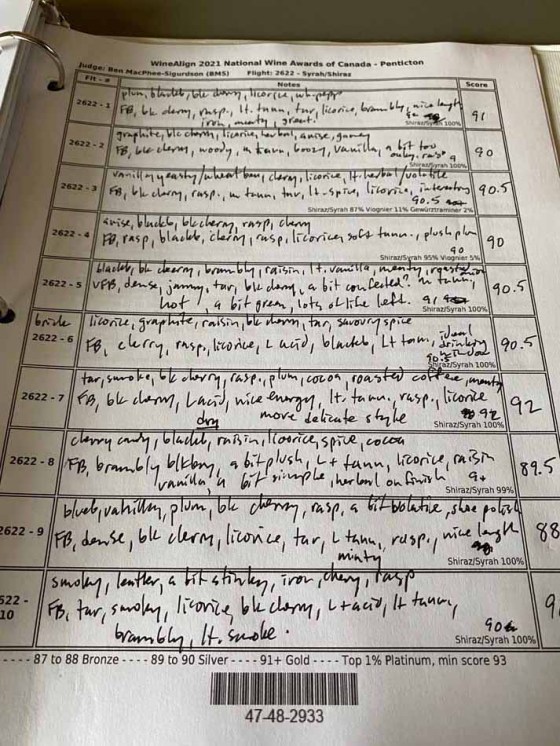
Just one page of a binder full of my chicken-scratch, short-hand tasting notes from the 2021 WineAlign National Wine Awards of Canada. In each box the top line is what I smell in the wine, and the bottom 1-2 lines how it tastes. (Ben Sigurdson / Winnipeg Free Press)
When it comes to picking up faults in wine, I’ve long been particularly sensitive to the effect of 2,4,6-trichloroanisole (or TCA) on a bottle. If you’ve ever had a wine that smelled/tasted like wet cardboard, or moldy newspaper, or wet dog (ew), chances are your wine has been impacted by TCA. Usually it means the cork in a bottle of wine hasn’t been properly or completely sterilized, allowing TCA, or cork taint, to impact the wine. (If the wine in question is bottled under screwcap and brings these flavours, well, chances are the wine’s just poorly made.)
I bring this up because last week we opened a very nice bottle of Italian red, the Occhipinti 2016 Siccagno, given to my partner by her former boss. I’d not tried the wine before, but after cutting through the thick wax, pulling the cork and pouring the wine into the glass, I took a big whiff and immediately detected that wet cardboard note of TCA — the wine was corked. This was a $60ish bottle of red wine that I desperately wanted to love, and underneath those musty notes I could tell there was a gem there waiting to be enjoyed.
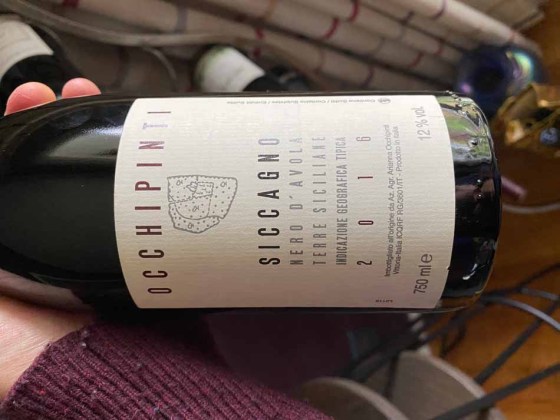
If you think a wine is faulted — if it seems corked, or if the wine smells/tastes like nail polish remover or onions or rotten eggs or the like — don’t dump it out or, worse, plug your nose and drink it.
If you’re at home, pour it back in the bottle, jam the cork back in the thing and take it back to the store from whence it came for an exchange, which is exactly what I did with the Occhipinti (thanks to the good folks at Ellement Wine + Spirits at The Forks Market for being so understanding). If you’re at a restaurant, alert your server about the potentially faulty wine and ask for another bottle. Because life is too short to drink corked wine.
|