The Macro
It was the summer of 1982 and I had a job painting the Alliston Memorial Arena, located about 90 minutes north of Toronto. It was the last summer before I went to university in Ottawa and I was desperate to make some money. So, I worked 10 hours a day in the blazing mid-summer heat painting the inside and outside of an aging arena.
As a job, painting is fun for like two days. And then, it becomes really, really boring. The only thing that saved me from going stark-raving bonkers that summer was — wait for it — The Clash.
The first time I heard The Clash’s Combat Rock, arguably the seminal album from one of the seminal rock bands of the 20th century, I was standing on the top platform of a 20-foot-high, rolling scaffold, painting the ceiling of the arena’s community hall. The album had just been released a few months earlier and I was vaguely aware some of the songs had been making their way onto Top 40 radio.
The first time I heard the scalding guitar riff at the beginning of Should I Stay, or Should I Go, I was in love.
At the time, I was a bit of a music nerd. I was big into Elton John, Bruce Springsteen, Supertramp and Fleetwood Mac. But I’d be the first to admit my musical tastes were a bit pedestrian. I can’t remember if I’d even heard about Joe Strummer, co-founder and spirit guide for The Clash, or paid much attention to the wave of British punk rock that was washing over North America.
But one of the guys I was working with knew about The Clash, and given that he was the only one of the four-student crew who was smart enough to bring a portable cassette tape player, he got to pick the music.
Thank God for that.
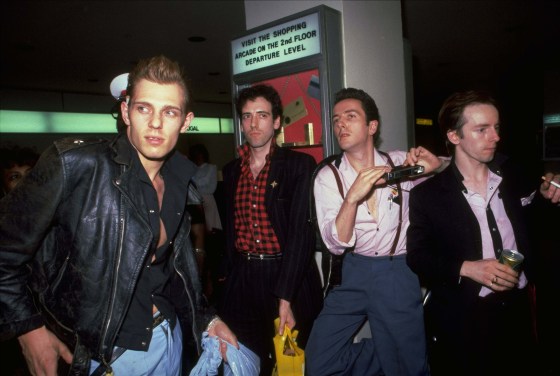
From left: Paul Simonon, Mick Jones, Joe Strummer and Topper Heyton of The Clash arrive in New York in May 1981. (David Handschuh / Associated Press files)
As soon as Mick Jones, the band’s co-founder and lead guitarist, hammered those iconic opening power chords, I felt as if I had been struck by lightning. I started dancing on top of the scaffold; one of my co-workers started moving the scaffold back and forth on its wheels. We all lustily sang along with the lyrics. This is what we did EVERY TIME THE SONG played or until a paint tray fell off the scaffold and required immediate attention.
Why am I waxing nostalgic about The Clash? In the years since my introduction to Combat Rock, I’ve found many opportunities to riff on the lyrics from Should I Stay in my columns, as they fit perfectly with so many different scenarios. Like whether or not I should stay with Twitter, or get the hell out of the way of Elon Musk’s toxic tsunami.
First, a couple of admissions. I really like Twitter and feel that it is an essential tool for bringing my work as a journalist to a bigger audience. I don’t really use other social media platforms that often, although I’ve been known to dabble in Facebook and Instagram. In addition to being a free source of promotion for my content, Twitter connects me with the people I write about: government and elected officials, opinion leaders in the community. In other words, the people I need to find stories also use Twitter.
But I’m also painfully aware Twitter is hardly the most important platform in the social media universe. In fact, depending on what source you use, Twitter is not even in the top 10 of social media sites based on the number of active users. Aggregating various data sources on social media users, you have Facebook at the top of the heap with roughly three billion users, followed closely by YouTube (2.6 billion), WhatsApp (2.0 billion), Instagram (1.5 billion), Weixin/WeChat (1.3 billion) and TikTok (1.0 billion).
Twitter, by comparison, has only 436 million active users. And thanks to Musk’s bully antics, that number is likely to fall. Quite a few famous people and high-profile organizations have abandoned the platform after Musk fired half his employees and then started repatriating some very ugly and toxic characters who had been suspended. Among those, Kanye West and Donald Trump who have been hanging out together quite a bit lately with notable white supremacists.
Musk claims his decision to welcome back previously banned users is actually sparking increased interest in Twitter. This week, Musk tweeted data on new signups this week, claiming that more than two million new users a day were opening accounts, up by 66 per cent over the same period the year before. He also claims that hate speech impressions have dipped significantly.
Perhaps, but none of that data can be independently verified. And there are reports that more than half of Twitter’s biggest advertisers have abandoned the platform since Musk took over in October, concerned about the manner in which he laid off employees and its potential inability to moderate content.
Which brings us back to me. At some point, journalists will have to decide whether Twitter is something they want to be associated with. If, as many fear, Twitter becomes a repository for the ugliest and most toxic content circulating on social media, it will be hard to stay.
But leaving will be hard, too. Just in case, I’ve signed up for hip-hop dance lessons so that I can throw all my social media efforts into TikTok.
Be afraid. Be very afraid.
|