|
John Friesen may have refused to pick up a rifle during the Second World War, but he still served his country.
John, who died on Nov. 29 at 101 years of age, was a conscientious objector. And he wasn’t alone. In Canada, almost 11,000 Canadians, from 33 cultural backgrounds, served in alternative service during the war. There were another 12,000 in the United States.
John was a Mennonite, but there were also Hutterites who were conscientious objectors, as well as Quakers and people from Brethren in Christ. It all stemmed from the belief that if Jesus told them to love all people, including enemies, how could they take up arms against others?
Advertisement

The program was later opened to anyone who expressed a commitment to non-violence, but they had to be able to persuade a judge of their commitment.
While others of their generation did fight overseas, conscientious objectors worked back home firefighting, in forestry, hospitals, institutions for people with mental illness, national parks and on farms.
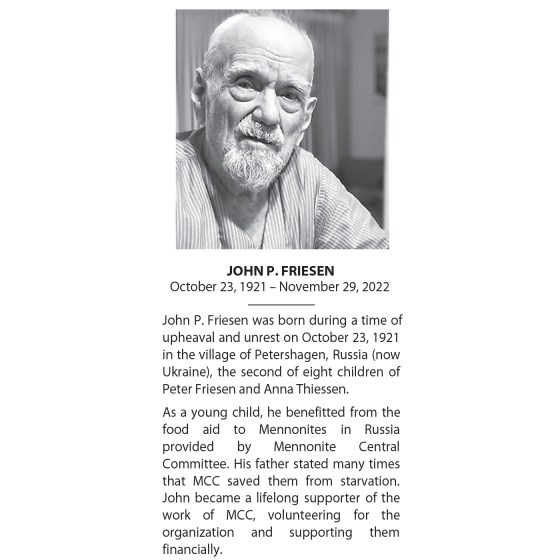
John was born in a village in Russia and benefitted from food aid sent there by the Mennonite Central Committee.
“His father stated many times that MCC saved them from starvation,” the family said in John’s obituary. “John became a lifelong supporter of the work of the MCC, volunteering for the organizations and supporting them financially.”
When John was 12, his family moved to Canada and settled in the Marquette area near the Assiniboine River. He went on to spend five decades farming with his brothers. And, after being baptized in the Pigeon Lake Mennonite Church in 1942, he became a conscientious objector with the belief Christians shouldn’t kill others.
His alternative service consisted of spending two years on a dairy farm.
After the war, John got his high school diploma, graduated with a theology degree from Canadian Mennonite Bible College (now Canadian Mennonite University) in 1953, and moved to Mexico to work as a teacher and minister.
John met and married Mary Giesbrecht, had four of their seven children in Mexico, and began farming once back in Manitoba in 1960.
He also served for several years as manager of Camp Assiniboia and, after retiring, gave back again to the MCC by volunteering at MCC Thrift Shops on Sargent and Selkirk avenues.
Only when John turned 95 and gave up his driver’s license, did he finally give up his volunteer work. And, in his final way of thanking the MCC for what they did for his family as a child, the family is asking for donations to the MCC instead of flowers.
John is survived by his wife, his children, 15 grandchildren and 13 great-grandchildren, as well as a brother and sister.
Read more about John here.
How They Lived
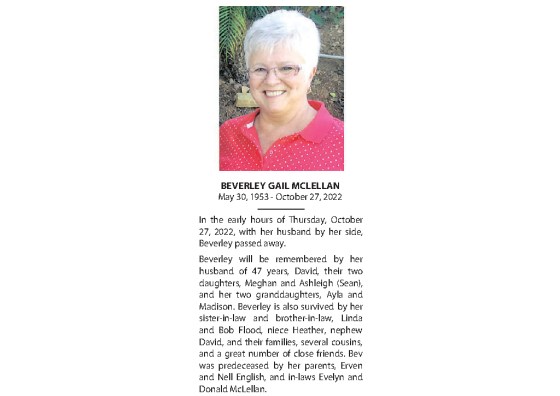
Bev McLellan was a volunteer who also worked with volunteers.
Bev, who died on Oct. 27 at 69, began volunteering when she was on the University of Winnipeg’s student council. From there, after graduating, Bev worked at the Volunteer Centre of Winnipeg while also giving her time to the Junior League of Winnipeg and the Winnipeg Minor Hockey Association. She even went to work for the Winnipeg School Division where, for many years until retiring, was its coordinator of volunteers.
Read more about Bev here.
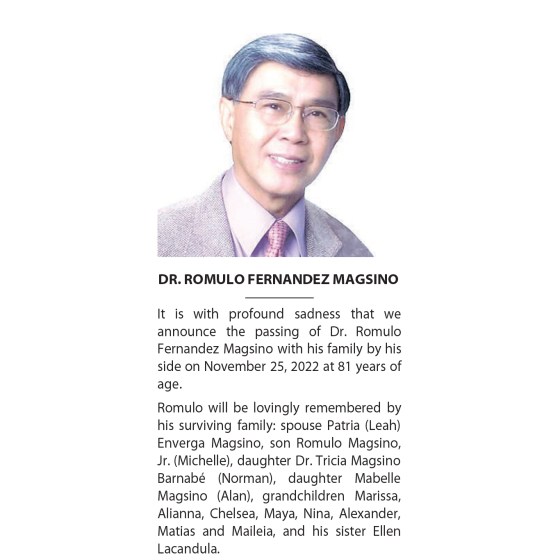
Romulo Magsino was the first Filipino-Canadian to become the Dean of Education at a major Canadian university.
Romulo, who was 81 when he died on Nov. 25, came to Canada in 1971 and joined the University of Manitoba in 1988. He was known as a recognized authority in education and an expert in the areas of multiculturalism, immigration, and intercultural education.
He was later honoured with the Order of Manitoba in 2008, in addition to an award from the president of the Philippines given to overseas Filipinos who have brought the country honour, and both the Golden and Diamond Jubilee awards.
Romulo served on the boards of The Winnipeg Foundation and the Seven Oaks Hospital Foundation, and he was instrumental in developing the Philippine-Canadian Centre of Manitoba and serving as its first president.
Read more about Romulo here.
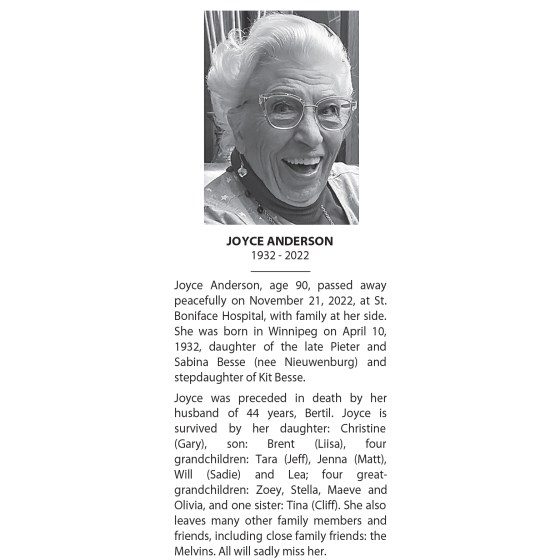
Joyce Anderson picked up a paintbrush when she was four and almost never put it down.
Joyce, who died on Nov. 21 at 90, went from copying Dutch Masters to painting portraits and landscapes. She was also an art teacher at Tec Voc and her work has been shown in the Winnipeg Art Gallery and Legislature and is in private collections in Winnipeg and around the world.
Read more about Joyce here.
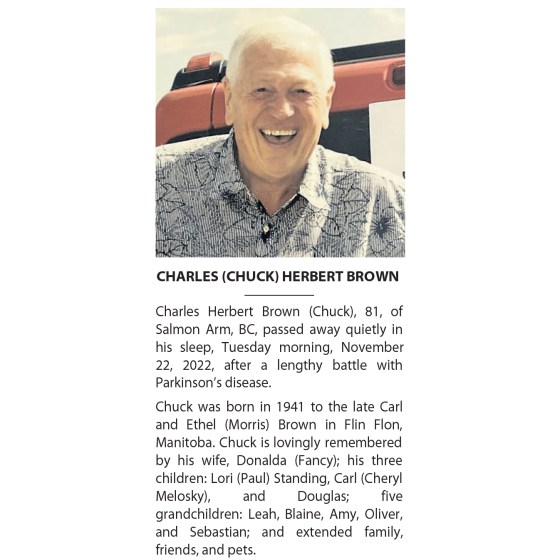
As an actuary, Chuck Brown kept his eyes on numbers.
But a friend once asked Chuck, who was 81 when he died on Nov. 22, to keep his eye on his girlfriend.
Just like with numbers, Chuck kept both eyes on her. In fact, he kept his eyes on her for the rest of his life because he was married to her for 59 years.
Read more about Chuck here.
Annaliese Harfiel was born in Germany and brought her heritage here.
Annaliese, who died on Nov. 27 at 71, came to Canada with her parents in 1956 and married her husband in 1982.
Through the years, she volunteered with the German Society of Winnipeg in several different roles, including its annual Folklorama pavilion and on its board of directors.
Annaliese also spent time at Camp Neustadt during the summer months.
Read more about Annaliese here.
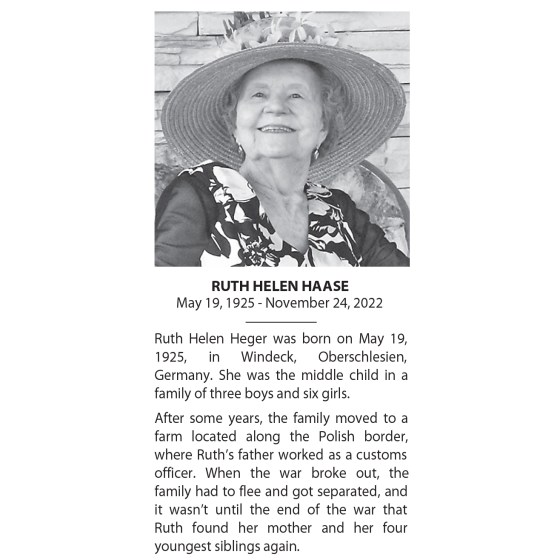
Ruth Haase lived on a farm in Germany near the Polish border but was forced to flee and became separated from her family when the Second World War broke out.
After the war, Ruth found her mother and her four youngest siblings, and three years later met her future husband, Erich.
The couple married and Ruth ended up coming to Canada because Erich had fallen in love with the country when he was a prisoner of war here, working in Alberta lumber camps and harvesting crops in Manitoba, and wanted to come back as quickly as possible.
Ruth, Erich and their first child immigrated to Winnipeg in 1953. She later worked at Salisbury House, became head cook at a seniors’ home and ran her own restaurant for a while.
And her family has grown to include children, grandchildren, and great-grandchildren.
Read more about Ruth here.
A Life’s Story
Anne Kostjuk lived a good, long life.
How long? Well, when she was 90, Anne received publicity for bowling a 388 score and she lived for another 18 more years before dying on Aug. 1 at 108.
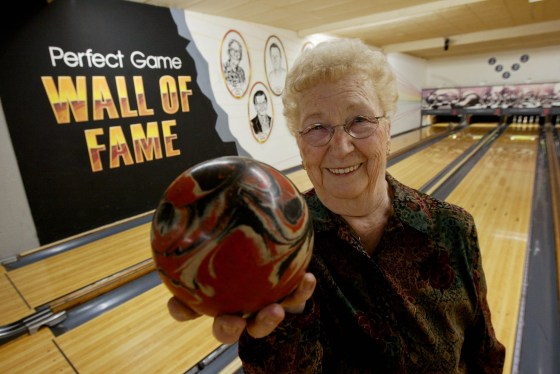
In 2005, at the age of 90, Anne Kostjuk bowled a 388 at Billy Mosienko Lanes. (Joe Bryksa / Free Press files)
Before that, Anne was an active curler.
“She would say all the time, ‘If you don’t use it, you’ll lose it,’” granddaughter Sherry Wiebe said.
Another granddaughter, Michele Hodge, said, “We don’t have longevity running on her side of the family and we often used to say, ‘What’s different about grandma?’ She was such an outgoing, social person and I think that kept her young.”
Read more about Anne’s life here.
Until next time, I hope you continue to write your own life’s story.
|