


First Trans Canada flight deserves recognition

Advertisement
If you were to book a flight from Halifax to Vancouver, the expected arrival time is about six and a half hours. At least that’s the estimate travel time on Google.
When the first Trans-Canada flight left Halifax for Vancouver back in 1920, the trip took 10 and one-half days. The actual time in the air, however, was 49 hours and seven minutes. The average speed was 68 mph, according to Gordon Crossley, Heritage Officer 17 Wing, who provided a fascinating account of the first Trans-Canada flight at Charleswood Historical Society’s heritage series.
In describing in detail the first Trans-Canada flight, Crossley outlined what was at once a daring yet necessary undertaking. Daring because the aviation industry was in its infancy, and Canada’s “air force” consisted of surplus British aircraft that had been gifted to Canada following the war. Necessary because more than 20,000 pilots and other service personnel who had served in the British forces returned to Canada, and needed work. This scenario created the political will for the development of the aviation industry in Canada.
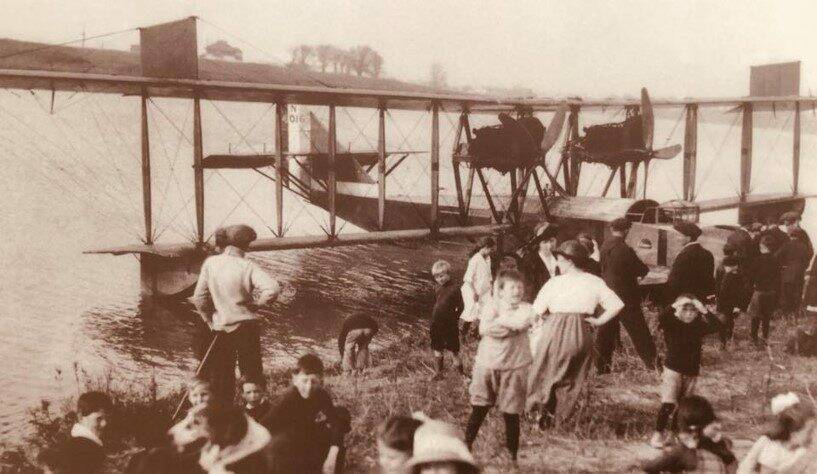
Supplied photo
A Felixstowe F3 flying boat docked in Winnipeg gathers a crowd of onlookers on Oct. 11, 1920. The aircraft had arrived from Rivière-du-Loup, Que., with fuel stops at Ottawa, Sault Ste Marie and Kenora, Ont., a flying distance of over 2,534 kilometres. The next year, this aircraft performed the first aerial forestry patrols in Manitoba, the beginnings of military aviation in the province.
Under the auspices of the Canadian Air Board, an organization formed after the First World War, the Trans-Canada flight was a way to test the viability of aircraft for mail and passenger service, as well as demonstrate the need for civil and military aviation in Canada, Crossley told an enthusiastic crowd.
The first Trans-Canada flight left Halifax, N.S., on route to Vancouver, B.C., on Oct. 7, 1920. The trip, which would end up involving six aircraft ranging from seaplane to the land planes, was planned in four segments. This was due in part to limited flying time of the aircraft before stopping to refuel. Engine problems, bad weather and navigation challenges meant the trip would result in 13 flying segments. These segments ranged from 45 to 540 miles. At each segment of the journey, bags of mail were transferred from one aircraft to another. The number of miles flown was 3,341, when the first Trans-Canada flight landed in Vancouver on Oct. 17, 1920.
While there was little fanfare along the way, a small crowd gathered in Richmond, B.C., where an envelope containing letters from mayors across Canada was delivered to the mayor of Vancouver. The envelope handed over to the Vancouver’s mayor had been signed by the mayor of Halifax, as well as all the five pilots who had participated in the 10 and one-half day journey. Media coverage had been sparse, Crossley notes, adding the Brandon Sun did run an article “Trans-Canada plan completes flight.”
Considering the evolution of the aviation industry in Canada over the past century, perhaps the first Trans-Canada flight can now garner the attention it deserved but didn’t get 106 years ago. For more information about the first Trans-Canada flight and the beginning of the aviation industry in Canada, contact gordon.Crossley@forces.gc.ca
Donna Minkus
Charleswood community correspondent
Donna Minkus is a community correspondent for Charleswood.
Our newsroom depends on a growing audience of readers to power our journalism. If you are not a paid reader, please consider becoming a subscriber.
Our newsroom depends on its audience of readers to power our journalism. Thank you for your support.
Donna Minkus
Charleswood community correspondent
Donna Minkus is a community correspondent for Charleswood.
Our newsroom depends on a growing audience of readers to power our journalism. If you are not a paid reader, please consider becoming a subscriber.
Our newsroom depends on its audience of readers to power our journalism. Thank you for your support.
Advertisement Advertise With Us
Advertisement Advertise With Us