


Louis Riel Olympians share their wisdom

Advertisement
The Louis Riel Arts and Technology Centre sent four of its students to the 2026 Milano Cortina Olympic Winter Games, but not for the reason you may think.
They weren’t athletes. They are broadcast media program graduates who helped broadcast Olympic curling to the world.
The four alumni recently returned to their alma mater to share their special experience with current BMP students.
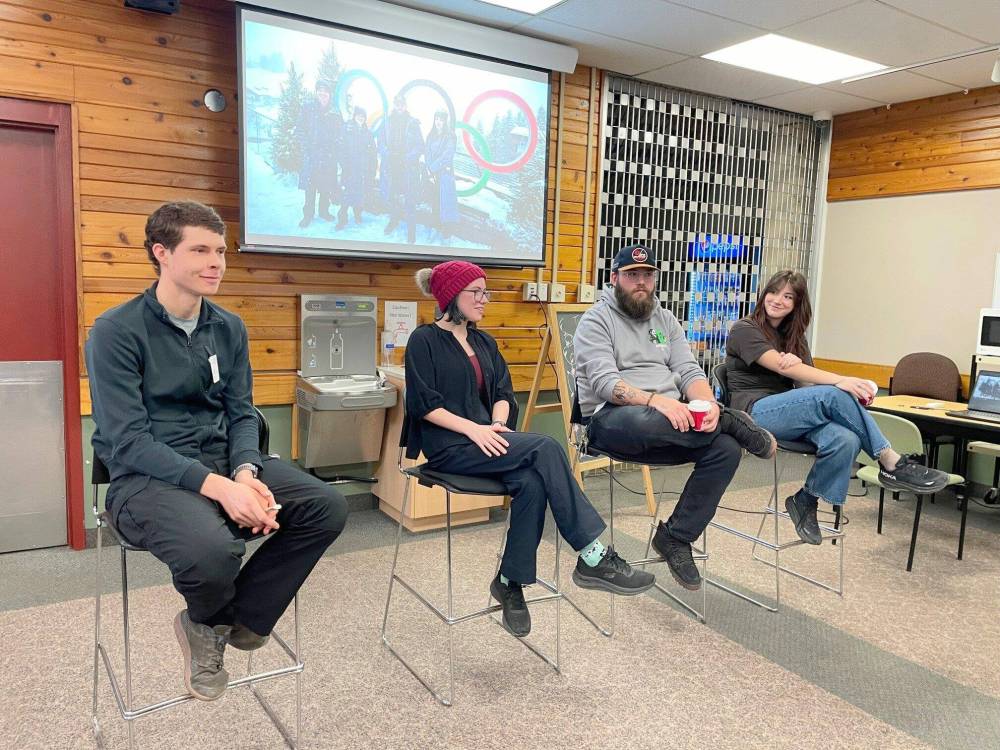
Photo by Adriano Magnifico
Louis Riel Arts and Technology Centre broadcast media program grads (from left) Graham Parsons, Zoe Krzuk, Johnathan Schneider, and Jamie Wiebe visited current students to share their experiences at the recent Winter Olympics in Italy.
They worked long days during the men’s, women’s, and mixed doubles curling competitions, which ran from Feb. 4 to 22 at the Stadio Olimpico del Curling di Cortina d’Ampezzo, a venue built just for the games.
Graham Parsons, a 2018 grad, was a camera operator, feeding the whole world from Cortina D’Ampezzo’s Olympic curling sheets. Graham also freelances at NHL and CFL games, doing camera work for Dome Productions.
Johnathan Schneider, a 2021 grad was the replay operator, making sure viewers had an instantaneous slow-mo perspective, a job that adds a little pressure to his work, but a challenge he relishes.
“Pressure is a privilege. Any job that matters to you has pressure. Mistakes are OK, you learn from them and move on,” he said.
Schneider currently works for TVA sports, the French broadcaster of the Montreal Canadiens Stanley Cup playoff run.
Zoe Krzuk, a 2022 grad, works as a freelance audio/visual technician for a variety of organizations. In Cortina, she worked as a Q-ball robotic/PTZ camera operator, capturing player arrivals in various shots in and outside the venue.
Jamie Wiebe, another 2018 grad, works for Dome Productions as a floor manager with the Winnipeg Jets and played a similar role at the Olympics, working with worldwide television producers and directors setting up interviews with medal winners and special guests.
“How did you four wind up in the Olympics?” an audience member asked.
The panel stressed the importance of building a professional reputation by bringing a relentless work ethic to every job, no matter how small; and constantly upgrading rapidly evolving, industry-driven skills.
Graham’s work ethic and skill found their way to Olympic contacts “after professionals saw me in action and confirmed that I work hard, put in the extra time, and solve problems.”
Jamie explained how every broadcast media job is “a test in adaptability, and the unique Cortina venue was no exception, with different equipment, setups, landscapes, and skilled professionals.”
Johnathan had a message for young workers in the industry: “Constantly learn and upgrade skills, adapt constantly to change – make yourself employable.”
Jamie credited broadcast media program teacher Ken Plaetinck with providing “a great foundation for our work in Cortina, especially connecting us to key people in the field.”
Congratulations to the LRATC Olympians who staged a gold-medal performance for millions of viewers around the world.
Learn more about the broadcast media program at www.lrsd.net/atc/broadcast-media.
Our newsroom depends on a growing audience of readers to power our journalism. If you are not a paid reader, please consider becoming a subscriber.
Our newsroom depends on its audience of readers to power our journalism. Thank you for your support.
Our newsroom depends on a growing audience of readers to power our journalism. If you are not a paid reader, please consider becoming a subscriber.
Our newsroom depends on its audience of readers to power our journalism. Thank you for your support.
Advertisement Advertise With Us
Advertisement Advertise With Us