


A rare Arctic visitor

Advertisement
Melanie Glenwright and her 17-year-old son were relaxing on Boxing Day afternoon two months ago, crafting in their Royalwood kitchen, when an unexpected visitor arrived on silent wings. Through the big windows facing their backyard, they saw a large, white bird with small, ear-like feathered tufts perched on their shed.
“Right away we Googled,” Glenwright said. “We could see lots of brown bars, so we weren’t sure. Our search told us the markings meant (it was) a young female snowy owl.”
Dr. James Duncan, a retired biologist based in Balmoral, Man., who continues to study owls with his wife and fellow biologist Patricia Duncan, confirmed Glenwright’s findings.
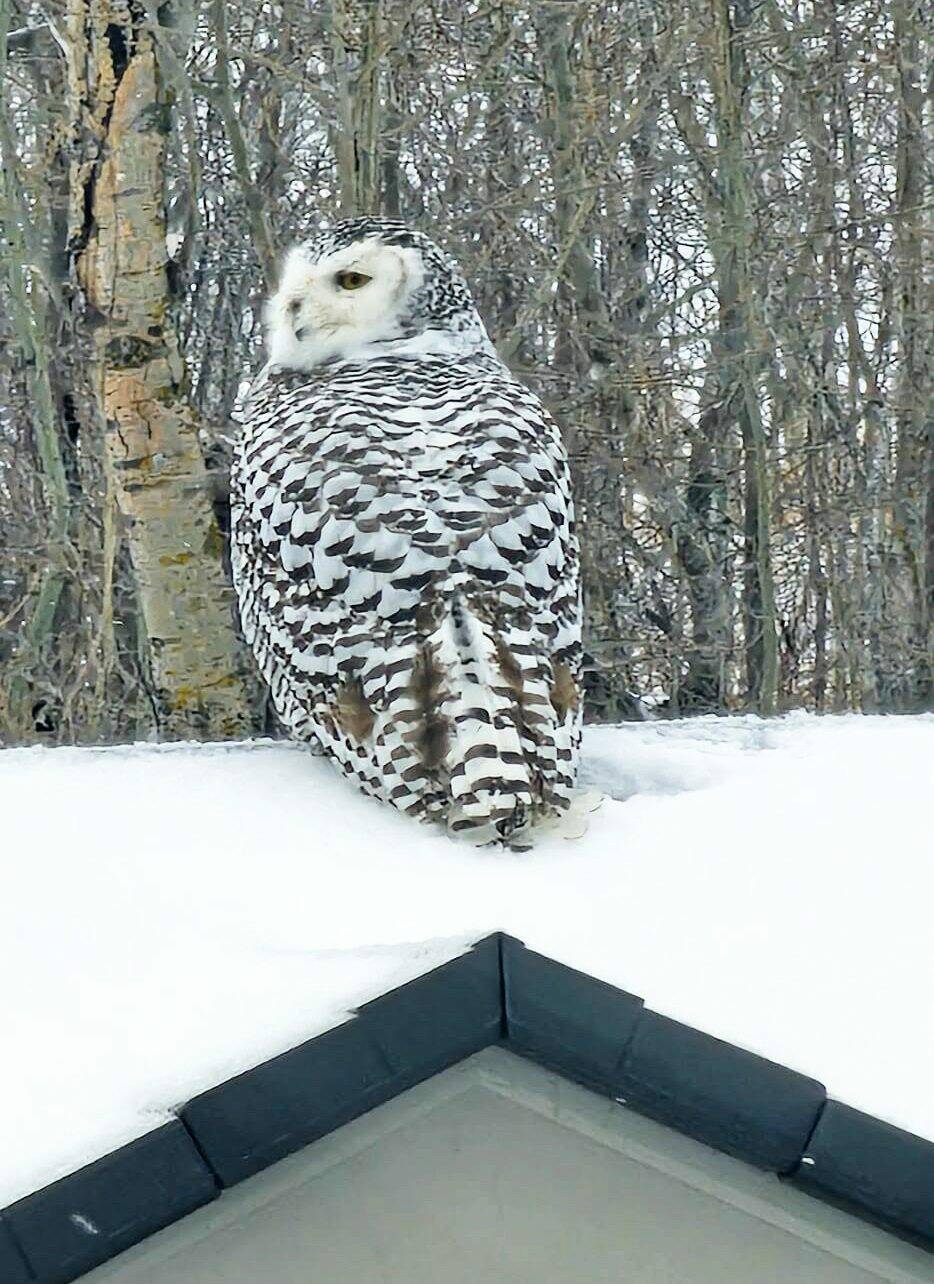
Supplied photo
A young snowy owl was an unexpected but welcome visitor for Melanie Glenwright and her son.
“The owl certainly looks like a juvenile female hatched in 2025, hundreds of kilometres from Winnipeg, in the Arctic tundra,” Duncan said. “Based on the photographs and video footage provided, she appears to be healthy and was likely hunting small mammals or birds.”
From Glenwright’s shed, the owl had a good view of the open area beyond the backyard. It seemed like an ideal hunting perch.
“My cat Lemon was absolutely transfixed, watching her carefully while she spent three hours checking out the field and resting,” Glenwright shared. “She would look back at Lemon and noticed my son and me. We didn’t make any sudden movements.”
According to Dr. Duncan, snowy owl numbers in and around Winnipeg fluctuate from year to year, from zero to 40 or more. They appear from mid-October to mid-April, after which they return to the tundra to seek out mates.
Living near Bois-des-Esprits, Glenwright has long enjoyed feathered visitors.
“Being close to the forest on a quiet street we see a wide variety of birds. Pileated woodpeckers, mourning doves, sharp-tailed grouse (which are often mistaken for partridges) and even a Baltimore oriole on one occasion,” she remarked.
“I’ve noticed photographers in the Bois-des-Esprits on my walks and have been fascinated by the images of birds that they capture. I never thought it would happen to me in my own backyard.”
Dr. Duncan said interested community members can help contribute to the overall knowledge of birds through citizen science programs such as eBird, or by volunteering for feeder watch or the Christmas bird count programs with Birds Canada at www.birdscanada.org.
“It was an incredible day,” Glenwright said. “We hope the owl visits again. She seemed to feel safe and we were fortunate to see her land and then fly away.”
Tanya Misseghers
Royalwood community correspondent
Tanya Misseghers is a community correspondent for Royalwood.
Our newsroom depends on a growing audience of readers to power our journalism. If you are not a paid reader, please consider becoming a subscriber.
Our newsroom depends on its audience of readers to power our journalism. Thank you for your support.
Tanya Misseghers
Royalwood community correspondent
Tanya Misseghers is a community correspondent for Royalwood.
Our newsroom depends on a growing audience of readers to power our journalism. If you are not a paid reader, please consider becoming a subscriber.
Our newsroom depends on its audience of readers to power our journalism. Thank you for your support.
Advertisement Advertise With Us